

The ETF industry is undergoing a structural shift, and the data is now catching up with the narrative. While passive funds continue to dominate total assets, active ETFs are capturing an increasingly disproportionate share of flows, launches, and innovation.
The contrast is striking. Total U.S. ETF assets stood at approximately $13.6 trillion as of March 31, 2026, yet active ETFs still represent only a fraction of that base, according to J.P. Morgan Asset Management . Despite this relatively small share, growth is accelerating rapidly, highlighting a segment that is still early in its adoption curve.
Flows Are Shifting Rapidly
According to J.P. Morgan Asset Management’s latest ETF monitor, active ETFs attracted $57 billion in inflows in March 2026 alone, accounting for roughly 42% of total ETF flows year-to-date. At the same time, more than 80% of new ETF launches in 2026 have been active strategies. Together, these figures point to a clear inflection point. While passive ETFs continue to dominate the installed asset base, the direction of new capital is increasingly shifting toward active approaches.
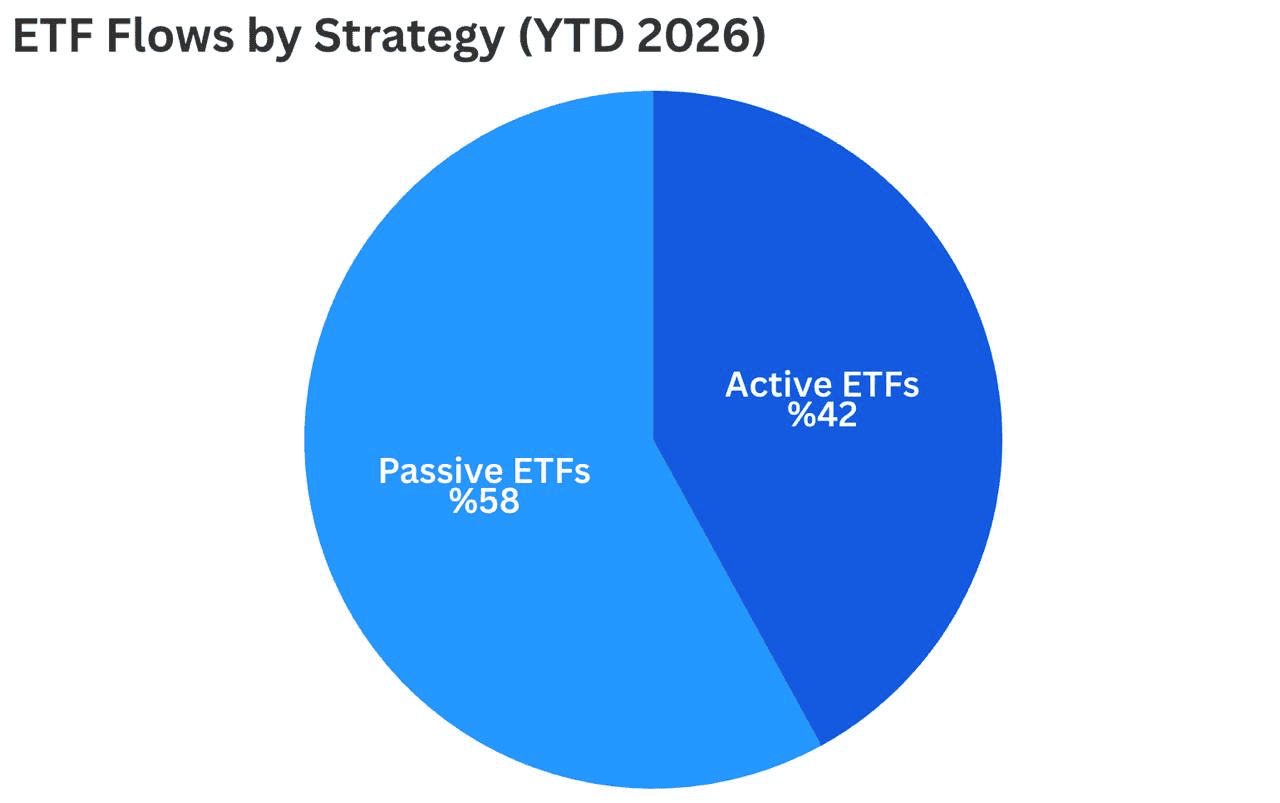
Over the past few years, active ETFs have steadily increased their share of total flows from low single digits in 2022 to nearly 40% in 2025-2026 suggesting a structural reallocation rather than a temporary rotation. Investors are not abandoning passive exposure, but they are increasingly complementing it with strategies that offer more targeted outcomes.
A $13 Trillion Market, With Growth Shifting to Active
The broader ETF market continues to expand, with U.S. ETF assets approaching $13.6 trillion. Within that, active ETFs still represent a relatively small share, but they are growing at a faster pace than the market as a whole. ETF trading volumes also remain elevated, consistently accounting for around 34% of total equity market activity, reinforcing the role of ETFs as both investment vehicles and trading instruments.
Passive ETFs continue to provide scale, efficiency, and broad market exposure, while active ETFs are increasingly driving growth, product development, and innovation. Rather than replacing passive strategies, active ETFs are reshaping how investors allocate at the margin expanding the ETF toolkit beyond simple index tracking toward more outcome-oriented approaches.
What Investors Are Actually Buying
The composition of flows provides further insight into investor behavior. According to JPMorgan’s top active ETF rankings (as of March 31, 2026):
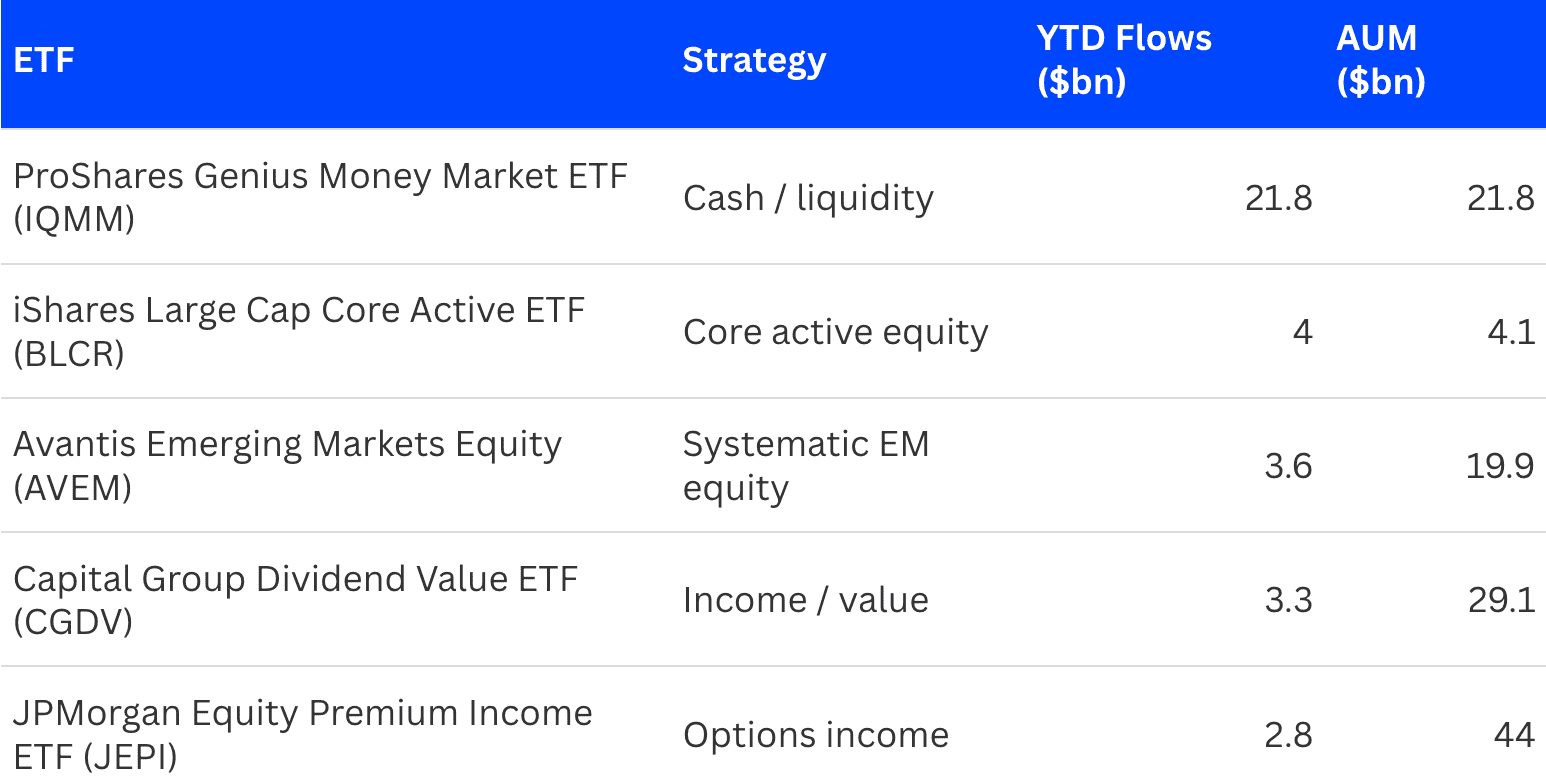
Three clear themes emerge:
1. Income is dominating flows
Strategies like JPMorgan Equity Premium Income ETF highlight strong demand for yield-generating ETFs, particularly those using options overlays.
2. Systematic active is scaling
Funds like Avantis’ EM ETF show that rules-based active strategies, sitting between passive and discretionary, are gaining traction.
3. Cash and short-duration exposure matters
The largest flows are going into liquidity-oriented strategies, reflecting macro uncertainty and elevated interest rates.
Fixed Income: The Core Growth Engine
One of the most important drivers behind the rise of active ETFs is fixed income, where bond ETFs have attracted approximately $558 billion in inflows year-to-date, with active fixed income strategies alone on track to exceed $200 billion in annual flows. Demand has been concentrated in ultrashort, intermediate, and multi-sector bond exposures, reflecting investor preference for flexibility in navigating interest rate uncertainty.
This shift is largely structural. Unlike equities, bond indices are not constructed purely on investment merit but are heavily influenced by issuance size and liquidity. As a result, they can overweight the most indebted issuers rather than the most attractive opportunities. This creates inefficiencies that active managers can exploit, making fixed income particularly well suited to active ETF strategies.
From Beta to Outcomes
Beyond asset class dynamics, the broader shift is conceptual. ETFs are evolving from simple tools for market exposure into vehicles designed to deliver specific outcomes. Increasingly, investors are using ETFs not just to track indices, but to generate income, manage downside risk, or express targeted views on factors and themes.
This can be seen in the rise of options-based income strategies, buffer products designed to limit drawdowns, factor-based allocations focused on quality or value, and thematic exposures tied to areas such as artificial intelligence or energy transition. The result is a more flexible ETF landscape, where the wrapper is used to package a wide range of strategies.
In that sense, ETFs are no longer confined to passive investing. They are becoming a multi-purpose investment structure, competing more directly with mutual funds and structured products while retaining the liquidity and transparency that defined their original appeal.
GCC Milestone: Active ETFs Arrive
This global trend is now reaching regional markets. The listing of KraneShares Artificial Intelligence & Technology ETF on Abu Dhabi Securities Exchange marks the first actively managed ETF in the GCC.
AGIX is particularly notable because it extends beyond traditional listed equities, incorporating both public and private AI exposure, aligning with global trends toward more flexible ETF structures.
At the same time, KraneShares Wahed FTSE USA Shariah ETF reflects another key development: the rise of options-based income strategies within a Shariah-compliant framework, demonstrating how global ETF innovations are being adapted for regional investors.
Conclusion
Active ETFs are no longer a niche segment, they are emerging as a structural growth driver within a $13 trillion industry. While they still represent a relatively small share of total assets, they are capturing an increasingly significant portion of flows and dominating new product launches.
The ETF landscape is expanding beyond traditional index tracking toward more strategy-driven and outcome-oriented exposures. As this evolution continues, the distinction between passive and active will matter less in isolation. What will matter more is how effectively ETFs deliver on specific investment objectives whether income, risk management, or targeted growth.