
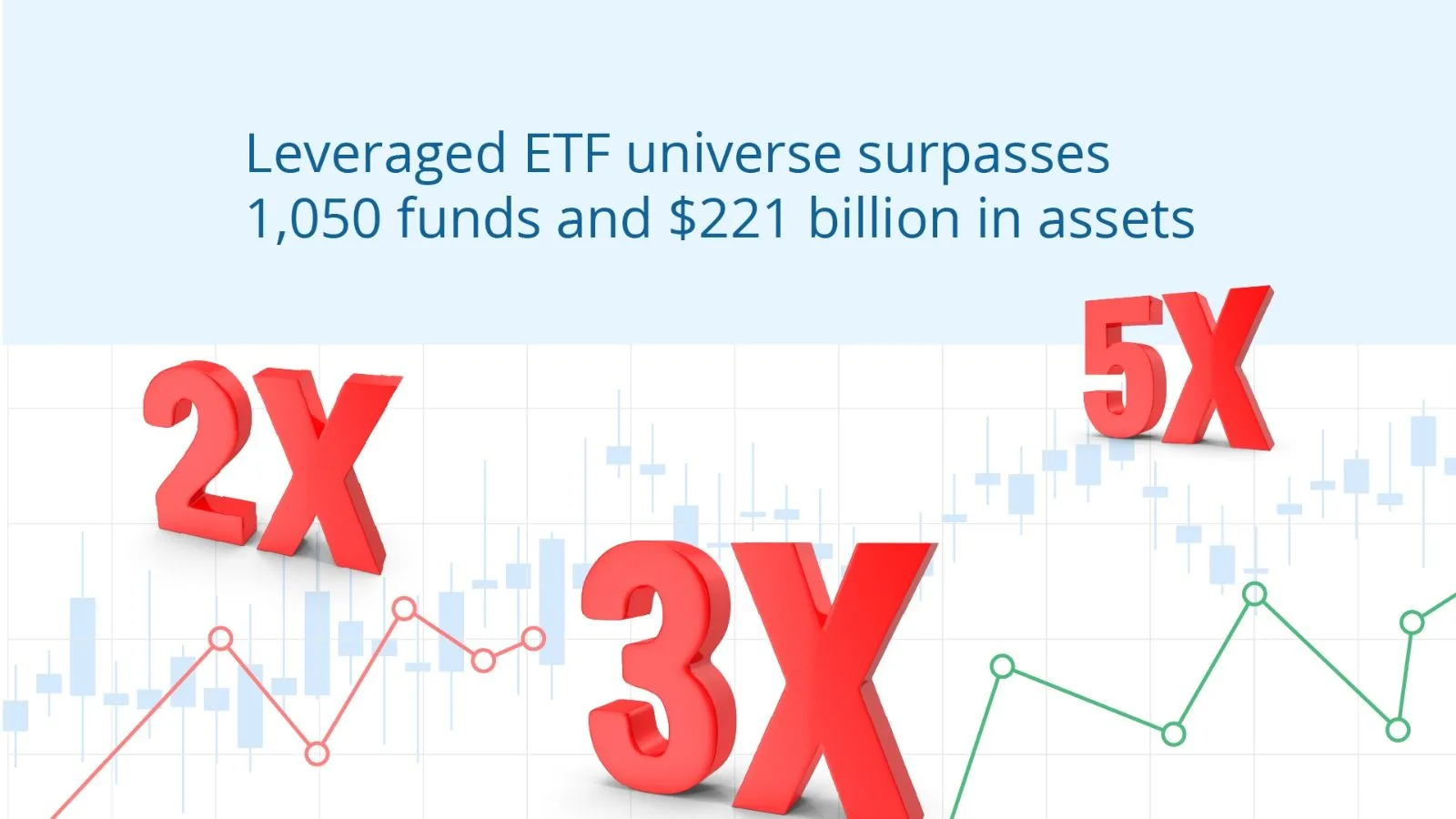
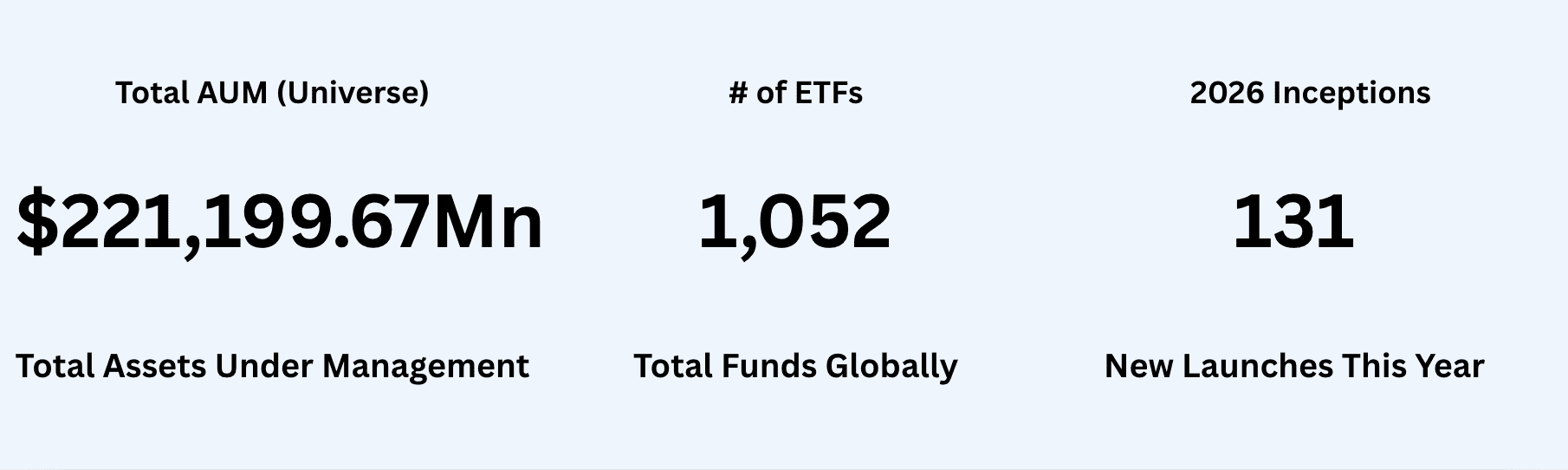
Assets invested across leveraged and inverse exchange-traded products have now surpassed $220 billion, reflecting rising investor demand for tactical investment tools that provide amplified exposure to stocks, sectors, commodities, and market themes. What was once a niche corner of the ETF market has evolved into a mainstream trading vehicle used by everyone from retail investors to institutional traders.
The growth has been accompanied by a surge in product launches. The leveraged ETF universe now consists of more than 1,050 funds globally, including 131 new launches in 2026 alone.
A Market Dominated by the United States
Despite growing global adoption, leveraged ETFs remain overwhelmingly concentrated in the United States.
US-listed products account for approximately $213 billion in assets, representing more than 96% of the global leveraged ETF market. By comparison, leveraged ETFs listed outside the United States account for just over $8 billion in assets.
The dominance reflects the depth of US capital markets, widespread ETF adoption, and a regulatory environment that has supported rapid product innovation. Many of the industry's largest and most liquid products continue to trade on US exchanges, attracting investors from around the world.
The Biggest Funds Still Control the Market
While the industry has become increasingly diverse, assets remain concentrated among a relatively small number of established funds.
The largest leveraged ETF globally remains the ProShares UltraPro QQQ (TQQQ), which manages more than $40 billion in assets and provides three-times daily exposure to the Nasdaq 100. It is followed by the Direxion Daily Semiconductor Bull 3X Shares (SOXL) with roughly $26 billion in assets.
Technology and semiconductor exposure dominate the list of the industry's largest products. Funds linked to the Nasdaq 100, semiconductors, and growth-oriented technology stocks account for a significant share of total industry assets, reflecting investor demand for sectors that have delivered some of the strongest returns in recent years.
Several of the largest funds have generated exceptional performance. SOXL, for example, has returned more than 140% year-to-date, while leveraged products tied to artificial intelligence infrastructure and semiconductor demand have been among the strongest performers across the ETF universe.
Investors Are Rotating, Not Just Buying
One of the more surprising developments in 2026 has been the divergence between asset growth and fund flows.
While the leveraged ETF industry continues expanding, some of its largest products have experienced significant outflows.
SOXL has recorded approximately $16.8 billion in year-to-date outflows, while TQQQ has seen more than $6.1 billion leave the fund. Other established products tied to technology and market indices have also experienced net redemptions.
At the same time, investors have been allocating capital to newer and more specialized products. Funds targeting specific stocks, sectors, and tactical themes have attracted growing interest, suggesting that investors may be rotating away from crowded positions rather than abandoning leveraged ETFs altogether.
This shift highlights the increasing sophistication of the market, where investors are moving beyond broad market leverage and toward more targeted strategies.
The Rise of Single-Stock Leveraged ETFs
Perhaps the most important trend shaping the industry is the rise of leveraged single-stock ETFs.
Historically, leveraged ETFs focused primarily on broad market indices such as the S&P 500 or Nasdaq 100. Today, investors can gain leveraged exposure to individual companies ranging from Nvidia and Microsoft to AMD, Palantir, Coinbase, Tesla, and MicroStrategy.
Several of the largest ETF launches in 2026 have been tied to individual companies and highly specific themes. Products linked to artificial intelligence, semiconductors, software, and digital infrastructure have accumulated hundreds of millions of dollars in assets within months of launch.
The trend reflects a growing preference among investors for precision exposure. Rather than expressing a broad market view, many traders increasingly want direct access to the companies and themes they believe will outperform.
Why Investors Keep Buying Them
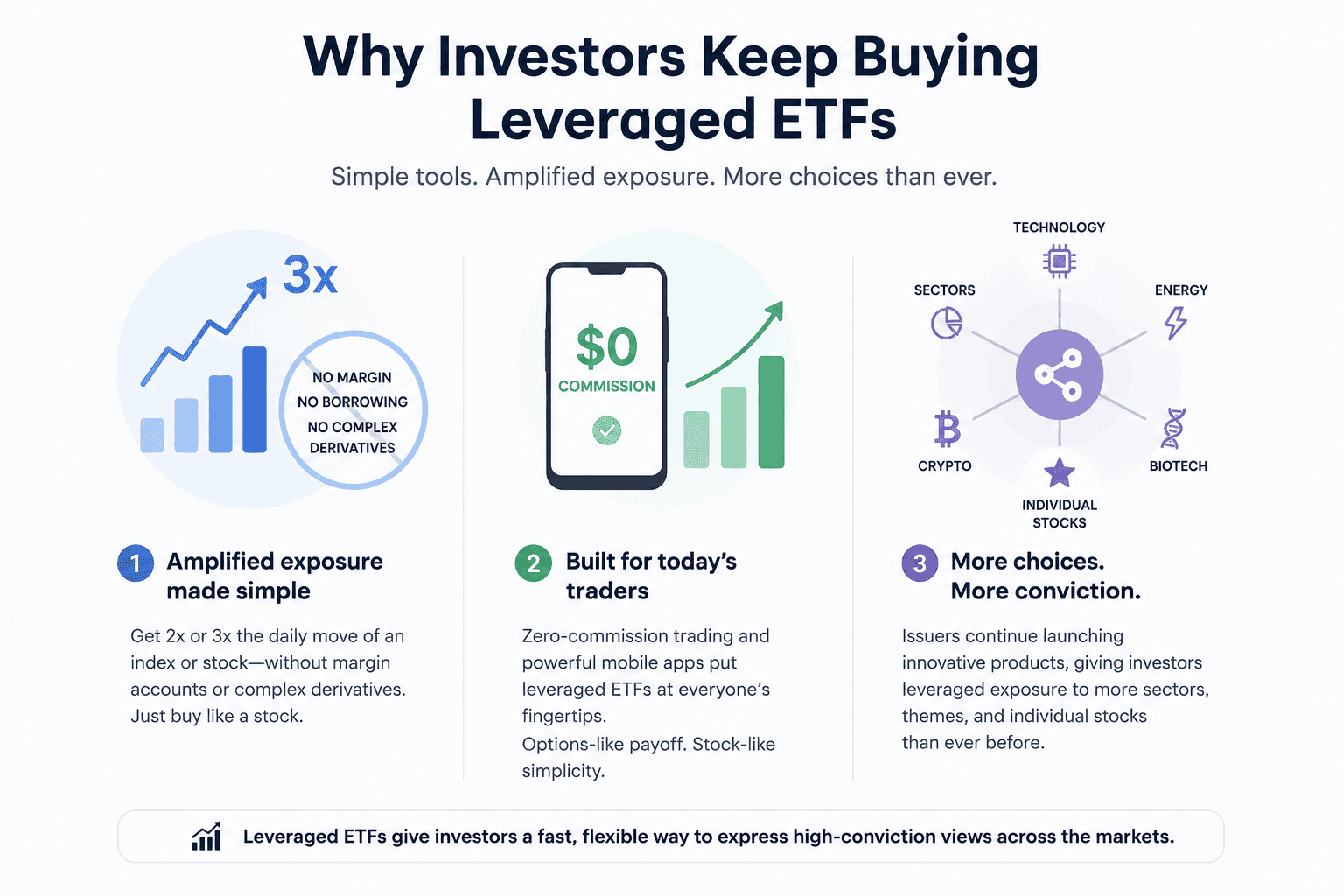
They allow investors to gain amplified exposure without opening margin accounts, borrowing capital, or trading complex derivatives directly. Instead, investors can access leveraged strategies through a familiar ETF structure that trades throughout the day like a stock.
The rise of commission-free brokerage platforms and mobile investing applications has further accelerated adoption. For many traders, leveraged ETFs offer an options-like payoff structure with greater simplicity and accessibility.
At the same time, issuers continue introducing increasingly specialized products, giving investors access to leveraged exposure across a growing range of sectors, themes, and individual companies.
Understanding the Risks
Most products seek to deliver a multiple of a benchmark's daily return rather than its long-term performance. To achieve this, funds use a combination of swaps, futures, and other derivatives while resetting exposure each day.
As a result, long-term returns can differ significantly from what investors may expect. During volatile markets, daily compounding can create what is commonly known as volatility drag, causing performance to diverge from the simple leverage multiple.
This is one reason leveraged ETFs are often viewed as tactical trading tools rather than traditional buy-and-hold investments.
What Comes Next?
With assets surpassing $300 billion, more than 1,050 funds globally, and over 130 new launches already in 2026, issuers continue expanding into increasingly specialized corners of the market.
The data suggests that the next phase of growth may not come from broad-market products alone. Instead, single-stock ETFs, thematic strategies, and highly targeted sector exposures appear poised to drive the industry's evolution.
For investors, leveraged ETFs have become far more than a way to amplify market returns. They are increasingly a toolkit for expressing specific views on stocks, sectors, and emerging market trends.