

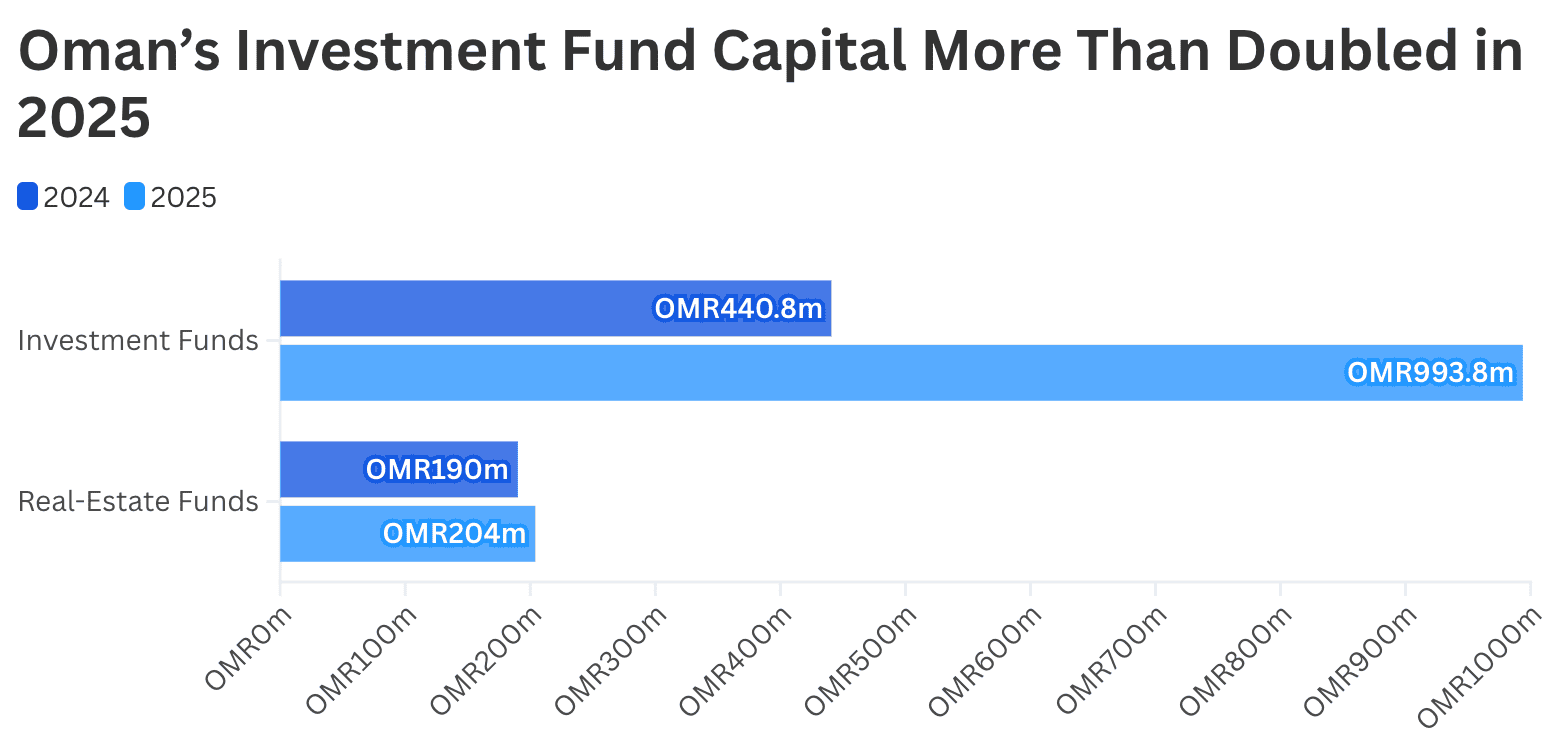
Oman’s fund industry expanded sharply in 2025, but almost all of the momentum came from investment funds rather than property vehicles. Combined capital across investment and real-estate funds reached approximately OMR1.2 billion, up 89.9% from OMR630.8 million in 2024, according to the Financial Services Authority. Investment-fund capital jumped 125.4% to OMR993.8 million, while real-estate fund capital increased only 7.4% to about OMR204 million.
Oman’s collective-investment market is broadening beyond the property structures that have historically been among the region’s more visible pooled investments.
Fund Assets Confirm the Expansion
Registered capital alone can give an incomplete picture because it may rise through new launches or capital increases without representing equivalent investor inflows. Oman’s latest figures provide a second measure.
Net assets attributable to investors across both categories climbed 71.9% to OMR1.36 billion in 2025, from OMR793.7 million a year earlier. Investment funds accounted for more than OMR1.14 billion, an increase of 94.6%, while real-estate funds reached roughly OMR218.2 million, up only 6.6%.
Investment-fund profits rose 162.5% to about OMR41 million, compared with a 2.9% increase to OMR16.34 million for real-estate funds. The FSA data do not disclose how much of the asset increase came from net subscriptions, new funds or market appreciation, so the 94.6% rise should not be described as investor inflows.
Oman Is Building a Much Broader Fund Menu
The New Executive Regulations for the Securities Law issued on July 26 formally expanded Oman’s collective-investment framework to 11 fund categories. Alongside conventional securities and real-estate funds, the framework now recognizes money-market, debt-instrument, holding, venture-capital, private-equity, endowment, green and sustainable-purpose funds. It also formally recognizes exchange-traded funds.
ETFs are particularly interesting because Oman does not yet have the developed locally listed ETF market seen in Saudi Arabia, the UAE or Qatar. The Muscat Stock Exchange currently presents listed fund units through its mutual-fund segment, while the new regulation provides a clearer legal basis for ETFs to emerge as a distinct product category.
A future Oman ETF would have a recognizable benchmark available. The MSCI Oman Index covers roughly 85% of the country’s free-float-adjusted equity market and carried a 4.45% dividend yield as of July 31. Oman remains classified within MSCI’s frontier-market index family.
More Funds Need More Assets to Invest In
Oman is simultaneously trying to expand the supply of securities available to those funds. Its Capital Market Incentive Programme offers several routes for private companies to enter the public-market ecosystem, including incentives for companies valued at OMR10 million or more that offer at least 25% of their shares. The programme runs for five years.
That creates a useful two-sided capital-market strategy. Oman is widening the types of pooled vehicles that can collect investor capital while encouraging more private businesses to become investable securities.
The 2025 numbers show that the first side is already expanding quickly. The next test is whether new ETFs, debt funds, private-market vehicles and additional MSX listings turn that surge in fund assets into a broader and more liquid domestic investment market.