

Imagine This…
It’s the mid-1990s. The Internet is still a buzzword whispered by a few tech enthusiasts, and most people are busy faxing. Now picture yourself holding AED 40,000 (a bit more than $10k) to invest. Where do you put it? Back then, picking one hot Internet startup felt like throwing darts blindfolded — risky, exciting, and full of uncertainty.
But what if instead, you had put your money into the tech-heavy NASDAQ index? In 1995, NASDAQ was around 450. Fast forward to today, and it’s trading at roughly 23,425. That’s more than 50 times growth — a jaw-dropping 5,000%+ return over three decades.
Déjà Vu: Enter Artificial Intelligence
We’re standing at a similar crossroads now. Only this time, it’s not the Internet — it’s Artificial Intelligence (AI). And just like the Internet revolutionized how we communicate, work, and invest, AI could be even bigger.
The UN Trade and Development (UNCTAD) projects the global AI market will hit $4.8 trillion by 2033 — larger than the entire Japanese economy. Even with conservative estimates, that’s a once-in-a-lifetime opportunity.
The challenge? No one has a crystal ball. Today, Nvidia is the king of AI chips. Tomorrow, some brand-new player might steal the crown. So why gamble on one stock when you can ride the whole AI wave?
Enter AI ETFs — Your Ticket to the Megatrend
AI ETFs (Exchange Traded Funds) let you invest in a basket of AI-focused companies with a single trade. Buy one share, and you instantly own a slice of dozens of AI leaders. It’s simple, smart, and a whole lot less stressful than guessing which stock will win the AI race.
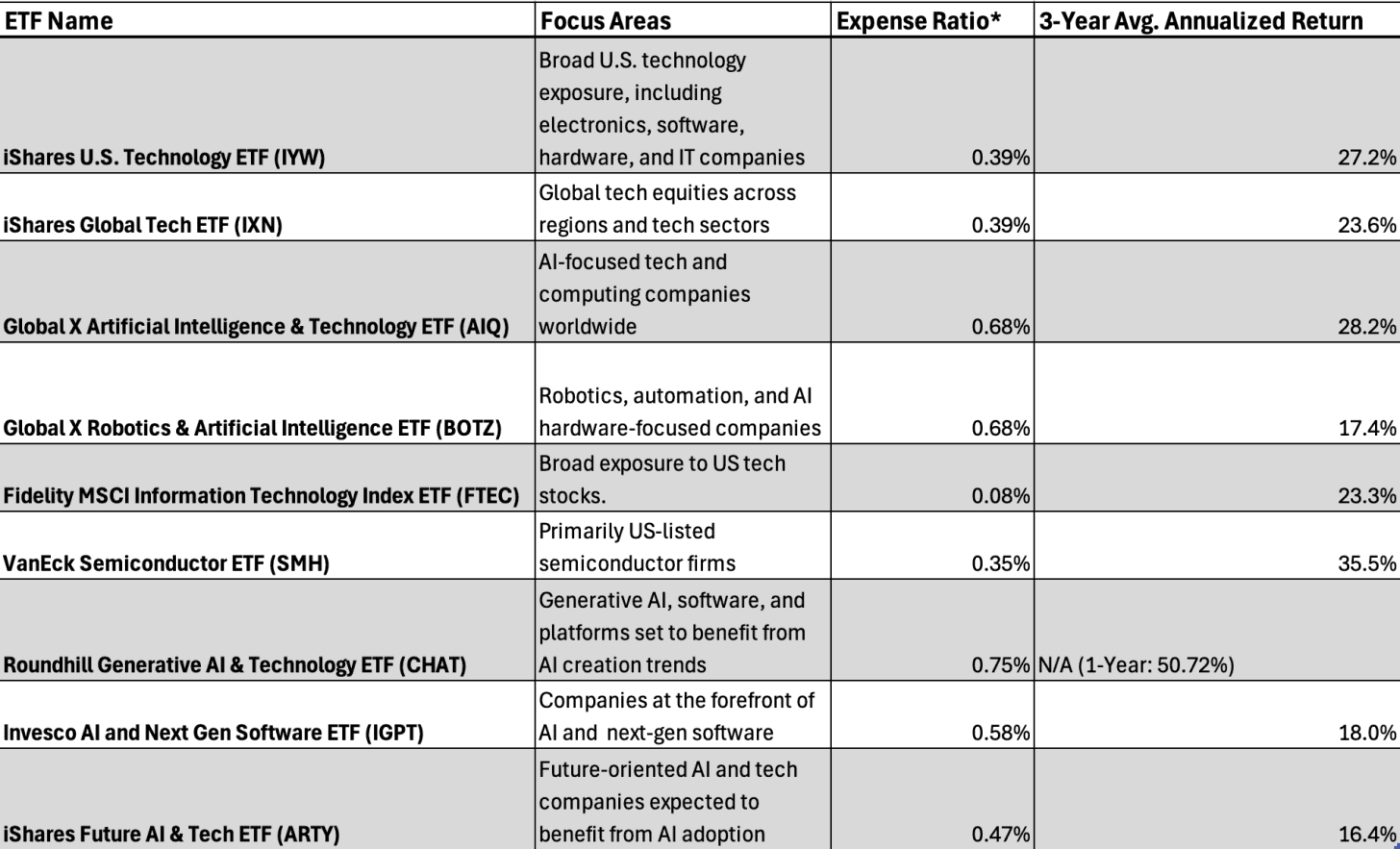
Take the Global X Artificial Intelligence & Technology ETF (AIQ) as an example. It holds over 90 AI heavyweights — from NVIDIA and Alphabet to Meta, Amazon, and Microsoft. As of August 26, 2025, one share costs $44.77, and over the last three years, AIQ has delivered a stunning 28.33% annualized return, almost double the S&P 500.
How GCC Investors Can Join the Ride
For GCC investors, the trick is access. Many AI ETFs are listed in the U.S. rather than on local exchanges. The good news? Platforms like THNDR and Sarwa let you open international brokerage accounts in minutes. Fund your account, pick an ETF, and you’re in.
Additionally, the Abu Dhabi Exchange (ADX) will soon list Lunate’s Quantum Computing ETF in one of the region’s first thematic ETFs. While quantum computing is tangentially related to artificial intelligence, we can expect to see similar thematic local listing options in the near future, expanding investor’s liquidity and market access.
Not All AI ETFs Are Created Equal
AI ETFs differ in focus. Some, like AIQ, spread across the full AI value chain. Others, like Roundhill Generative AI ETF (CHAT), zero in on generative AI. Broader funds like iShares U.S. Technology ETF (IYW) cast the net even wider across tech.
Before investing, it’s worth checking each ETF’s holdings and expense ratios (the annual fees). Lower expense ratios mean more of your returns stay in your pocket.
Select US Tech and AI-Focused Funds
Who Should Invest?
If you believe AI will reshape industries — from finance and healthcare to manufacturing and beyond — AI ETFs are a smart way to get exposure without betting on a single company. They’re ideal for:
- Long-term investors chasing megatrends
- Diversifiers who want global exposure to cutting-edge tech
- Practical investors who want simplicity without sacrificing opportunity
Mind the Risks
Of course, no trend is risk-free. AI stocks can be volatile, and even ETFs won’t shield you from a sector-wide downturn. The key? Think long term. Start small, use dollar-cost averaging, and keep AI ETFs as just one slice of your portfolio pie. Pair them with broader market ETFs to stay balanced.
Final Word
We may only be at the dawn of AI’s story — and the next few decades could be transformative. By investing through AI ETFs, GCC investors can get in on the action early, spread their risks, and ride one of the greatest growth stories of our lifetime.