
The GCC ETF market entered Q1 2026 in a consolidation phase, with activity remaining elevated but growth slowing. Total assets held broadly steady over the quarter, while trading levels pointed to continued repositioning and as a reaction to geopolitical news rather than a meaningful new capital deployment.
Global macro conditions set a challenging backdrop. Shifting expectations around global inflation, and interest rates weighed on growth assets, while ongoing uncertainty in China, particularly around the property sector and policy effectiveness, continued to pressure sentiment. The result was a quarter defined by volatility, dispersion, and selective positioning, rather than a clear directional trend. Oil related assets did well for the most part.
On the positive side, in January, the Boreas Absolute Luxury ETF launched on ADX to add more thematic ETFs. Also in Q1, two more Kraneshares have been approved for launch by the Capital Market Authority (CMA) and are about to be approved by the Abu Dhabi Stock Exchange (ADX). Both funds are expected to launch in April and continue the trend of more innovative ETFs listings in the GCC.
Market Snapshot: Stability at the Surface, Activity Beneath
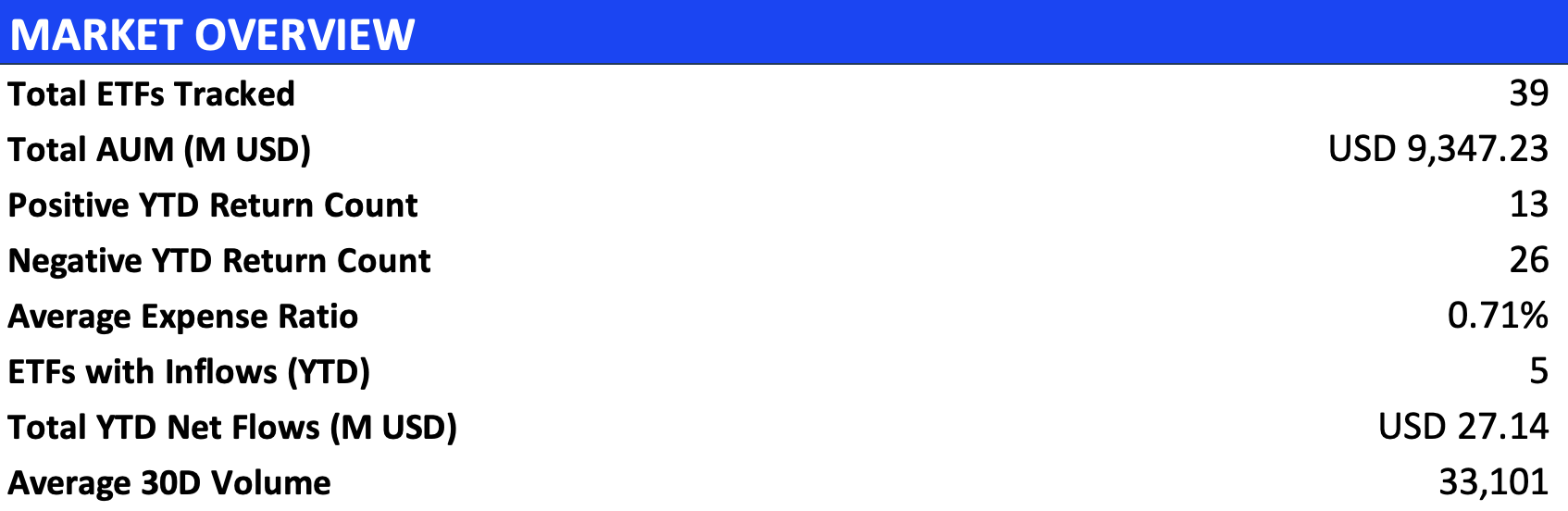
The GCC ETF universe comprised 39 ETFs with a total AUM of $9.35 billion (as of Q1 2026) . Performance across the market was broadly negative, with only 13 ETFs delivering positive returns compared to 26 in decline. Overall, the data reflects a market that is active but narrow, with capital and liquidity concentrated in a small subset of products. Only 5 ETFs saw inflows in the first quarter of 2026 led by the Albilad Gold ETF.
Performance: Rotation Replaces Momentum
Winners: the oil-haves and selective pockets
Performance in Q1 2026 was driven by a narrow group of idiosyncratic winners, rather than broad market strength. The leading ETFs were concentrated in specific country exposures and commodities, particularly Turkey, Saudi petrochemicals, gold, and Egypt.
Countries like Saudi Arabia, Turkey, and Egypt were resilient during the quarter. Saudi Arabia’s oil exposure supported its local market, with Aramco reaching new highs amid higher oil prices, as well as its continued ability to export oil through the Bab el-Mandeb Strait, which remains open. Turkey’s market continues to reflect optimism driven by country-specific factors, including the normalization of macroeconomic conditions and interest rate policy, while valuations remain attractive compared to other emerging markets. Egypt delivered strong performance in January and February. Despite a market pullback in March due to the war, both Egypt’s market and its ETFs still posted positive returns for the quarter.

Laggards: China and Growth Themes Under Pressure
The ongoing Middle East conflict and resulting energy shock have reshaped the outlook for emerging market equities between the oil-haves and the oil-have-nots. This is driving a rotation due to higher stagflation risks and commodity prices which can impact oil dependent countries like India and threaten corporate earnings. The situation is putting pressure on valuations and investors expectations. EM valuation in general derated more than 8% in March impacting EM ETFs listed in the GCC.
China internet stocks declined in Q1 due to a mix of weak domestic consumption, rising competition, and downward earnings revisions, all of which pressured growth expectations. At the same time, heavy investment in AI and data infrastructure weighed on margins in the near term, raising concerns about return visibility. The sector also faced broader macro headwinds, including a more cautious policy backdrop in China and global risk-off sentiment driven by geopolitical tensions and higher energy prices.

Thematic ETFs also struggled for the most part, particularly those linked to carbon and high-growth technology, as valuation pressures and global rate dynamics weighed on performance. AI power and quantum computing ETFs held up relatively well, with near-flat performance for the quarter. The petrochemical ETF significantly outperformed.

Flows & Trading Activity
Flows in Q1 2026 were modest and highly concentrated, reflecting selective allocation rather than broad market participation. Despite weak performance, ETFs recorded $27.1 million in net inflows, with only a small number of products attracting new capital. This indicates that investors were targeting specific exposures, while reducing or rotating out of others. The Albilad Gold ETF attracted $30 million in Q1 while the Boreas S&P AI Data Power and Infrastructure ETF lost $1.84 million.
Volatility and uncertainty driving ETF volumes in Q1
Trading activity remained steady, with average 30-day volumes around 33,000 shares, concentrated in a handful of larger and more liquid ETFs. Most activity appears to have taken place in the secondary market, enabling investors to adjust positions without significant primary creations or redemptions.
Investors can still find yield in GCC-listed ETFs
While recent geopolitical events have resulted in more financial pressure on GCC countries, the region remains resilient and well capitalized to deal with the situation. Both the UAE and Qatar rolled out stimulus packages for the financial sector and remain ready to provide economic assistance.
New Launches and Pipeline Expansion
In January, Boreas launched its S&P Global Luxury UCITS ETF, adding a niche thematic exposure focused on global luxury and consumer brands.
Momentum continued into April with the approval of KraneShares AGIX and KWIN ETFs by the CMA for cross-listing on ADX. These funds are expected to launch in April pending a final approval from ADX. These additions point to a gradual reopening of the ETF pipeline, with new products focusing on specialized themes and differentiated income strategies, rather than broad market exposures.
Conclusion
Q1 2026 showed some progress relating to ETFs in the GCC. We expect more global and thematic ETFs to list in the GCC during 2026. While the conflict has impacted sentiment and prices during the quarter, it has driven more volume and interest in regional assets.