
Gulf markets opened the week under fire and closed before the most important signal of the day had even landed. By Monday’s session end, Dubai had shed 3% and Abu Dhabi 1.5%, as Iran’s threat to strike Gulf energy and water infrastructure sent investors to the exits across real estate, banking, aviation, and energy. Then, after the close, the script flipped: Trump announced a five-day postponement of threatened strikes on Iranian power plants, while Iran’s Parliament Speaker dismissed it as “fake news.” The back channels, however, appear to be open.
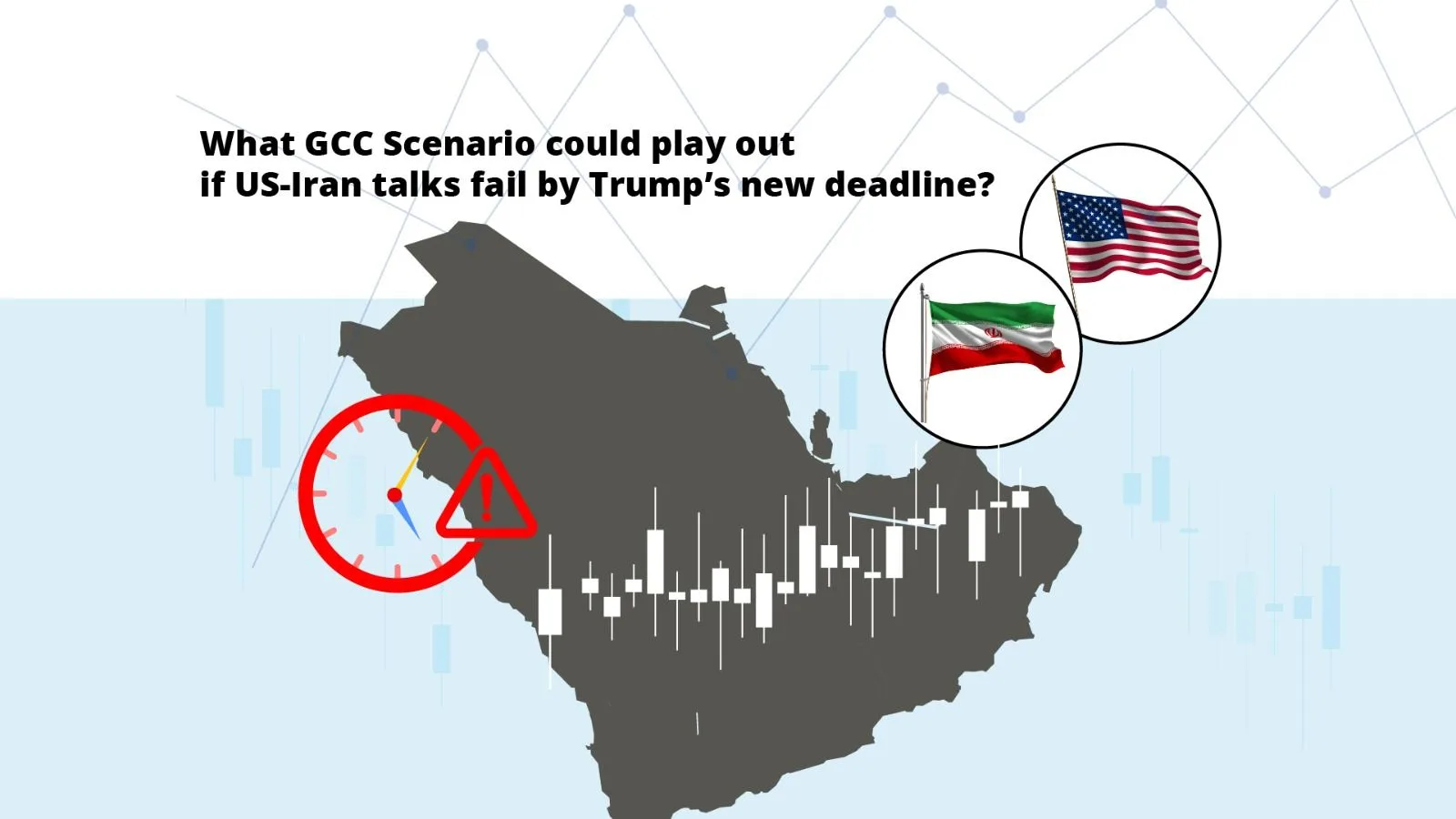
The question now is not what Monday meant but what happens when this window closes.
How Much Did UAE Markets Decline on Monday, 23 March?
Both UAE benchmark indices declined sharply in early trading, with losses sustained across the session before Trump's post-market statement was issued.
The selloff was almost entirely sentiment-driven. The single confirmed operational casualty was ADNOC Gas, which disclosed temporary adjustments to LNG and export-traded liquids output due to Strait of Hormuz shipping disruption with debris falling near facilities, though inspections cleared all assets. Crucially, this Hormuz thread remains active under every diplomatic outcome.
Three GCC Scenarios if the Deadline Fails
The first Trump deadline, the 48-hour Saturday ultimatum, triggered immediate selling. This second deadline introduces a delayed, binary risk: markets will either reprice a resolution or absorb a fresh escalation shock. The base case is another extension; a deal is constrained by Iran's domestic politics and unbridged nuclear terms; a collapse is the tail risk.
One critical distinction: the power plant strike threat and the Strait of Hormuz shipping disruption are two separate risk threads. Trump's postponement addresses only the first. Even in Scenario A, Hormuz normalisation takes weeks, not a statement. Any recovery next session will depend on whether markets reprice the postponement signal or wait for confirmation from Tehran.
Which GCC Stocks Should Investors Watch Now?
Monday's declines were almost all sentiment-driven, meaning the recovery trade is real but only if the diplomatic signal holds. Joseph Dahrieh of Tickmill noted that UAE banking and real estate names 'maintain strong financial positions, leaving the market well-placed for a recovery once risk aversion fades.' In sector terms, real estate and banks carry the highest recovery beta; energy and utilities carry the highest geopolitical beta.
How Did the Escalation Unfold?
Monday's market moves were the product of a rapid sequence of statements across the preceding 48 hours. The timeline below draws only from explicitly sourced reporting.
The key watch item on Friday: Iran's official response to the 5-day window. If Tehran tones down its Parliament Speaker's 'no deal' stance or allows Hormuz traffic to resume voluntarily, sentiment names (Emaar, FAB, Air Arabia) are the fastest recovery trade. If IRGC-linked media acts on its 'special plans' threat before the deadline, Monday's lows become the ceiling, not the floor.
Bottomline
Monday’s selloff was the market pricing a war that had not yet been called off. The postponement changes the near-term risk picture but does not resolve it. Two separate threats remain live: the strike deadline and the Strait of Hormuz disruption. Trump’s announcement addresses only the first.
For GCC investors, the recovery trade is real, but it requires two things to go right, not one. A rebound in sentiment names depends on both Tehran staying quiet and Hormuz traffic stabilising. ADNOC Gas remains the only name with confirmed operational disruption, and that risk thread runs independently of whatever Washington and Tehran agree.
The most likely outcome this week is not a deal or a war but another extension, another deadline, and another round of markets trying to price a conflict with no clear end date. Position accordingly.