



What Are Carbon Credits?
A carbon credit is a tradable certificate that represents the right to emit one metric ton of carbon dioxide (CO₂) or an equivalent amount of another greenhouse gas. These credits are the backbone of carbon markets, which use financial incentives to reduce global emissions by capping total pollution and allowing participants to trade allowances.
The system is designed around the principle of scarcity: by setting limits on emissions and gradually lowering those limits, regulators create rising demand for credits. This mechanism, in turn, drives investments in cleaner technologies and sustainable projects.
From Kyoto to Paris
Carbon markets were first institutionalized under the Kyoto Protocol (1997), which introduced the Clean Development Mechanism (CDM). But it was the Paris Agreement of 2015 that catalyzed today’s global expansion. Article 6 of the Paris framework provided the legal basis for international carbon trading by allowing countries to cooperate in meeting emission-reduction targets through market mechanisms.
As of 2025, over 70 national and subnational jurisdictions have adopted some form of carbon pricing, covering nearly 23% of global greenhouse gas emissions. The World Bank estimates these systems generated $104 billion in revenue in 2023, up from $95 billion in 2022, showing rapid adoption and financial impact.
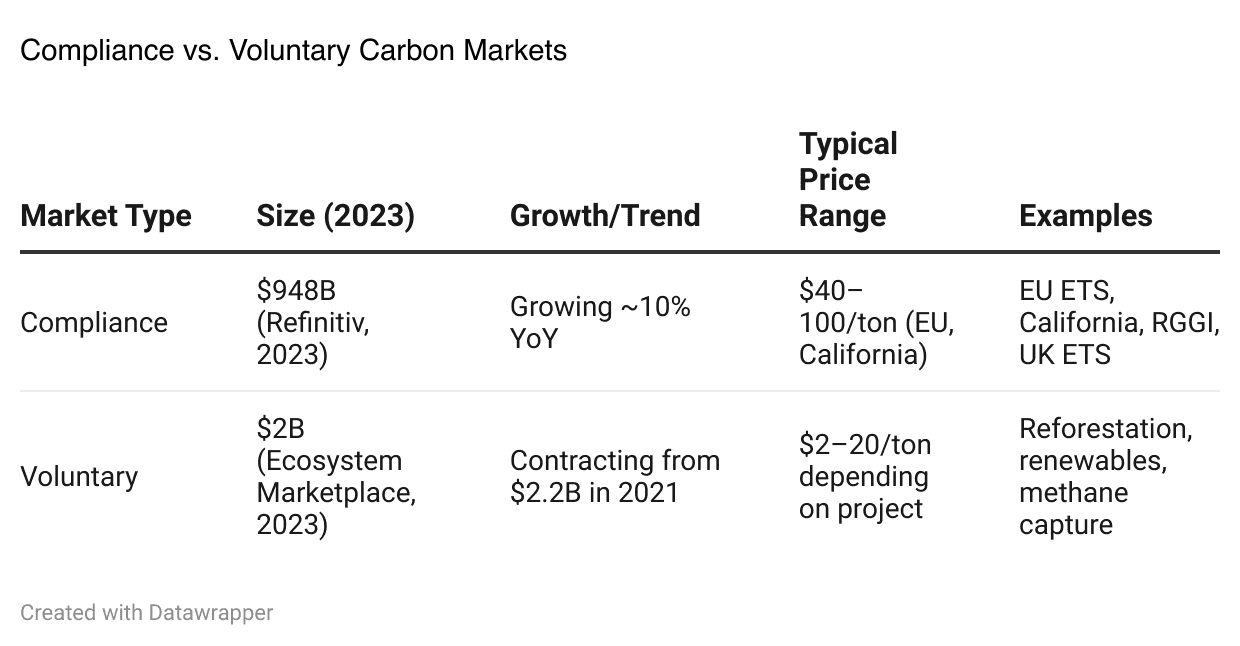
Compliance markets are government-mandated systems where entities must surrender allowances equal to their emissions. The two largest programs are:
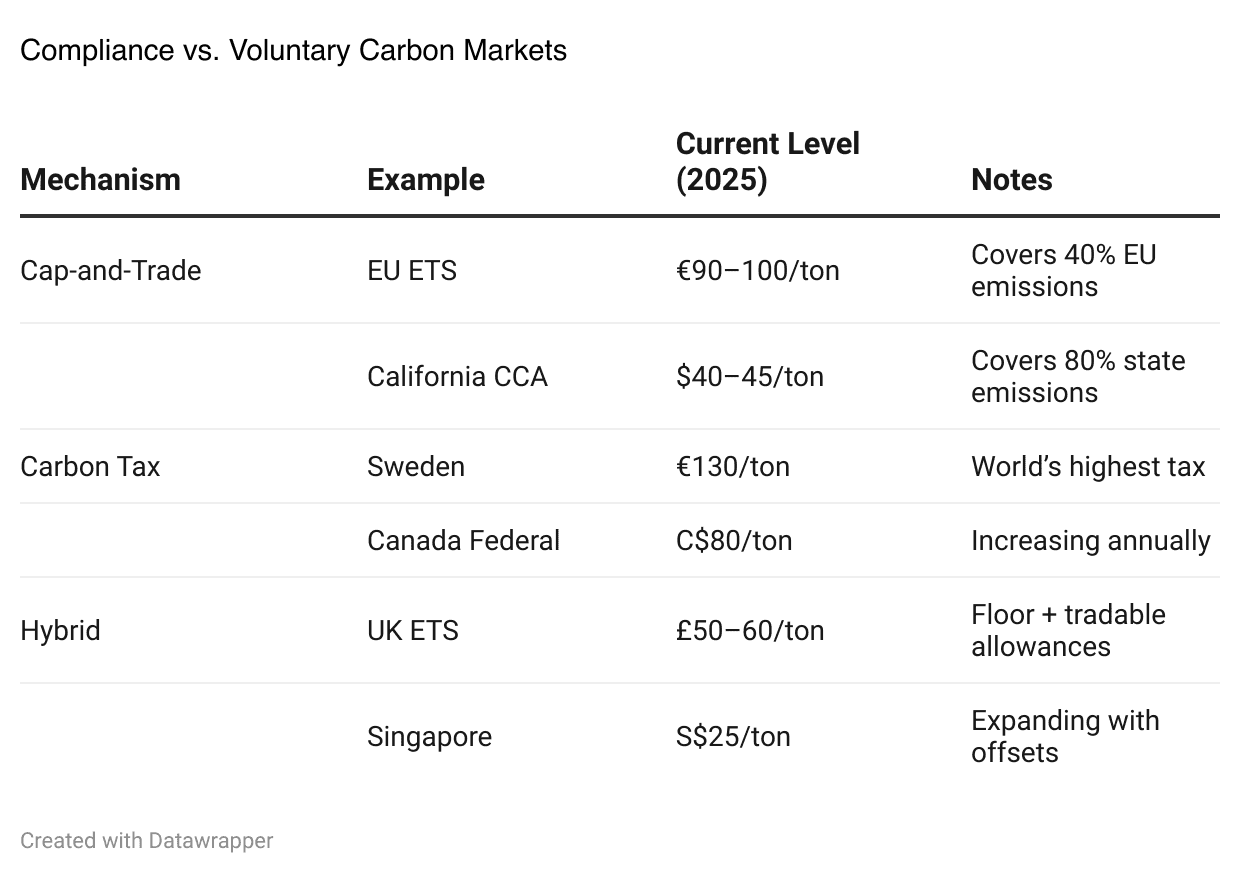
- EU Emissions Trading System (EU ETS): Covers over 10,000 installations across 30 countries, representing about 40% of EU emissions. Carbon prices in 2025 have fluctuated around €90–100 per ton, making it the global benchmark.
- California’s Cap-and-Trade (linked with Quebec): Covers 80% of state emissions, recently extended through 2045. Current allowance prices trade around $40–45 per ton.
Voluntary markets operate outside government mandates. Companies or individuals purchase credits to offset emissions, often tied to reforestation, renewable energy, or methane capture projects. The voluntary market is smaller, estimated at $2 billion in 2023, down from a peak of $2.2 billion in 2021 but still influential.
Types of Compliance Mechanisms
Why Carbon Credits Are an Investment Opportunity
Carbon credits are increasingly recognized as an emerging asset class with attractive characteristics:
- Historical Returns: EU ETS allowances (EUAs) have delivered returns exceeding 1,000% since 2017, rising from about €5 per ton to nearly €90–100 in 2025.
- Low Correlation: Carbon prices tend to have low correlation with traditional equities and bonds, offering diversification benefits.
- Policy Tailwinds: With over 90 countries committed to net-zero by mid-century, demand for credits is structurally supported by regulation.
- Institutional Adoption: ETFs such as the KraneShares Global Carbon ETF (KRBN), KraneShares California Carbon Allowance ETF (KCCA), and KraneShares European Carbon Allowance ETF (KEUA) have brought compliance carbon exposure to mainstream investors. As of mid-2025, KRBN manages over $1.6 billion in assets.
- Market Growth: Refinitiv projects compliance markets could exceed $1.5 trillion by 2030 if current expansion continues.
Conclusion
From their origins in global climate agreements to their rapid growth in both compliance and voluntary forms, carbon credits have evolved into a core pillar of climate finance. For investors, they represent not only a tool for emissions accountability but also a promising asset class shaped by regulatory momentum, scarcity-driven pricing, and institutional adoption. As climate policies tighten and markets deepen, carbon credits could become as integral to global portfolios as commodities or fixed income.