
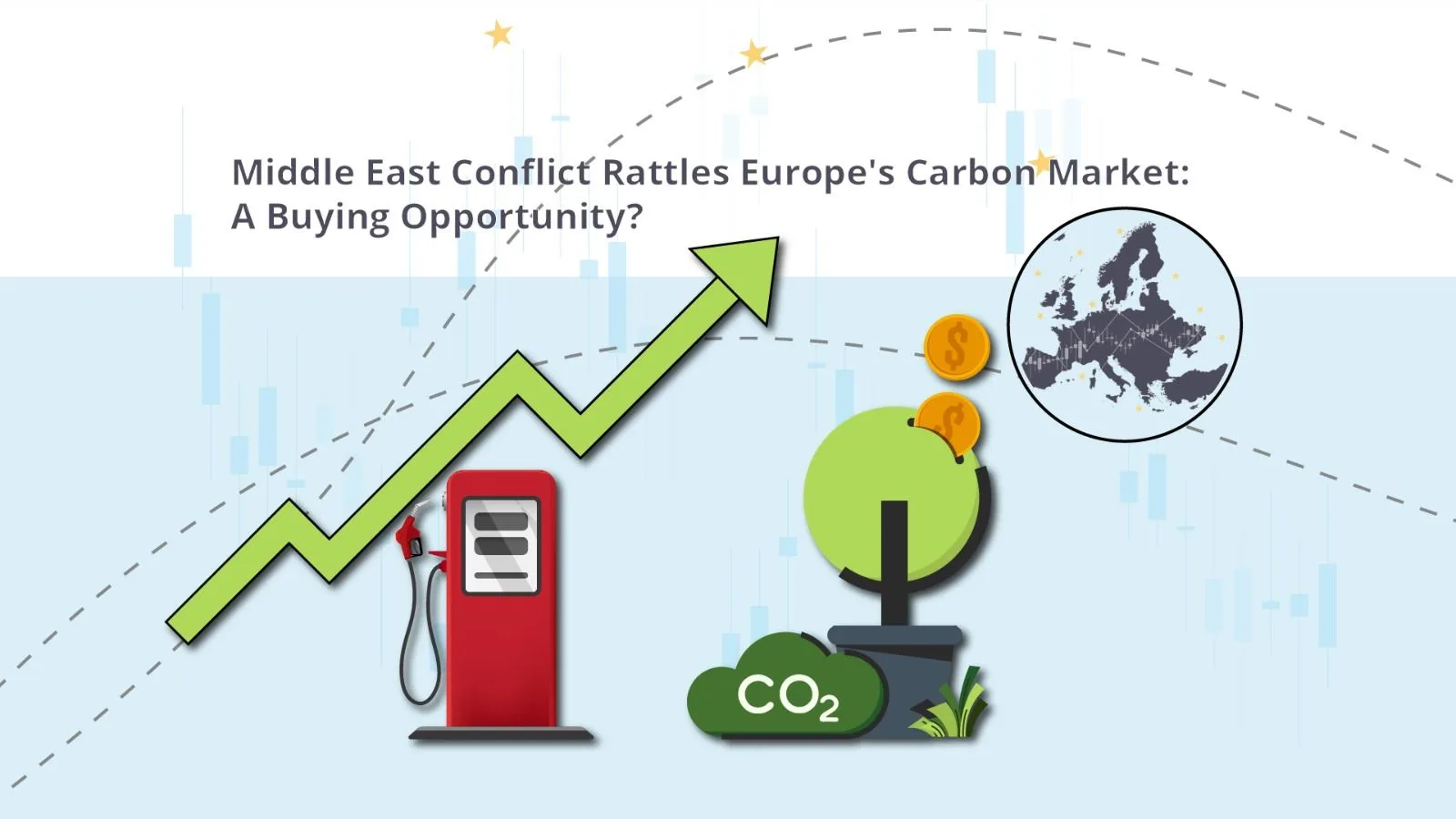
Europe’s carbon market is rarely front-page news. But right now, it should be on every investor’s radar.
The ongoing conflict involving Iran has added a significant new layer of volatility to the EU Emissions Trading System (EU ETS), the world’s largest carbon pricing mechanism, covering power generation and heavy industry across the EU, and accounting for approximately 40% of the bloc’s total greenhouse gas emissions.
What Is the EU ETS?
The EU ETS operates on a “cap and trade” principle: companies receive a limited annual allocation of carbon allowances, and those that emit more must purchase additional permits. Prices respond sharply to energy market disruptions, meaning geopolitical shocks in the Middle East have direct and measurable consequences for European carbon costs.
The ETS carbon price has risen to levels well above €50 per tonne of CO₂ since 2021, lifted significantly by the introduction of the Market Stability Reserve.
The Energy Cost Shock: By the Numbers
Historical precedent is instructive. When Russia invaded Ukraine in 2022, the resulting energy crisis increased Europe’s energy import bill by roughly €1 trillion.
The Iran conflict risks creating a similar energy market shock, though current impacts remain smaller than those seen during the 2022 crisis.
According to Ember, a London-based energy think tank, the cost of gas-fired power in Europe has risen sharply in recent weeks following renewed energy market volatility.
Why Energy Shocks Matter for Carbon Prices
Carbon prices are closely linked to Europe’s power mix.
When natural gas becomes expensive, utilities often switch generation back to coal. Coal emits significantly more CO₂, which increases demand for carbon allowances under the ETS.
This “fuel-switching” mechanism means geopolitical disruptions affecting global energy supply, whether in Eastern Europe or the Middle East, can indirectly influence carbon markets.
However, the effect is not always one-directional. Energy shocks can simultaneously weaken industrial output, reducing emissions and lowering allowance demand.
Analysts often describe this as a “two-way pull” on carbon prices:
Duration Is the Key Variable
Risk advisory firm Redshaw Advisors flags conflict duration as the most critical factor. Their analysis notes that the longer the conflict runs, the more likely “industrial demand destruction” becomes a scenario where high energy costs force European factories to cut output, slashing EUA demand and destabilising prices further.
RLAM echoes this, warning that geopolitical energy shocks produce “two-way ESG effects” either accelerating renewables economics or triggering short-term fossil fuel policy reversals that set back the energy transition.
Why This Conflict May Be Different From the Ukraine Crisis
Carbon market analysts frequently draw an important distinction between the current tensions involving Iran and the structural energy shock triggered by the Russia-Ukraine war.
Russia’s invasion of Ukraine permanently disrupted pipeline gas flows to Europe and forced a multi-year restructuring of the continent’s energy system. The result was a prolonged energy crisis that reshaped power markets and drove major volatility in EU carbon prices.
By contrast, many analysts expect the Iran-related conflict to be shorter in duration, meaning its impact on European energy markets could prove more temporary.
If the disruption proves short-lived, carbon prices could experience sharp swings without fundamentally altering the long-term tightening of the EU carbon market.
For investors, that dynamic may create opportunities.
Periods of geopolitical volatility have historically triggered temporary sell-offs in EU carbon allowances, followed by strong recoveries once energy markets stabilise. As a result, some market participants view conflict-driven weakness as a potential buying opportunity in carbon markets.
What GCC and Global Investors Should Watch
For sovereign wealth funds such as Mubadala Investment Company and ADQ, which hold substantial European infrastructure and industrial assets, volatility in the EU Emissions Trading System can increase hedging costs and complicate long-term decarbonisation planning.
One widely used instrument for accessing carbon markets is the KraneShares Global Carbon Strategy ETF, managed by KraneShares. The ETF tracks the S&P Global Carbon Credit Index, providing diversified exposure to major compliance carbon markets, including the EU ETS and North American cap-and-trade systems.
Because European carbon allowances dominate global carbon trading volumes, movements in EU carbon prices tend to drive much of the ETF’s performance. For investors monitoring how geopolitical shocks in energy markets translate into carbon price movements, instruments such as KRBN provide one of the most direct market barometers.
The Bottom Line
The Iran conflict has added a geopolitical risk premium to an ETS that was already navigating energy volatility, industrial uncertainty, and a formal policy review in Brussels. Folland’s position is clear: “Higher oil and gas prices are not a reason to weaken carbon markets.” ¹
With the EU Council meeting imminent and Von der Leyen’s ETS modernisation agenda in focus, the decisions made in Brussels over the coming weeks will determine whether Europe’s carbon market emerges from this turbulence strengthened or structurally weakened.