
ETF liquidity refers to how easily investors can buy or sell exchange-traded fund (ETF) shares without significantly affecting their market price. However, an ETF's liquidity is not determined by trading volume alone. The bid-ask spread, liquidity of the underlying investments, and ability of market participants to create or redeem ETF shares also influence trading costs.
Understanding how ETF liquidity works can help investors evaluate trading costs before placing an order. This guide explains the difference between primary and secondary market liquidity, why some ETFs are easier to trade than others, and how to assess an ETF's liquidity using key indicators.
How ETF Liquidity Works: Primary vs Secondary Markets
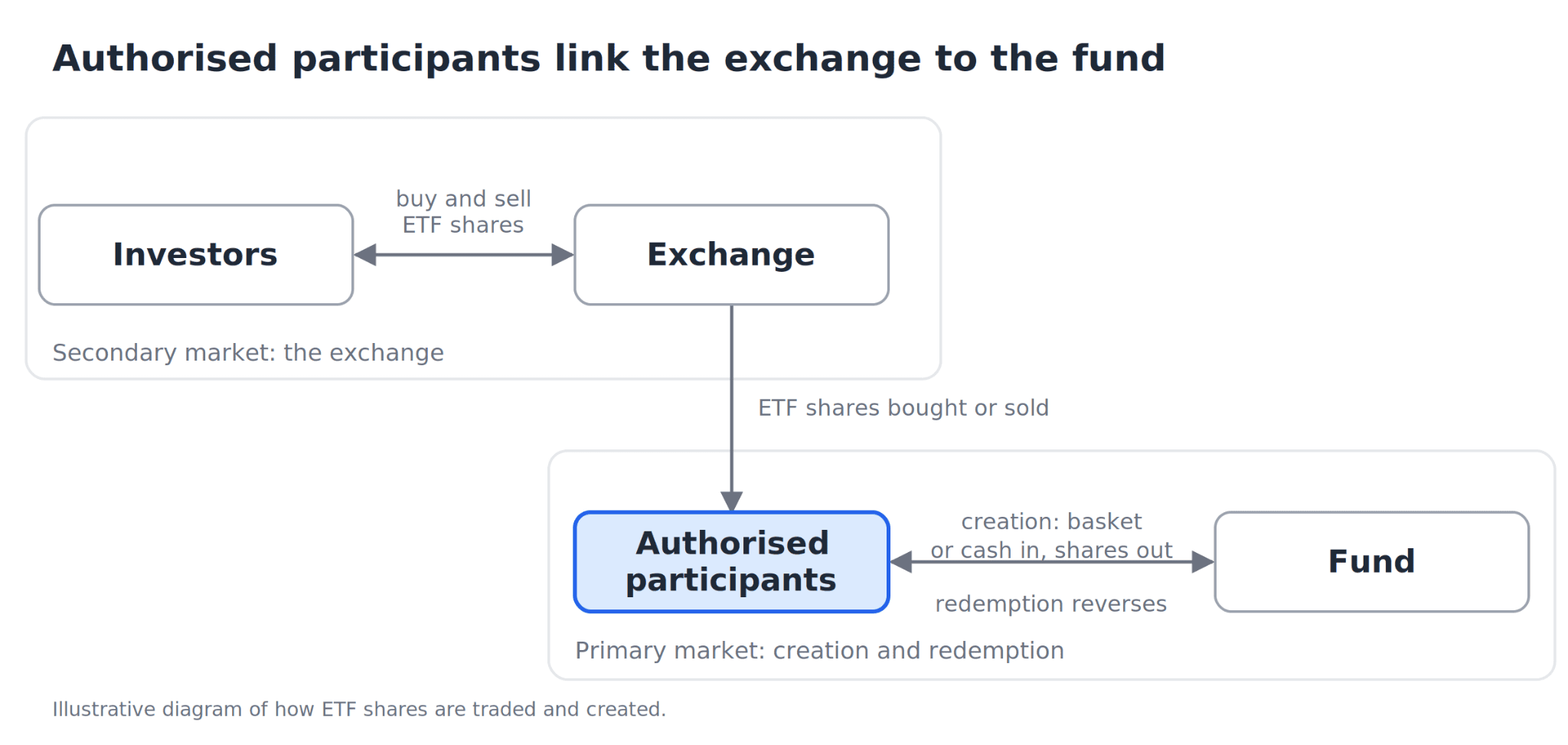
The secondary market is where investors buy and sell ETF shares on a stock exchange, just as they buy or sell company shares. The primary market is where authorized participants (APs) work directly with the fund to create new ETF shares or redeem existing ones.
For example, imagine an ETF that invests in shares of 50 companies. If demand increases, an authorised participant may be able to provide the underlying shares to the fund in exchange for new ETF shares and sell them in the market. If the ETF trades below the value of its underlying investments, the participant may instead buy ETF shares and redeem them with the fund. These transactions can help adjust the supply of ETF shares to demand, although their effectiveness depends on market conditions and costs.
This process helps keep an ETF's market price close to the value of its underlying investments, known as its net asset value (NAV). For example, imagine an ETF whose investments are worth $100 per share but whose market price rises to $103. An authorized participant may be able to create new ETF shares and sell them at the higher market price if the potential price difference outweighs the associated costs.
This activity can help bring the market price closer to NAV. However, trading costs and market conditions can affect whether this opportunity is worthwhile, so the price difference may not disappear immediately.
Why ETF Trading Volume Does Not Tell the Whole Story
ETF trading volume measures how many shares are bought and sold over a given period, but it does not show the full picture of ETF liquidity. An ETF with low trading volume may still be relatively easy to trade if its underlying investments are liquid and market makers can access them efficiently.
For example, imagine an ETF that trades only a small number of shares each day but invests in popular company stocks that are easy to buy and sell. Even if few investors trade the ETF itself, market makers may still be able to trade its underlying stocks to help meet demand. However, this does not guarantee that ETF shares can be bought or sold at a favourable price.
By contrast, an ETF with high trading volume may still face liquidity challenges if its underlying stocks are difficult to buy or sell. During periods of market stress, trading these securities can become more expensive, potentially affecting the ETF's bid-ask spread and the price investors receive.
The size of an ETF also does not tell the whole story. A small ETF can be easy to trade if its underlying investments are readily available. Two ETFs tracking the same index can also have different trading costs, depending on how actively they are traded and how much support they receive from market makers. A well-known fund provider or lower fee does not automatically mean an ETF will be cheaper or easier to trade.
How Underlying Assets Affect ETF Liquidity
An ETF's liquidity also depends on the assets it holds. ETFs investing in large, actively traded companies generally benefit from more liquid underlying markets. ETFs holding less-liquid securities, including some real estate investments and emerging-market stocks, may face higher trading costs when market participants buy or sell the underlying assets.
What happens when some investments are hard to find?
When an ETF creates new shares, market makers may need to collect all the investments that the fund holds. If some are difficult to find or buy, the fund may allow them to provide cash instead. The fund can then use that money to buy the missing investments. Additional costs may be charged to the relevant market participant. However, this depends on the fund's rules, and not every ETF offers this option.
What about cryptocurrency ETFs?
Bitcoin and ether ETFs provide another example of why liquidity can differ between funds. In January 2024, the US Securities and Exchange Commission (SEC) approved the listing and trading of spot bitcoin exchange-traded products. It approved rule changes for spot ether products in May 2024, and trading began in July 2024.
These products provide a way to gain cryptocurrency exposure through exchange-traded products. However, trading liquidity can vary by product and market conditions. Investors should examine trading volume, bid-ask spreads, and available market depth rather than assuming all bitcoin or ether products are equally easy to trade.
Key Factors to Check Before Trading ETFs
- Check the bid and ask spread. Compare the best available buying and selling prices. Observe how spreads change during the trading session rather than relying on a single quote. A narrower spread generally means a lower immediate trading cost, but it does not capture every cost associated with a large order.
- Compare the market price with NAV. Occasional premiums or discounts are normal. Persistent or unusually large differences warrant closer investigation, particularly when the underlying market is volatile or difficult to trade.
- Examine the underlying holdings. Look beyond the ETF's own trading volume. If the underlying securities are difficult to trade, creating or redeeming ETF shares may also become more expensive or challenging.
- Plan large orders carefully. Ask your broker about available market depth, execution options, and the likely cost of your intended trade size. An institutional desk may be able to arrange a size-specific quote or facilitate a creation or redemption through an authorized participant. Retail investors generally buy and sell ETF shares on the exchange rather than creating or redeeming them directly with the fund.
The bottom line
ETF liquidity depends on more than daily trading volume. Bid-ask spreads, the liquidity of underlying investments, available market depth, and the creation and redemption process all influence how easily ETF shares can be traded. By checking these factors before investing, investors can better understand potential trading costs and make better-informed decisions.