
A Debate in Financial Economics
Exchange-traded funds (ETFs) have become one of the most consequential innovations in modern financial markets. What began with the launch of the SPDR S&P 500 ETF Trust (SPY) in 1993 has evolved into a global ecosystem with trillions of dollars in assets and deep integration into trading, asset management, and portfolio construction.
Global ETF assets surpassed $20 trillion in early 2026, according to industry estimates from PwC, reflecting both institutional adoption and growing retail participation.
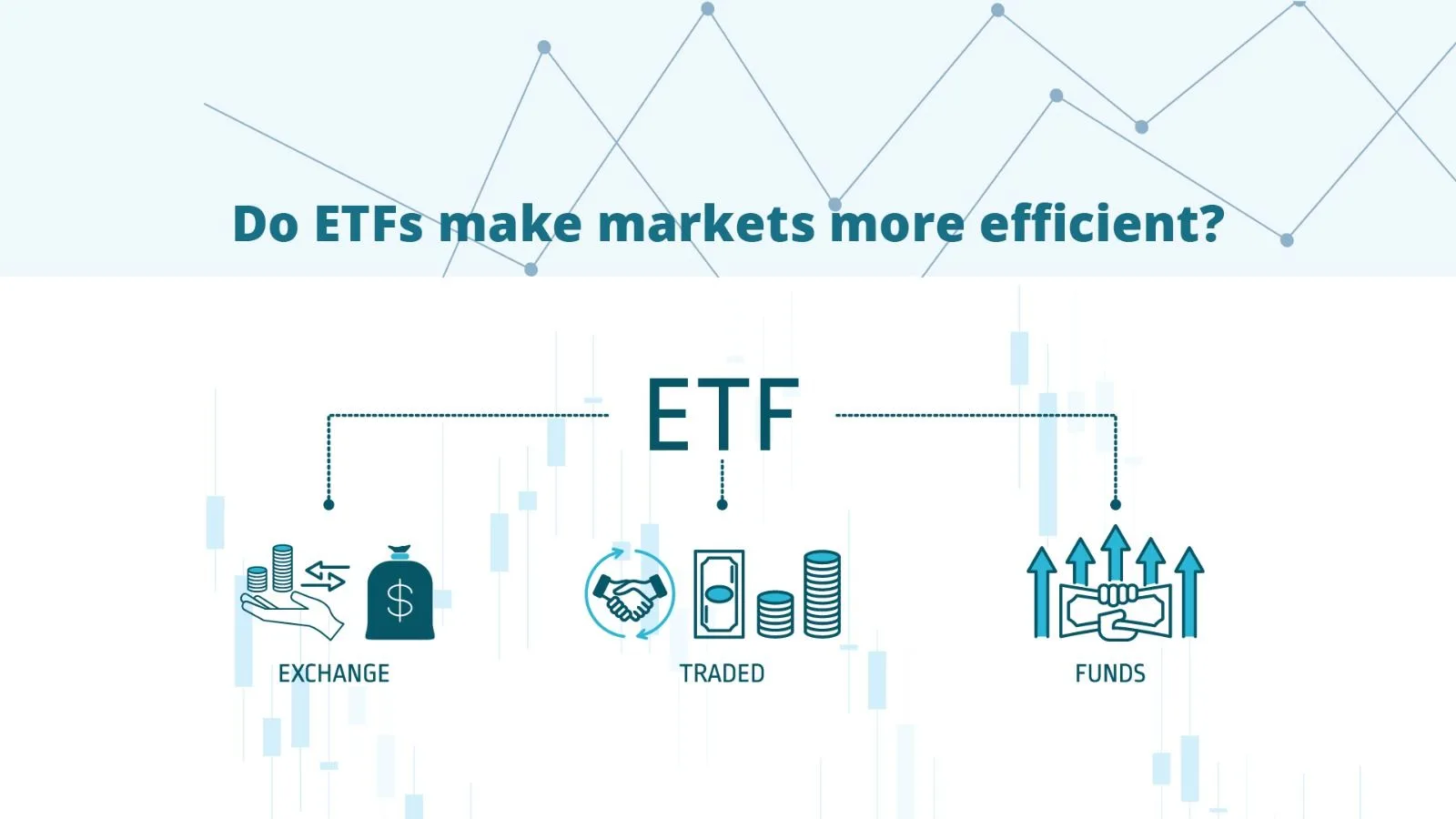
Yet this rapid expansion has triggered an important economic debate: do ETFs improve market efficiency, or do they introduce new forms of distortion and systemic risk?
Economists remain divided. Some argue ETFs enhance price discovery, liquidity, and capital allocation. Others warn that the same mechanisms may amplify volatility, increase correlations between assets, and transmit shocks across markets.
Understanding this debate requires examining the economic theories behind how markets process information.
Arguments in Favor: How ETFs Can Improve Market Efficiency
Helps Price Discovery
The debate begins with the Efficient Market Hypothesis, developed by Eugene Fama, which argues that financial markets incorporate information into prices quickly and efficiently.
ETFs can accelerate this process because they allow investors to trade entire portfolios through a single security. When new macroeconomic or sector information emerges, investors can express views instantly by trading ETFs rather than adjusting positions across dozens of individual securities.
Research by Joel Hasbrouck shows that index-based trading venues often incorporate information faster than individual stock markets. ETFs therefore function as price discovery hubs, aggregating information from multiple investors into a single tradable instrument.
This dynamic becomes especially visible in less liquid markets such as fixed income.
The Bank for International Settlements notes that ETFs can improve price discovery because they create a continuously traded benchmark even when the underlying assets trade infrequently.
During the bond-market turmoil of March 2020, for example, corporate bond ETFs continued trading actively while the underlying bonds were difficult to transact. The ETF price effectively became a real-time signal of market consensus.
Improves Market Efficiency Through Arbitrage
A defining feature of ETFs is the creation-redemption mechanism, which allows specialized institutions known as authorized participants (APs) to exchange ETF shares for the underlying basket of securities.
If an ETF trades above the value of its underlying portfolio, its net asset value (NAV) APs can buy the underlying securities, deliver them to the ETF issuer, receive newly created ETF shares, and sell those shares in the market. If the ETF trades below NAV, the reverse process occurs.
This arbitrage process helps keep ETF prices closely aligned with the value of their underlying holdings, reducing persistent mispricing and limiting deviations between market prices and fundamental asset values. By allowing traders to quickly exploit price discrepancies, the mechanism encourages continuous price alignment across markets.
Research from the Federal Reserve Board suggests ETF mispricing typically disappears quickly, with the half-life of mispricing in equity ETFs averaging less than half a day. This rapid adjustment mechanism helps lower pricing distortions and improve overall market efficiency.
From an economic perspective, the arbitrage structure also creates a bidirectional information link between ETF markets and the underlying securities. Information entering either market can be transmitted quickly to the other, helping prices adjust more rapidly and reducing the likelihood of prolonged market dislocations.
Concentrates Liquidity and Improves Market Depth
ETFs may also enhance market efficiency by concentrating liquidity.
Liquidity refers to the ability to buy or sell an asset quickly without causing large price movements. Highly liquid markets generally process information more efficiently because trades can occur without significant friction.
ETFs aggregate trading interest from many investors into a single instrument, concentrating liquidity that might otherwise be dispersed across multiple securities. Investors can gain exposure to entire sectors or markets with one transaction rather than trading each underlying asset individually.
This concentration attracts high-frequency market makers who provide continuous bid–ask quotes and tighten spreads.
Empirical research from the Federal Reserve System, examining mutual-fund-to-ETF conversions, finds that securities associated with ETF structures tend to experience improved liquidity and lower volatility after conversion. The results suggest ETFs can strengthen secondary-market functioning.
ETF Flows Can Reveal Investor Sentiment
ETF flows may also transmit information about investor expectations.
Because ETFs represent broad market exposures, inflows and outflows often reflect macroeconomic sentiment rather than company-specific developments. For example, strong inflows into equity ETFs may signal optimism about economic growth, while flows into bond ETFs may indicate rising risk aversion.
These signals can influence the pricing of underlying securities as market participants adjust positions accordingly.
In this sense, ETF markets act as aggregators of investor sentiment, providing an additional layer of information for financial markets.
Arguments Against: How ETFs Could Distort Markets
Can Increase Correlations Across Stocks
Despite these benefits, critics argue ETFs may distort price signals.
Research by Itzhak Ben-David, Francesco Franzoni, and Rabih Moussawi suggests ETF trading can increase correlations between stocks.
When investors buy or sell ETF shares, they effectively trade baskets of securities simultaneously. This can cause unrelated companies within the same ETF to move together even if their fundamentals differ.
Higher correlations may reduce the market’s ability to differentiate between individual firms.
Liquidity Mismatch in Bond ETFs
Another concern involves liquidity mismatch, particularly in fixed-income ETFs.
Many bond ETFs hold securities that trade infrequently, yet the ETF itself trades continuously. Economists Jun Pan and Yao Zeng argue this mismatch could create fragility if investors rush to exit ETFs during periods of stress.
Authorized participants may struggle to arbitrage efficiently because the underlying bonds are difficult to trade, potentially allowing ETF prices to diverge from NAV.
Leveraged ETFs and Market Volatility
A separate debate surrounds leveraged ETFs, which aim to deliver multiples of daily index returns.
Because these funds rebalance daily to maintain leverage targets, they may need to buy assets after market gains and sell after losses. Critics argue this process can reinforce market moves and increase short-term volatility.
Some studies have found that leveraged ETFs can amplify trading volumes near market close as funds rebalance positions.
While these effects appear limited in most circumstances, they remain a topic of ongoing academic and regulatory discussion.
Efficiency With Trade-Offs
More than three decades after the launch of the first ETF, the academic debate remains unresolved.
Evidence suggests ETFs often improve price discovery, concentrate liquidity, and enhance information transmission across markets. At the same time, they can also increase correlations between securities and transmit volatility more rapidly during periods of stress.
In other words, ETFs reshape how markets function.
For economists and policymakers, that means ETFs should be viewed not only as investment products but as financial infrastructure. Understanding their impact requires examining not just what they track, but how they influence the broader ecosystem of global capital markets.