
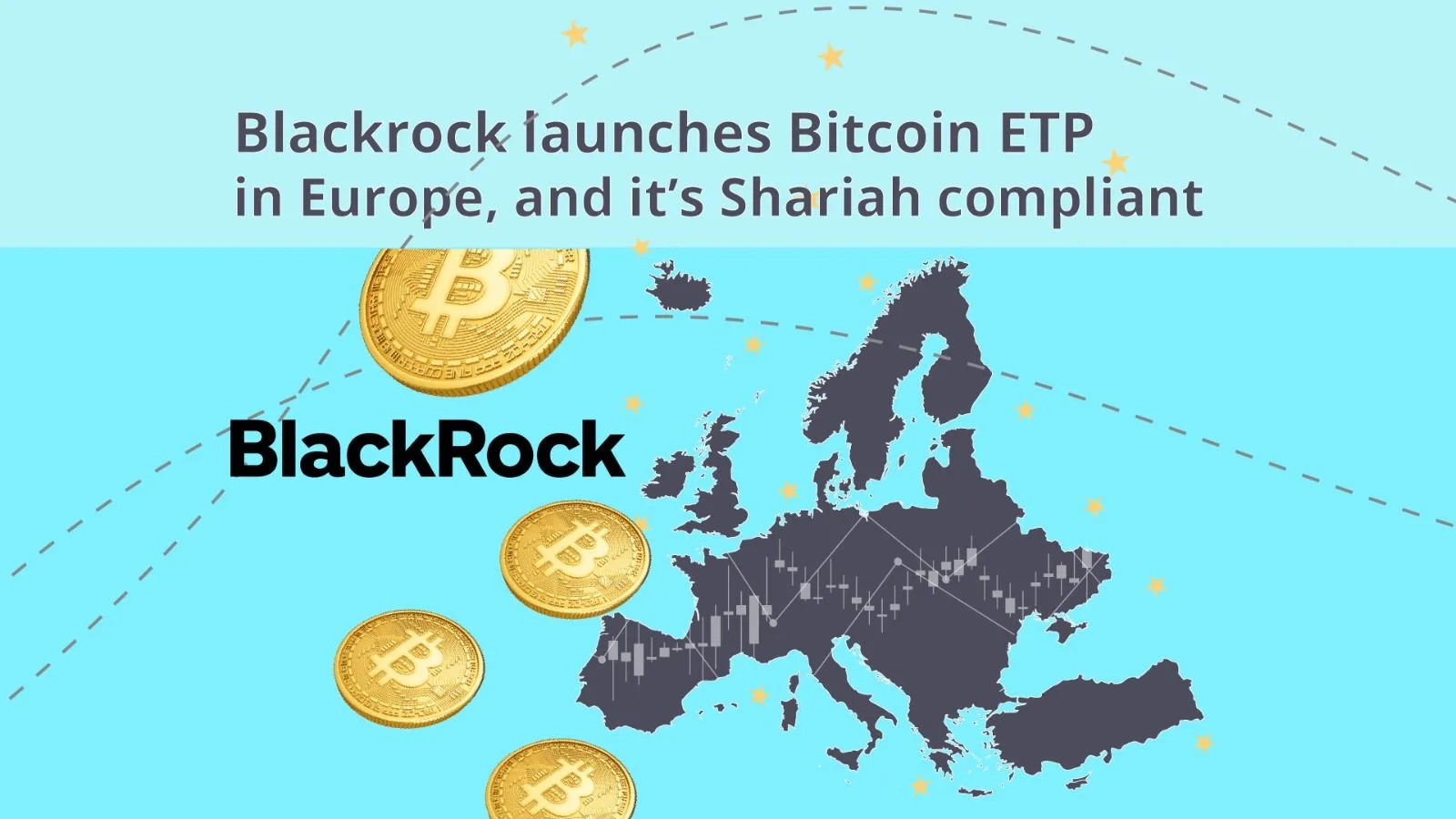
BlackRock, the world’s largest asset manager, has broadened its digital asset footprint in Europe with the launch of a Shariah-compliant Bitcoin exchange-traded product (ETP) that offers regulated investors a new route to gain exposure to Bitcoin’s price performance. The product is designed to meet Islamic finance principles while operating under established European regulatory frameworks
This marks a notable development in the intersection of traditional financial markets, digital assets, and ethical investing.
The Europe-listed iShares Bitcoin ETP (ticker IB1T) debuted on major venues including Deutsche Börse’s Xetra, Euronext Paris and Amsterdam, and other continental exchanges in March 2025. The product is physically backed by Bitcoin held in cold storage through regulated custodians, providing a direct link between the ETP’s market price and the underlying cryptocurrency’s performance. Unlike many earlier crypto investment vehicles that relied on derivatives or futures contracts, this ETP’s structure ensures that for every share issued there is a corresponding holding of real Bitcoin backing it up.
What Makes It Shariah-Compliant
Shariah compliance in financial products is centred on avoiding excessive uncertainty (gharar), interest (riba), and speculative leverage; The principles that traditional Islamic finance standards seek to minimize. While digital assets like Bitcoin are often debated in Islamic finance circles, Shariah-aligned structures typically focus on ensuring transactions are direct, transparent, and free from forbidden elements such as interest or derivative gambling.
Within this context, a physically backed Bitcoin ETP can satisfy key compliance points by:
- Providing direct economic exposure to the underlying asset rather than synthetic or leveraged exposure, which can be deemed excessive uncertainty or speculative.
- Avoiding interest-based financing structures in the product’s fee or custody arrangements.
- Ensuring transparency and ownership clarity, with Bitcoin held in regulated custodial arrangements rather than unregulated wallets.
By embedding these design principles into its governance and documentation, BlackRock has created a product that can be analyzed and certified by recognized Shariah advisors for compliance, making regulated Bitcoin exposure more accessible to institutional investors and clients in markets where Shariah considerations matter deeply. (Shariah certifications and standards referenced by Islamic finance bodies are generally applied to ensure such alignment.)
It is important to note that discussions around Bitcoin’s Shariah status vary among scholars, and compliance depends on specific product mechanics, certification, and interpretation. Nevertheless, having an ETP explicitly designed with these criteria in mind significantly broadens the pool of investors who can consider regulated crypto exposure within ethical finance frameworks.
How This Differs from BlackRock’s IBIT
BlackRock’s iShares Bitcoin ETP in Europe builds on the firm’s track record in crypto investment products, but its structure and investor context differ meaningfully from the iShares Bitcoin Trust (ticker IBIT) , the flagship spot Bitcoin ETF launched in the United States in January 2024. While both products aim to track Bitcoin’s spot price, key distinctions include:
- Legal Structure and Jurisdiction
IBIT is structured as a US-regulated Bitcoin ETF, approved by the US Securities and Exchange Commission (SEC), and is designed to be held directly in typical US brokerage accounts. Its regulatory framework and disclosure obligations reflect stringent SEC rules on securities and ETF governance. IB1T, by contrast, is listed in Europe under non-UCITS ETP frameworks (European markets do not allow a pure UCITS ETF for single assets like Bitcoin under current directives), and is typically structured as an ETP or ETN product within Swiss or European rules. - Target Investor Base
IBIT is broadly accessible to US investors, including retail and institutional flows, and has rapidly become one of the largest spot Bitcoin exchange-traded products globally, with tens of billions in assets under management. European ETPs like IB1T are often available to qualified or professional investors in many jurisdictions, and have historically been smaller in scale due to differing regulatory environments and market adoption. - Fee and Expense Structures
At launch, IB1T has offered a competitive total expense ratio (TER) in some cases around 0.15 % with temporary fee waivers which is comparable to or slightly below many physical Bitcoin ETPs in Europe but remains distinct from US ETF cost structures. By contrast, IBIT’s fee profile is aligned with US spot ETF norms, reflecting both competitive pricing and regulatory cost expectations in the US marketplace. - Shariah Considerations
Most US ETFs, including IBIT, are not explicitly designed with Shariah compliance in their structure or documentation, even though spot ETFs can be interpreted as halal by some scholars due to direct holding of underlying assets without leverage or interest. The European Shariah-compliant ETP explicitly incorporates compliance design mechanics, widening its appeal to faith-based investors. (General interpretations of Shariah compliance in ETFs are discussed by Islamic finance communities.)
Risks and Considerations
As with all digital asset investment products, Bitcoin ETPs carry inherent risk. Price volatility, liquidity considerations, and regulatory shifts can affect performance and valuation. Even with Shariah-compliant design, investors should conduct due diligence, consider risk profiles, and consult qualified advisors when integrating such products into broader investment strategies.
Conclusion
BlackRock’s Shariah-compliant Bitcoin ETP represents a meaningful step in the institutionalization of digital assets, particularly for investors who require both regulatory clarity and ethical alignment.
By combining physical backing, established European market infrastructure, and explicit consideration of Shariah principles, the product broadens the pathways through which Bitcoin can be accessed in regulated portfolios. While debates around crypto and Shariah interpretation will continue, the launch underscores a growing effort to bridge traditional finance, digital assets, and faith-based investing. Signalling that Bitcoin exposure is no longer confined to a narrow investor base, but increasingly part of the global capital markets conversation.