

Goldman Sachs is deepening its push into digital assets with a filing for a new Bitcoin exchange-traded fund (ETF), but with a structure that reflects a broader shift in ETF design rather than a simple move into crypto exposure.
The proposed fund, the Goldman Sachs Bitcoin Premium Income ETF, is designed to generate returns by selling options linked to Bitcoin. The strategy collects option premiums income earned from selling derivatives contracts effectively allowing investors to monetize Bitcoin’s volatility rather than relying solely on price appreciation.
The filing places Goldman alongside a growing group of asset managers exploring options-based income strategies across asset classes. While earlier Bitcoin ETFs, including spot products launched in the U.S., focused on providing direct exposure to price movements, newer structures are increasingly targeting income generation and volatility management.
Option-income strategies growing in popularity
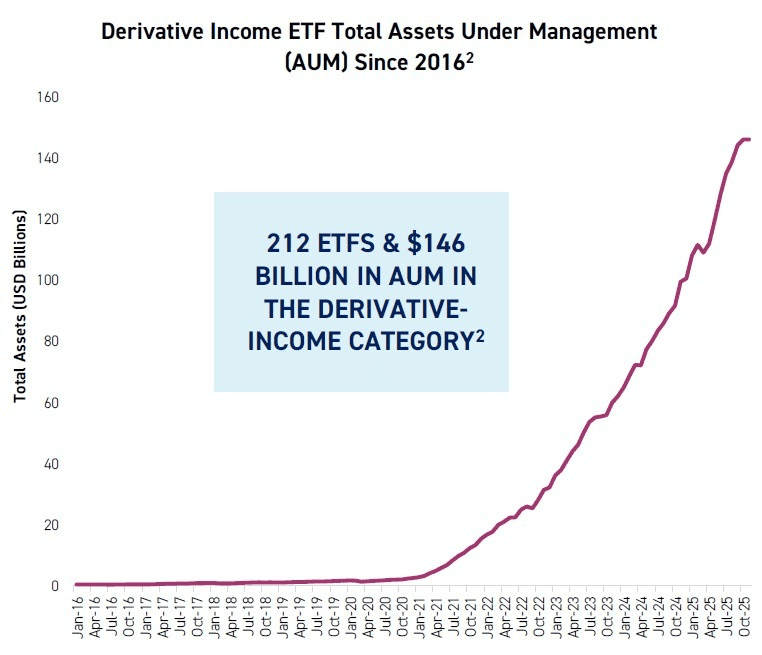
This trend is not limited to crypto. Options income ETFs have become one of the fastest-growing segments of the global ETF market. Strategies that harvest income by selling call options and often referred to as covered call or premium income strategies have attracted significant investor flows in recent years, particularly in a higher interest rate and volatile market environment.
Products such as the JPMorgan Equity Premium Income ETF have helped establish the model at scale, demonstrating demand for strategies that prioritise cash flow and downside cushioning over full participation in market upside. As of 2025, the segment has grown to more than $180 billion in assets, according to Strategas.
Goldman’s approach applies the same framework to Bitcoin, an asset class historically characterised by high volatility and limited income generation. By introducing an options overlay, the ETF aims to reshape how investors access crypto exposure particularly for those seeking more controlled return profiles.
The move also reflects increasing competition among major asset managers, including BlackRock and Morgan Stanley, to expand product offerings around digital assets within regulated ETF structures.
Source: Morningstar data; KraneShares, latest available
ETF Trend Extends to GCC Markets
The strategy is already beginning to appear in regional markets. The recently launched KraneShares Wahed Alternative Income Index ETF (KWIN), listed on Abu Dhabi Securities Exchange (ADX), applies a similar options-based income approach, but within a Shariah-compliant framework.
KWIN generates income by implementing a structured options strategy, specifically combining equity exposure with options overlays designed to produce consistent cash flow. While derivatives are used in the process, the structure is designed to remain compliant with Islamic finance principles through screening, structuring, and oversight.
While KWIN focuses on U.S. equities rather than crypto, the underlying concept is comparable: harvesting income from volatility rather than relying purely on capital appreciation. This highlights how options-based ETFs are evolving into a cross-asset strategy, spanning equities and now extending into digital assets.
Trade-Offs Remain
Despite their growing popularity, such strategies come with clear trade-offs. Selling options generates steady income but typically limits upside participation during strong market rallies. In volatile downturns, the income collected may also not fully offset declines in the underlying asset.
For Bitcoin in particular, where sharp directional moves are common, this balance between income and upside will be a key consideration for investors.
The Bigger Picture
Goldman’s filing underscores a broader shift in the ETF industry toward outcome-oriented products, strategies explicitly designed to deliver income, manage volatility, or shape return profiles.
What began as a niche approach in equity markets is now expanding across asset classes, with crypto becoming the latest frontier.
For investors, the development is less about Bitcoin itself and more about how financial engineering is redefining access to traditionally volatile assets turning them into structured exposures aligned with specific investment objectives.