

On Abu Dhabi Securities Exchange (ADX), the Initial Offering Period (IOP) is the short window, typically several market days. When an exchange-traded fund (ETF) accepts initial subscriptions before it lists and starts trading on the exchange. In this primary phase, investors apply for new ETF units at the offering price via ADX’s eIPO portal and/or through authorized participants (APs); allotted units are then credited and the ETF lists shortly after the window closes. ADX’s issuer guidance describes the lifecycle succinctly: “end-to-end… from IOPs to Listing,” culminating with units available for secondary trading on ADX.
Who can subscribe and how?
Two channels are commonly used during the IOP:
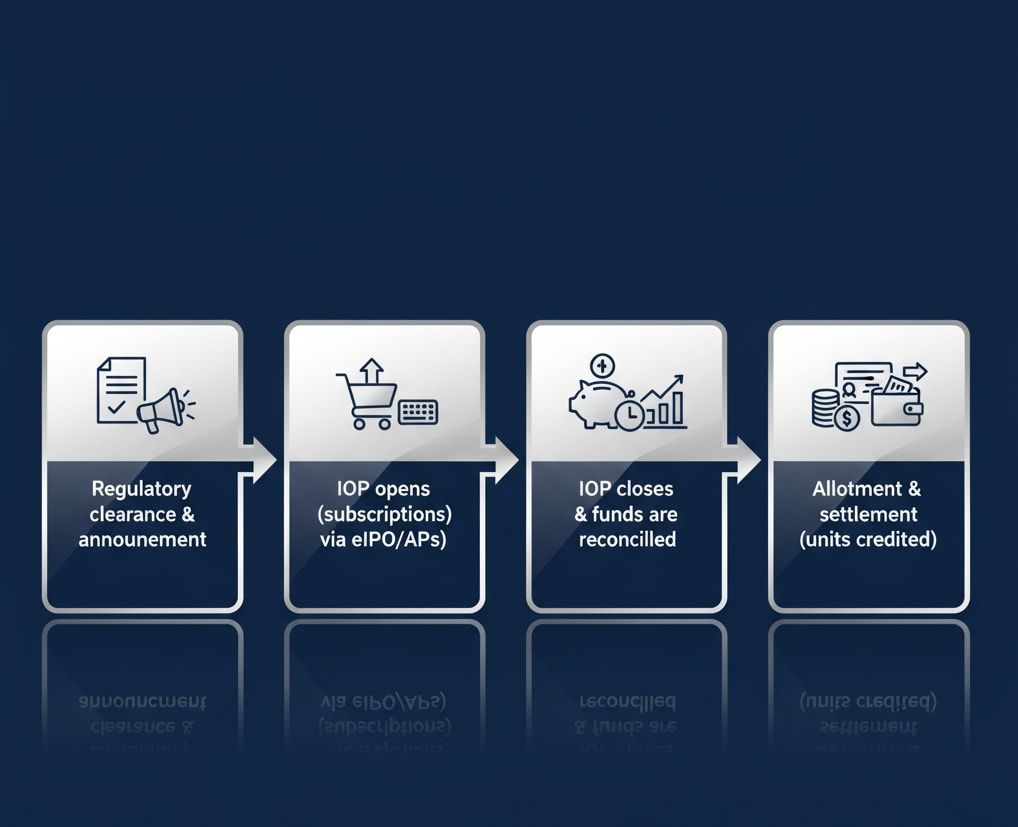
- eIPO (for individuals and institutions): Investors with a National Investor Number (NIN) and a UAE bank account can apply online in the eIPO portal during the subscription window. Funds must settle into the designated subscription account before the cut-off; incomplete funding means the application is not processed.
- Authorized Participants (APs): Market intermediaries (broker-dealers/banks) that stand between the fund and primary market demand. ADX communications for recent IOPs list APs such as International Securities, Arqaam, EFG Hermes UAE, BHM Capital, Daman, and FAB Securities.
For illustration, the Boreas Solactive Quantum Computing UCITS ETF set a six-day IOP, explicitly defining the IOP as the period when initial subscriptions commence before listing. Another case, Lunate/Chimera’s JP Morgan Global Sukuk ETF, ran an IOP 25 June–2 July 2024 with a US$1 (AED 3.67) per-unit offering price and allowed subscriptions via eIPO or listed APs. These examples show the mechanics and typical window length in practice.
Pricing, allocation, and settlement
IOP documentation (the prospectus/KID and ADX notices) sets the offering price,often a round figure like US$1 per unit in fixed-income or money-market style ETFs, the subscription lot size, and allocation rules if demand exceeds supply.
After the window closes and applications are reconciled, ADX’s post-trade process settles and credits units to investor accounts ahead of the listing date; the ETF then moves to the secondary market (ADX Growth Market for new ETFs), where live intraday pricing and market making take over.
Roles in the IOP and what each party does
- Issuer/Manager: Files an Arabic prospectus with the Securities and Commodities Authority (SCA) for approval, coordinates the IOP timetable, appoints market makers/APs, and sets offering details.
- SCA & ADX: The SCA reviews and clears the public offering documentation; ADX handles the eIPO plumbing, account crediting, and listing/market-ops.
- Authorized Participants (APs): Create units by delivering the in-kind basket (or cash) during IOP and, later, on an ongoing basis post-listing. ADX’s issuer page outlines the flow from AP creation to settlement and crediting.
- Market Makers: Provide continuous two-sided quotes post-listing to support liquidity and tighter spreads. Licensing and participation rules are published by ADX.
Timeline: what to expect
Why the IOP exists for ETFs (vs an IPO for equities)
Unlike a corporate IPO, where new shares are sold once and then trade freely, ETFs require an ongoing primary market creation/redemption mechanism. The IOP jump-starts the fund’s seed assets and initial unit holders so that post-listing market makers and APs can keep units aligned with net asset value (NAV) via creations/redemptions. ADX explicitly maps this from “IOPs to listing” and into the secondary market.
Investor protections, disclosures, and caveats
All subscription terms, including dates, pricing, minimum investment amounts, eligibility criteria, and allocation or proration rules, are determined by the prospectus and official ADX notices, which investors should review carefully before subscribing.
The funding process also demands precision, as eIPO applications are automatically voided if the full subscription amount is not deposited into the designated account before the deadline. Liquidity conditions can vary during the early days of trading; bid-ask spreads are generally tightest when authorized participants and market makers are fully engaged following the listing, while thinner participation may initially result in wider spreads.
ADX establishes the overall framework and licenses market makers to maintain orderly and efficient trading once the ETF becomes active on the exchange.
Recent ADX IOPs, evidence from the tape
- Chimera iBoxx US Treasury Bill ETF (listing announced 20 Feb 2025): subscriptions during the IOP were routed via a roster of APs before listing.
- Chimera S&P Japan UCITS ETF (May 2024): subscriptions from 16–23 May via eIPO and four APs; listing 29 May.
- Boreas Quantum Computing UCITS ETF (Sep 2025): IOP 10–16 Sep 2025 before ADX listing; documents define IOP clearly for investors.
Market scale context: By end-Aug 2025, market cap of ADX-listed ETFs doubled YoY to AED 1.7bn a sign that IOP-to-listing throughput is growing.
How ADX’s IOP compares globally
The IOP concept is not unique to Abu Dhabi; Hong Kong also uses “ETF IOP” terminology and a subscription workflow ahead of first trade, underscoring a shared global playbook for seeding ETF liquidity.
A timely global footnote: in the US, regulators have just cleared the way for ETF share classes, which may change how some funds come to market there.
That’s a different mechanism from Abu Dhabi’s IOP (it merges ETF and mutual-fund share classes within one portfolio), but it highlights how issuance models vary by jurisdiction while pursuing the same goal: efficient primary issuance and liquid secondary trading.
Practical takeaways for issuers and investors
For issuers and investors, the ADX IOP process requires a blend of preparation and precision. Issuers are encouraged to secure authorized participants and market makers well in advance, publish transparent IOP terms covering dates, pricing, and settlement details, and coordinate closely with both the Securities and Commodities Authority (SCA) and ADX to prevent last-minute operational frictions.
On the investor side, participation through the eIPO platform requires a valid National Investor Number (NIN) and a UAE bank account, unless the subscription is made through an authorized participant, and it is essential that funds are deposited before the deadline to avoid application rejection.
Liquidity typically strengthens once the ETF is listed and authorized participants and market makers commence continuous quoting, transforming the IOP from the initial seeding phase into an active secondary market where bid-ask spreads naturally tighten.