

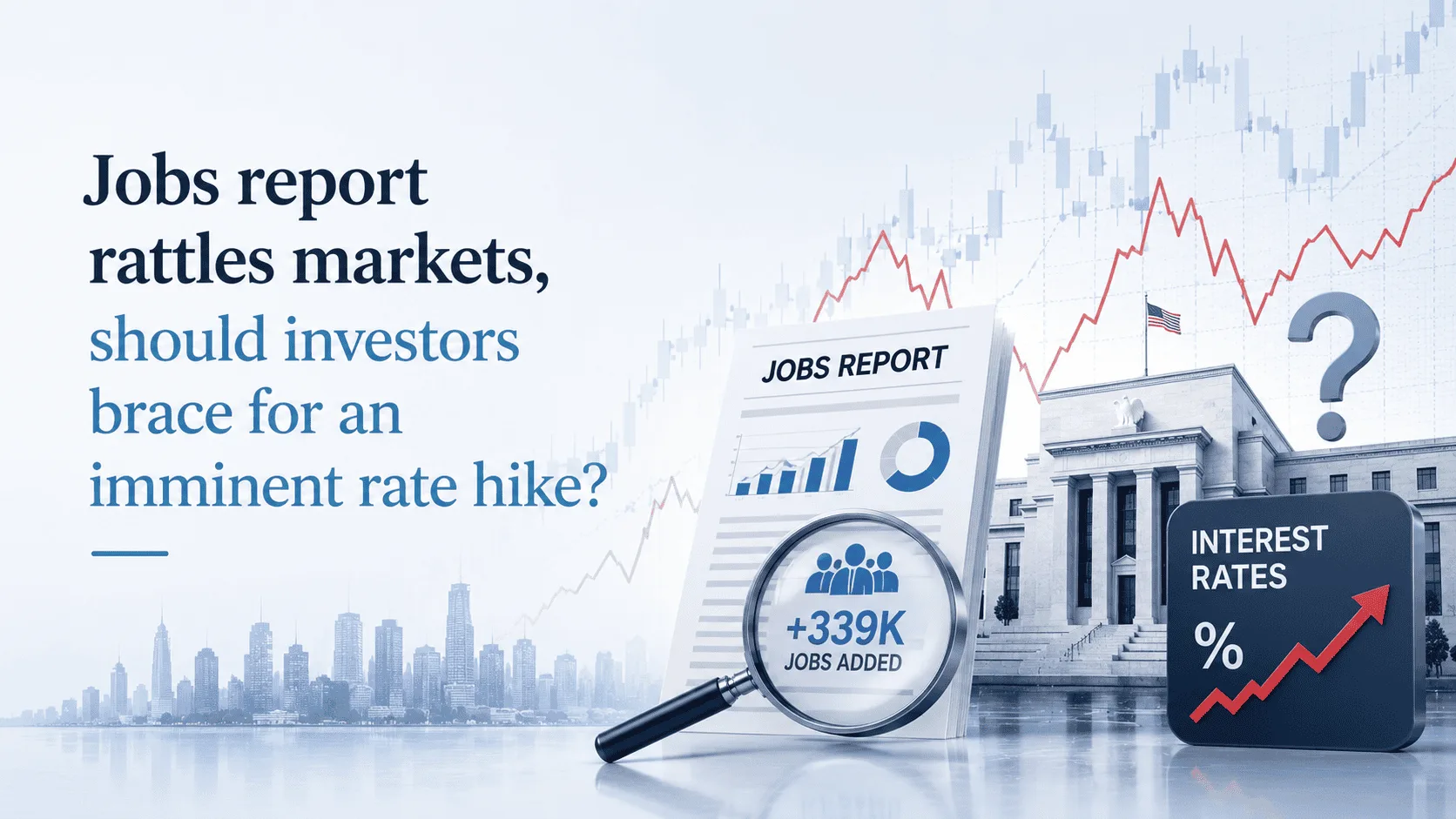
A stronger-than-expected U.S. jobs report has shaken global markets and reignited concerns that interest rates could remain higher for longer. While the data points to a resilient U.S. economy, investors quickly reassessed the likelihood of near-term rate cuts, sending Treasury yields higher and equity markets lower.
For GCC investors, the implications are particularly important because most Gulf currencies remain closely linked to the U.S. dollar, meaning monetary policy decisions in Washington often ripple across the region.
What Did the Jobs Report Reveal?
US employers added 172,000 nonfarm payroll jobs in May, nearly double forecasts of around 85,000, while the unemployment rate held at 4.3%. Payrolls for March and April were also revised upward by a combined 93,000, confirming a labour market that has firmly reaccelerated after losing a net 42,000 jobs between June 2025 and February 2026.
Is the Labor Market as Strong as the Headline Suggests?
The headline payroll number was undeniably strong, but the underlying details paint a more nuanced picture.
Leisure and hospitality and local government accounted for approximately 73% of May's job gains. Meanwhile, long-term unemployment continued to rise, and some cyclical private-sector industries remained relatively soft.
Why Did Markets React So Sharply?
Investors interpreted the stronger-than-expected jobs report as reducing the urgency for the Federal Reserve to cut interest rates. As expectations for policy easing diminished, Treasury yields rose sharply while equities sold off.
Market Reaction at a Glance
Rate-cut odds for 2026 collapsed to just 1.1% on the CME FedWatch tool. Futures markets sharply reduced expectations for rate cuts and increased the probability of further policy tightening following the jobs report. The 2-year Treasury, the most policy-sensitive maturity, surged above 10 basis points to 4.16%, a one-year high. The 10-year broke above the 4.5% psychological threshold to 4.54%. Both 20- and 30-year yields crept further above 5%.
Can the US Equity Rally Withstand Higher Rates?
Before the jobs report, US equity markets had built exceptional momentum in 2026 gains that many GCC investors and sovereign funds participate in through broad US ETFs such as SPY and QQQ. The strong payroll data has now raised the prospect that interest rates could stay higher for longer, challenging one of the key drivers behind this rally.
The gap between the two tells the story: QQQ’s near-double YTD outperformance versus SPY reflects a tech-dominated rally built on AI investment themes and expectations of lower rates. Higher-for-longer rates directly compress the long-duration valuations that have driven that premium. On report day alone, the Nasdaq fell 4.2%, almost double the S&P 500’s 2.6% drop, previewing what a full rate-hike cycle would look like for QQQ holders.
Why Does This Matter for GCC Investors?
Most GCC countries maintain currencies that are pegged to the U.S. dollar. As a result, regional central banks generally align monetary policy with the Federal Reserve to preserve currency stability.
Kuwait remains a notable exception within the GCC because the Kuwaiti dinar is linked to a basket of currencies rather than a strict U.S. dollar peg, giving policymakers somewhat greater flexibility.
If U.S. rates remain elevated, borrowing costs across much of the GCC are likely to stay higher as well.
Which GCC Sectors Could Benefit?
Higher interest rates do not affect all sectors equally.
Banks are generally among the biggest beneficiaries because higher rates can support net interest margins and profitability. By contrast, property-related sectors often face pressure from higher financing costs and slower credit growth.
What Does This Mean for GCC ETF Investors?
Unlike the U.S. market, where technology companies dominate major indices, GCC equity markets tend to have significant exposure to financial institutions, energy companies, telecom operators, and industrial firms.
This sector composition could make some GCC-focused ETFs more resilient in a higher-rate environment than growth-heavy global equity funds.
Saudi-focused strategies may benefit from substantial exposure to banks and diversified financial institutions, while UAE-focused products could see a more mixed impact given their greater exposure to both financials and real estate.
What Could Shape the Fed's Next Move?
The Bottom Line
The latest U.S. jobs report has reinforced the view that interest rates could remain higher for longer. While that does not necessarily mean another rate hike is imminent, it has reduced expectations for near-term policy easing and reminded investors that inflation remains a key concern.
For GCC investors, the message is clear: a prolonged higher-rate environment may continue to support banks and other financial institutions, while creating challenges for rate-sensitive sectors such as real estate. For ETF investors, sector composition matters, and funds with greater exposure to financials may be better positioned than those heavily reliant on financing-sensitive industries.
Rather than focusing solely on whether rates rise again, investors should pay close attention to inflation trends, oil prices, and regional earnings growth factors that will ultimately determine how GCC markets perform through the remainder of the year.