

July 23, 2026, Dow Jones futures were little changed in overnight trade following Wednesday's close, while S&P 500 and Nasdaq-100 futures slipped as Alphabet (GOOGL) and Tesla (TSLA) both fell after posting second-quarter results. Despite broadly strong operating results, investor attention shifted almost entirely to accelerating AI infrastructure spending, reigniting unease over the cost of the AI buildout even as chip and AI hardware names mostly held up and, in some cases, rallied.
Overnight Market Snapshot
Wednesday's regular session was mixed-to-lower: the Dow eased 0.01% but held its 21-day line, the S&P 500 slipped 0.14% while remaining above its 50-day moving average, the Nasdaq Composite fell 0.6%, and the small-cap Russell 2000 dropped 0.9%, slipping below its 21-day line and closing in on its 50-day. Crude oil continued its sharp advance, rising roughly 3% to $86.83 a barrel in the cash session, a gain of about 10% over the past four sessions as the U.S. carried out an 11th consecutive night of airstrikes against Iran. Overnight futures pushed crude above $88. The 10-year Treasury yield rose three basis points to 4.66%, nearing an 18-month high and moving in tandem with oil.
Despite the selloff in technology shares, the Invesco QQQ Trust (QQQ) remained one of the market's most liquid ETFs. According to Nukoud, the fund averaged 39.06 million shares traded per day over the past month, with average daily volumes of 37.05 million over one week, 42.75 million over three months, and 53.26 million over one year. QQQ also maintained a tight 0.01% average bid-ask spread, underscoring its deep liquidity as investors repositioned around Big Tech earnings and AI-related developments.
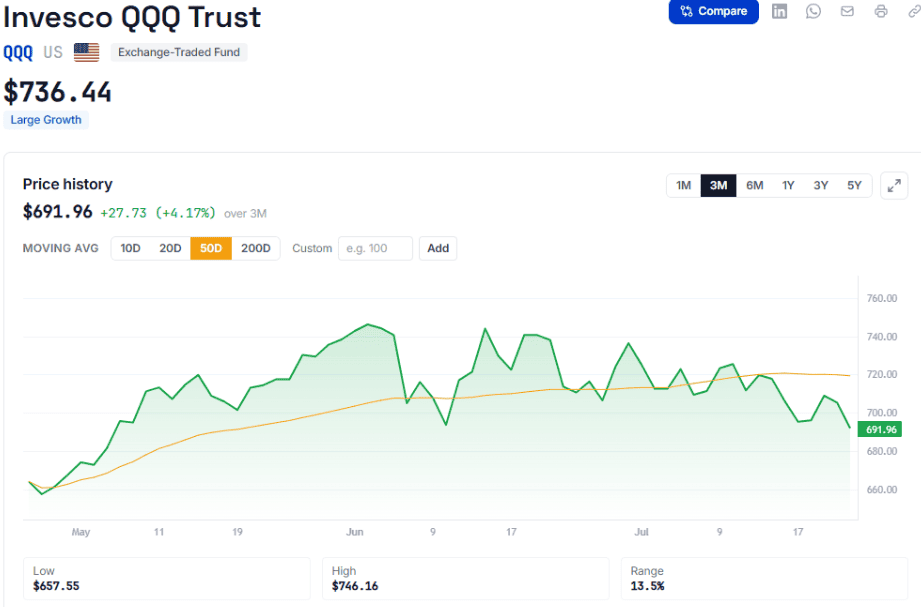
QQQ Trading & Liquidity (as of Jul. 23, 2026)
Alphabet Delivers Strong Growth, but Capex Steals the Spotlight
Alphabet delivered a strong second quarter, with revenue rising 24% year over year to $119.8 billion, driven by accelerating Google Cloud growth and continued momentum across its AI businesses. Google Cloud revenue surged 82% to $24.8 billion, reflecting strong demand for AI infrastructure and enterprise AI solutions. Net income available to common stockholders increased 298% year over year to $112.1 billion, while diluted EPS rose 294% to $9.11. Alphabet also disclosed that other income included a $98.0 billion gain on equity securities, which increased diluted EPS by $6.26. Excluding that one-time gain, diluted EPS would have been approximately $2.85, providing additional context for the headline EPS growth and the company's underlying operating performance.
Alphabet raised its 2026 capital expenditure guidance to $195 billion–$205 billion, up from the previous $180 billion–$190 billion range, and reiterated that capital spending is expected to increase significantly again in 2027. Despite the strong operating performance, the higher spending outlook became the primary focus for investors as Alphabet continued expanding its AI infrastructure investments.
Alphabet's elevated AI spending also weighed on cash generation. The company reported its first quarterly negative free cash flow on record, reflecting the scale of its AI infrastructure investments. The sharp deterioration in free cash flow underscores how rapidly capital expenditure has accelerated as Alphabet expands its AI infrastructure. Combined with the higher capital expenditure outlook, the results reinforced management's willingness to prioritize long-term AI leadership over near-term cash flow. The additional disclosure around the one-time equity gain also provides useful context for interpreting the headline earnings figures, which were significantly boosted by non-operating income.
Google shares fell 1.5% to $342.09 in Wednesday's regular trading session, extending losses below the 50-day moving average. The stock weakened further in after-hours trading as investors reacted to the company's higher capital expenditure guidance. Fellow hyperscalers Microsoft, Amazon, and Meta also edged lower in sympathy, with their own capex updates due next week, a key overhang for the broader AI trade.
The higher spending wasn't viewed as entirely negative, however. While the surge in AI investment pushed Alphabet into negative free cash flow for the quarter, it also reinforced demand across the AI supply chain, including chips, servers, networking equipment, and memory, helping several AI hardware stocks move higher even as Alphabet shares declined.
Tesla's Growth Story Faces a Cash Flow Test
Tesla's quarter presented a contrasting picture: strong operational momentum but a weaker bottom line. Q2 EV deliveries improved substantially, and earnings grew from the prior year, but the results still fell short of Wall Street's consensus estimates. More notably, Tesla burned cash for the first time in years a smaller shortfall than feared, but a milestone nonetheless as capital spending rose (though by less than expected) alongside tighter core automotive margins.
On the call, CEO Elon Musk struck a cautious tone on the pace of robotaxi expansion and Optimus humanoid-robot development, while pledging "massive" capex ahead. He specifically credited Micron Technology's memory chips as a beneficiary of AI infrastructure demand.
Sister company SpaceX had a rough session independently, closing down 6.7% to $115.26, a fresh low and nearly half its June 16 peak of $225.64, and now well below its $135 IPO price before edging higher in after-hours trading. Media reports have linked Tesla and SpaceX to a chip initiative referred to as "Terafab," although neither company has officially confirmed the project. Reports have also speculated about closer collaboration between Elon Musk's companies, but no formal merger plans have been announced.
UAE AI and Quantum ETFs Reflect Big Tech Volatility
The market's response to Alphabet's and Tesla's earnings extended to UAE-listed technology ETFs, as concerns over rising AI investment costs weighed on AI infrastructure strategies while quantum computing funds faced heightened volatility.
The Lunate AIPOWR UCITS ETF (AIPOWR), which tracks companies involved in AI-related data center and power infrastructure, declined 3.14% over the past month as investors reassessed the pace of AI infrastructure investment. Despite the recent pullback, the fund remained 10.70% higher year-to-date, reflecting continued long-term confidence in AI infrastructure demand.
The Boreas Solactive Quantum Computing UCITS ETF (QUANTM) fell 24.27% over the past month, highlighting the higher volatility associated with emerging technology themes. Even so, the fund remained 9.98% higher year-to-date, suggesting that investor interest in quantum computing continues despite recent market turbulence.
AI Infrastructure Emerges as the Bright Spot
Even as the two megacaps that reported Wednesday fell, several names tied to AI infrastructure demand moved higher, underscoring that investors are rotating within the AI trade rather than abandoning it. Super Micro Computer surged on a record order backlog, pulling AI-server peer Dell Technologies higher alongside it. AMD gained on news of a chip supply deal with Anthropic. Separately, OpenAI reportedly plans a significant expansion of its data-center footprint alongside substantially higher long-term AI spending. This data point reinforces the broader infrastructure-demand narrative even as individual hyperscaler results were mixed.
On the downside, GE Vernova fell on mixed results and concerns that its own expansion plans may be outpacing demand, a reminder that capex-driven scrutiny is not confined to the AI megacaps alone.
What To Watch Next
With the S&P 500 and Nasdaq sitting on opposite sides of their 50-day lines, market leadership remains narrow and highly dependent on AI-related earnings heading into a dense stretch of Big Tech reports, including Microsoft, Amazon, and Meta next week. Investors will be watching closely whether AI monetization, particularly cloud growth, can keep pace with the scale of capex now being committed by hyperscalers, and whether oil's rapid climb feeds through to broader inflation expectations. Until that picture clarifies, the more actionable stance is likely to stay defensive on new positions, keep watchlists updated, and let confirmed leadership emerge from the earnings cycle rather than anticipate it.
Bottom Line
Alphabet and Tesla delivered solid operating results, but investors focused less on earnings and more on the rising cost of AI. Alphabet's higher capital spending plans and Tesla's return to negative free cash flow underscored the enormous investment required to stay competitive in AI and next-generation technologies. Even so, the market reaction highlighted a growing divide: while software and the megacaps came under pressure, companies supplying AI infrastructure continued to benefit from robust spending expectations. With Microsoft, Amazon, and Meta reporting next week, the broader market's direction will depend on whether strong AI demand continues to justify accelerating capital expenditure.