


Authored by Gerald Blondel-CMSA
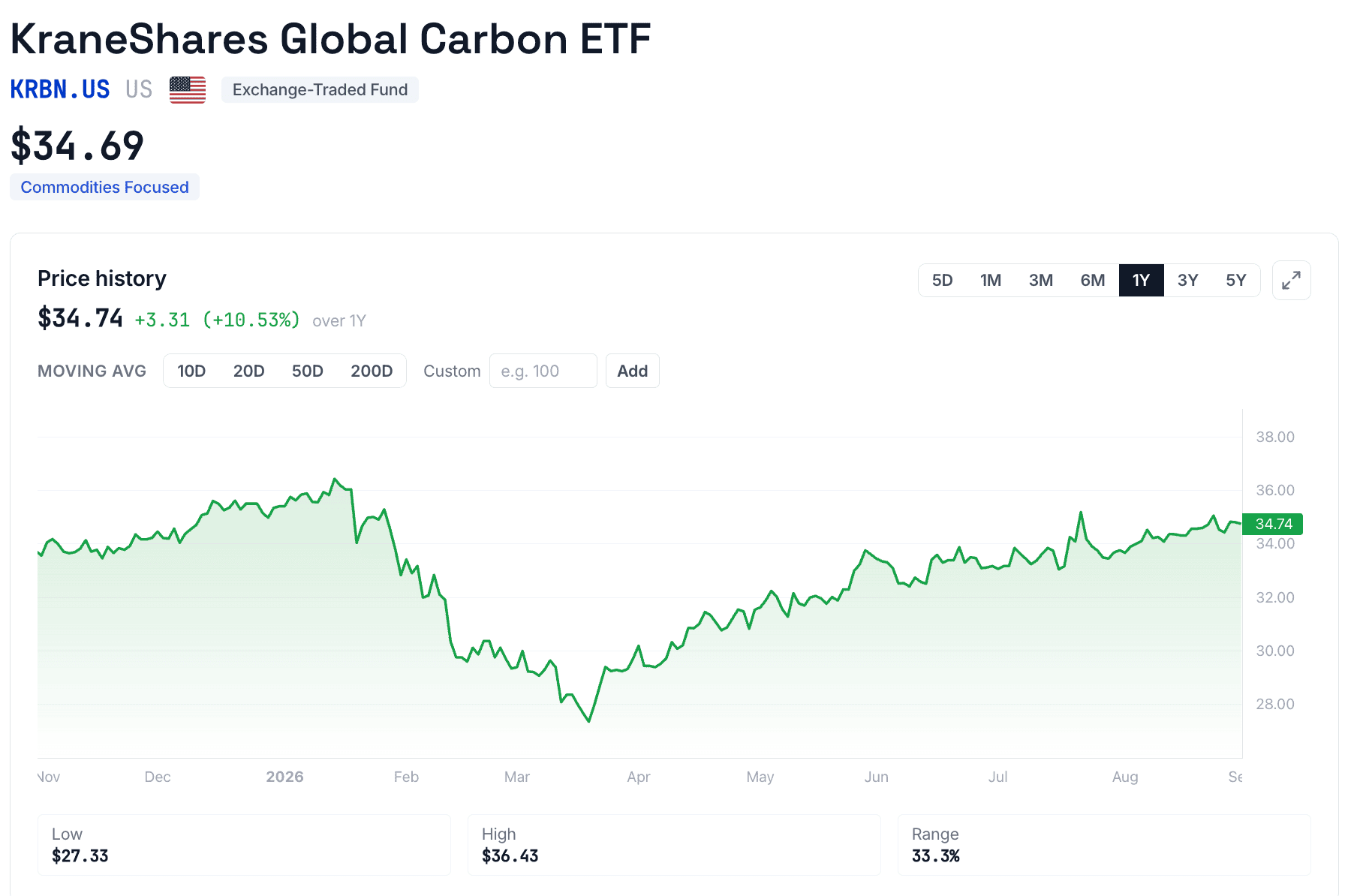
The KraneShares Global Carbon Strategy ETF (KRBN) has disappointed investors who bought into the powerful carbon-price rally of 2020–21. After an exceptional 2021, when the fund’s NAV rose 108.8%, returns turned sharply: -10.5% in 2022, a modest 6.6% in 2023, and uneven performance thereafter. An investor who bought five years ago would have seen a small overall loss by early August 2026.
It is tempting to blame US policy, especially given the change in Washington’s attitude toward climate regulation and the political pressure facing state-led carbon programmes. But that explanation is incomplete. US policy has added a risk premium to North American carbon allowances; it is not the principal reason KRBN has failed to match the original bull-case expectations.
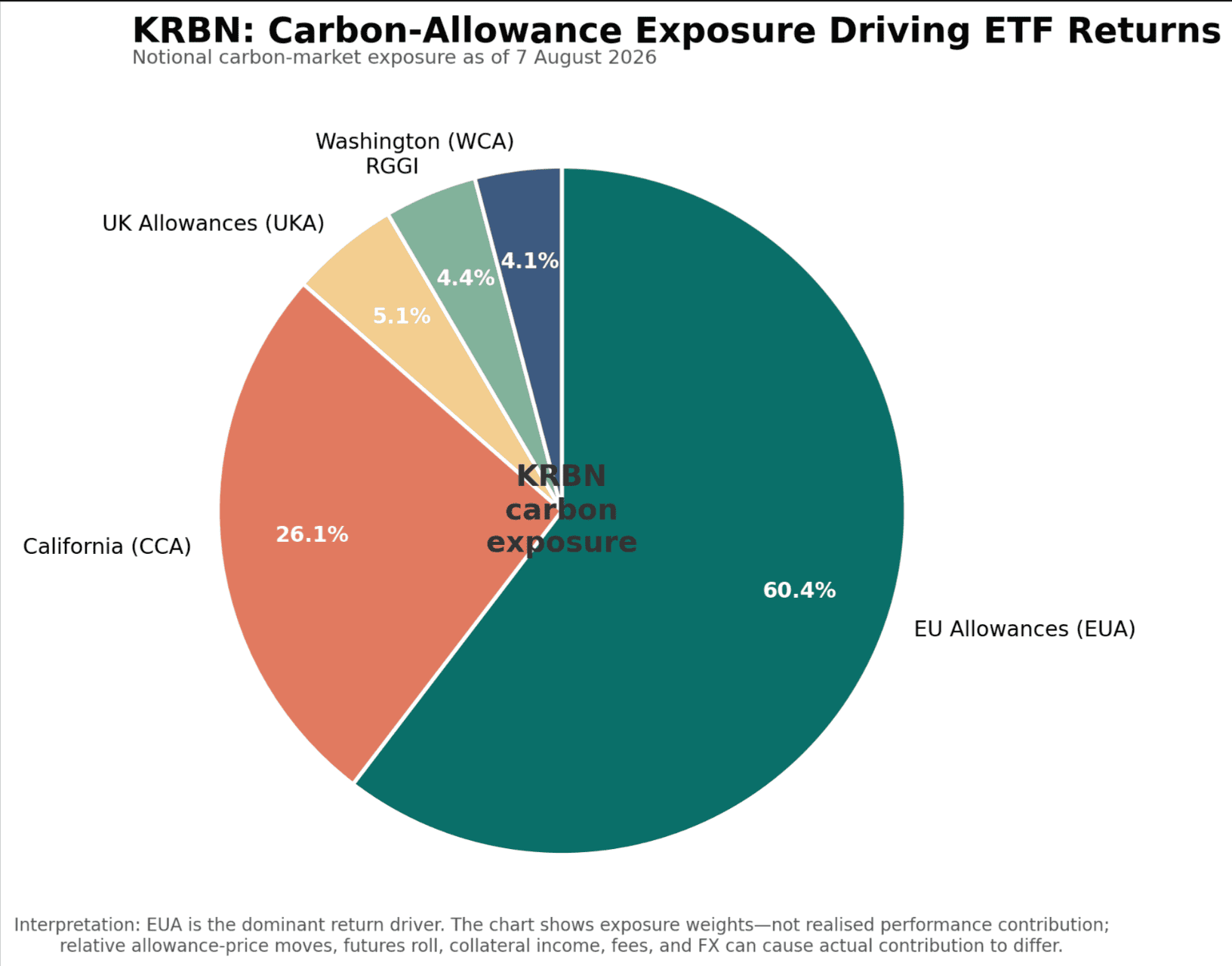
The first point investors should remember is that KRBN is not a US carbon ETF. It tracks the S&P Global Carbon Credit Index through futures linked to regulated allowance markets, and its portfolio is dominated by European Union Allowances (EUAs). At the end of July, EUAs accounted for roughly 59% of NAV, while California Carbon Allowances made up about 26%; the UK, RGGI and Washington represented smaller allocations. The ETF’s direction is therefore still primarily an EUA story.
That matters because the European market experienced a major reset after the 2021 boom. The Russia-Ukraine energy shock weakened European industrial activity and altered power-market dynamics. As industrial production and electricity demand slowed, compliance demand for allowances fell. At the same time, the EU changed the short-term supply profile of its carbon market to fund REPowerEU, selling allowances earlier to finance the bloc’s energy-security and transition measures.
REPowerEU is the European Union’s energy-security and clean-transition plan, launched in May 2022 after Russia’s invasion of Ukraine exposed Europe’s dependence on Russian fossil fuels. Its objectives are to cut energy use, diversify supply, and accelerate renewables, electrification, grids, storage and energy efficiency.
From July 2023 to August 2026, the European Commission redirected part of Member States’ auction supply and the Innovation Fund to raise €20 billion for REPowerEU. This was not a permanent abandonment of the EU ETS scarcity model, but it was a meaningful near-term supply shock. More permits were auctioned while the market was already confronting weaker industrial demand. The result was a lower carbon-price environment and a damaged investor narrative.
The policy lesson is uncomfortable: carbon allowances are not merely an environmental asset. They are policy-created commodities. Their valuation depends on the trajectory of the emissions cap, auction volumes, banking behaviour, fuel switching, weather, economic activity and regulatory credibility. A structurally tighter cap can be overwhelmed, at least temporarily, by weaker demand or an unexpected change to the supply calendar.
US policy still matters. The absence of a nationwide US carbon market means KRBN’s American exposures depend on California, RGGI and Washington. Federal hostility toward climate regulation can increase litigation risk, discourage long-term allocations and create uncertainty around future tightening. That uncertainty deserves a discount in valuation. Yet it should not be confused with a direct dismantling of the programmes themselves: these are state or regional schemes with their own legal and political foundations.
The more balanced conclusion is that KRBN’s weakness has been mostly a global carbon-market and European policy problem, with US political risk acting as an additional headwind. Investors expecting a simple, long-only decarbonisation trade were caught by a far more complex reality: short-term policy intervention and cyclical demand can dominate the long-term scarcity thesis.
Where KRBN is going
In February 2026, I gave a floor of $27.50. It touched $27 on March, 19th and bounced back.
There is no conventional intrinsic value for KRBN: it is a futures-based exposure to regulated carbon allowances. So, working a valuation isn’t straight forward.
A sensible Q3–Q4 2026 fair-value range is $33–$38, with $35–$36 as a base-case midpoint, very close to its $34.52 close on 7 August.
Fair-value framework
KRBN’s price should be estimated as a weighted change in its underlying allowance markets, adjusted for futures roll, collateral income, fees and FX, not through a P/E or discounted-cash-flow valuation.
Target KRBN ≈ 34.52 × (0.604 REUA + 0.261 RCCA + 0.051 RUKA + 0.044 RRGGI + 0.041 RWCA)
EUA is the decisive variable: it accounts for approximately 60.4% of exposure. California adds 26.1%, so these two markets drive about 86.5% of the outcome.
The base case reflects an EUA market already around €83.29 on 7 August, while one contemporaneous macro forecast estimated €84.41 by the end of Q3 suggesting limited near-term EUA upside without a stronger scarcity catalyst. For California, the key uncertainty is the post-2030 programme design: market debate has centered on a potential 2026 allowance price above $100 under a sharply tightening trajectory, but that outcome depends on policy decisions rather than current spot-market pricing.
What would change it
The $35–$36 midpoint is reasonable if today’s carbon-market structure persists. It is not a call that KRBN will necessarily trade there every day; it is the level consistent with broadly unchanged EUA and CCA prices.
Move toward the $39–$44 range only if investors gain confidence that EUA scarcity will reassert itself after the REPowerEU auction effects fade, and that North American programmes retain credible tightening paths.
Conversely, a renewed European industrial slowdown, further carbon-supply intervention, or adverse California policy signals would make the high-$20s to low-$30s defensible.
Disclaimer
This material is provided for informational and educational purposes only and does not constitute investment advice, research, a recommendation, or an offer to buy or sell any security, fund, derivative, carbon allowance, or other financial instrument.
Any views, forecasts, price targets, scenarios, and calculations are opinions based on information believed to be reliable at the time of writing. They are inherently uncertain and may change without notice. KRBN and carbon-allowance markets can be volatile and are influenced by regulatory decisions, auction supply, economic activity, energy prices, liquidity, futures-roll effects, currency movements, and other factors.
Past performance is not indicative of future results. Investors may lose some or all of their capital. You should conduct your own due diligence and consult a qualified financial, legal, tax, and investment adviser before making any investment decision.