


Quick Summary
-Steeper Curve Opens Opportunities: Short-term yields fell more than long-term, aiding duration-sensitive ETFs.
-GCC Bonds Stay Attractive: Gulf rate cuts mirror the Fed, but sukuk still offer higher yields.
-Risks Loom Large: Inflation, jobs, and global shocks could blunt bond gains.
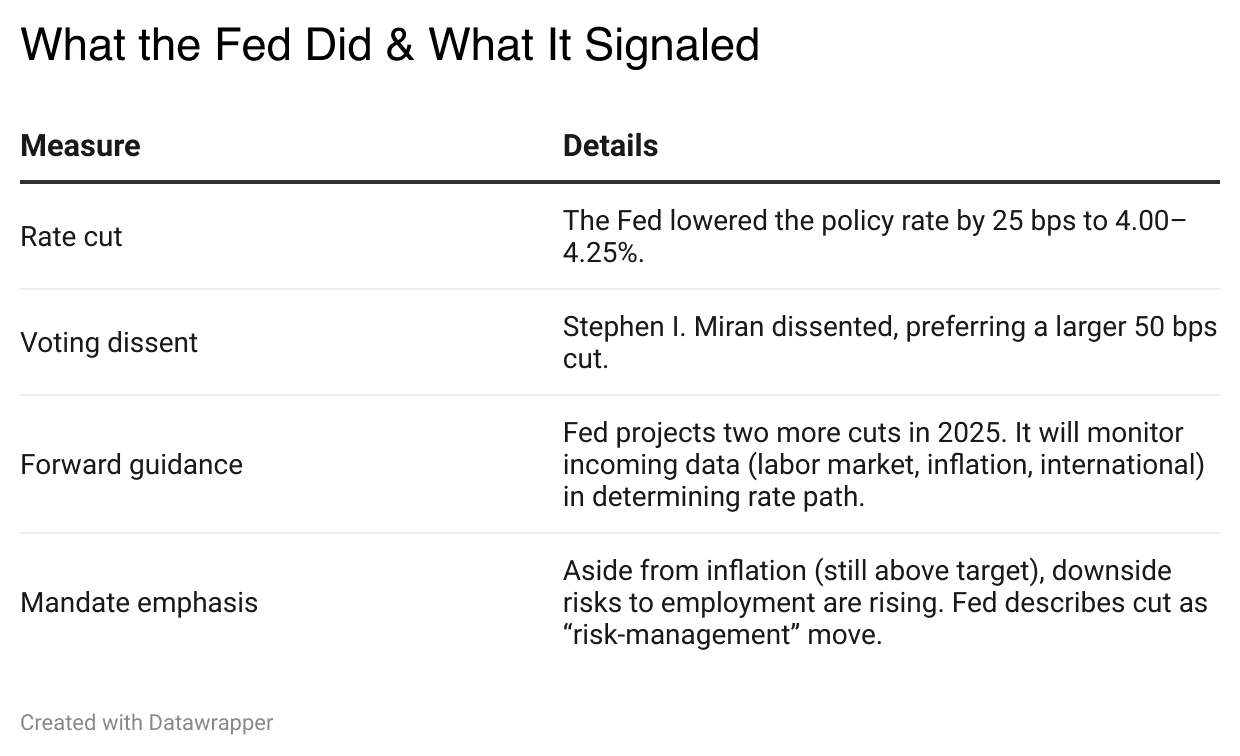
On September 17, 2025, the U.S. The Federal Reserve (Fed) lowered its target federal funds rate by 25 basis points to a range of 4.00% to 4.25%, marking its first rate cut since December 2024.The Fed also signaled two more cuts later this year, while acknowledging the job market is weakening and inflation remains elevated.
For global and GCC fixed income (bonds, sukuk) investors as well as ETF holders, this shift has important implications:
(1) yields on U.S. Treasuries and related instruments are likely to adjust lower
(2) bond prices (especially existing ones with higher coupons) may benefit
(3) ETFs that are bond-oriented or sensitive to rates will see differentiated impact depending on duration, credit risk, and geographic exposure
(4) GCC economies largely pegged to the U.S. dollar are likely to follow suit in easing, with consequences for local borrowing, savings, and asset allocation.
Bond Market Impacts Globally
U.S. Treasuries and Rates
- The 10-year Treasury yield was about 4.08% going into the Fed decision (ahead of it) and has hovered around similar levels, giving some indication that long-term yields haven’t collapsed; they have shown modest downward drift.
- The 2-year yield fell by ~ 11 basis points in the days leading into and immediately after the Fed decision, reaching approx 3.47% ahead of the cut.
- The 30-year Treasury yield dropped about 7 bps in that stretch (from just above ~4.85-4.90% down to ~4.78%) as markets anticipated easing.
- Yield curve steepness (for example, between 5- and 30-years) widened: the 30-year vs 5-year spread was around 123 basis points.So: short-term yields (2-year, front end) fell more sharply; long-term yields eased but not as much, reflecting inflation / fiscal / growth uncertainties.
Bond ETFs & Fixed Income Flows
- In the leadup to the cut, taxable bond ETFs saw record monthly inflows of about US$43 billion (in August, ahead of expectations of the cut).
- After the cut, in the week ending September 10 (just before the cut), bond mutual funds + ETFs saw inflows of US$2.371 billion, with ETF flows alone about US$1.963 billion. This was a sharp increase from US$429 million the week prior to that.
- Some bond ETFs whose long-duration exposure benefitted included:
• The iShares 20+ Year Treasury Bond ETF (TLT) whose year-to-date return had moved up to ~ 4.1% by then.
• The iShares 7-10 Year Treasury Bond ETF (IEF) had a YTD return of ~ 7.5%.
• The iShares 1-3 Year Treasury ETF (SHY) had been about 3.9% YTD by those reports.
GCC Monetary Policy in Lockstep with the Fed
Because most Gulf currencies including the UAE dirham and the Saudi riyal are pegged to the U.S. dollar, local central banks typically mirror the Federal Reserve’s policy moves to maintain monetary stability.
In the wake of the September cut, Saudi Arabia reduced its repo and reverse repo rates to 4.75 percent and 4.25 percent, respectively. The UAE followed by lowering its overnight deposit facility rate to about 4.15 percent, while Qatar, Bahrain, Oman, and other Gulf states also eased their key benchmarks by 25 basis points.
The immediate effect of these moves is lower borrowing costs for governments and corporations across the region. As benchmark rates decline, the yields on newly issued Gulf bonds and sukuk also fall, reducing financing costs for issuers.
For global investors, however, sukuk and sovereign bonds from the region may become more appealing. Even after recent cuts, GCC debt still offers relatively higher yields than comparable U.S. instruments, and the potential for further yield compression creates opportunities for capital gains on existing holdings.
For savers within the Gulf, the picture looks different. Falling deposit and money-market rates will erode returns on cash, reducing the income available from short-term instruments. This shift is likely to push some investors toward longer-term fixed income or dividend-yielding exchange-traded funds (ETFs) as they seek to preserve income streams in a lower-rate environment.
What Could Go Wrong
A key risk for bond investors is inflation persistence. If consumer prices remain above target driven by energy costs, housing, or sticky services inflation the Fed may slow or halt its pace of rate cuts. In such a scenario, long-duration bonds, which are most sensitive to changes in yields, could suffer losses rather than enjoy the rally many investors are anticipating.
At the same time, the labor market presents another point of vulnerability. Weak job creation or a rise in unemployment would undermine growth expectations and pressure corporate earnings. That, in turn, could widen credit spreads, hurting corporate bondholders even as sovereign debt remains a safer haven.
Fed credibility is also in the spotlight. The September decision was not unanimous, with Fed Governor Stephen Miran dissenting in favor of a larger 50 basis-point cut. Such divisions, coupled with political pressure in a pre-election climate, raise concerns over the central bank’s independence and its ability to balance inflation and employment mandates consistently.
Global shocks add a further layer of uncertainty. Volatility in oil prices, renewed geopolitical risks, or unexpected weakness in China and other emerging markets could trigger sudden shifts in capital flows. Such events would likely boost safe-haven demand for U.S. Treasuries in the short term, but also complicate the outlook for GCC economies that remain closely tied to energy exports and international investor sentiment.
Takeaways for GCC / UAE & Global Fixed Income Investors
For investors in both global and regional markets, the first step is to re-evaluate cash holdings. With central banks in the U.S. and the GCC lowering deposit rates, the opportunity cost of sitting on cash has increased, tilting the balance toward riskier assets that can deliver income.
One beneficiary could be GCC sukuk and sovereign bond markets, where yields remain relatively attractive compared with U.S. Treasuries. Solid corporate issuers and government sukuk from the region offer spreads that may look increasingly compelling to global income seekers, particularly as rate cuts compress yields elsewhere.
That said, investors will need to manage duration exposure carefully. Longer-maturity bonds stand to gain the most if rates continue to fall, but they also carry greater downside risk if inflation proves stickier than expected or if growth surprises on the upside. Balancing short and long-duration exposure remains key in this environment.
Exchange-traded funds remain a useful tool for navigating these shifts. U.S. bond ETFs are highly liquid and will reflect market expectations around the Fed’s path, while regional bond or sukuk ETFs, though smaller in scale, may offer yield advantages tied to local dynamics. For GCC investors, these vehicles can provide diversified exposure without the hurdles of buying individual bonds.
Finally, the broader message is diversification across geographies and credit types. Investors who concentrate only on U.S. Treasuries or GCC debt risk missing opportunities or absorbing shocks from localized volatility. Adding global corporate bonds, emerging market debt, or inflation-protected securities can help balance the portfolio in what remains an uncertain rate environment.