The Saudi Exchange, or Tadawul, stands as the largest and most active stock market in the Middle East and North Africa (MENA) region, reflecting Saudi Arabia’s push for economic diversification under Vision 2030.
However, in 2025, the market has faced headwinds from both international economic pressures and domestic challenges. By mid-2025, the Tadawul All Share Index (TASI) reached 11,163.96 points*, down approximately 4.4% from the same period in 2024, amid softer trading volumes, cautious investor sentiment, and energy market volatility.
The number of shares traded in the first half of 2025 fell to 29.4 billion, down 25.5% year over year and the total trading value decreased 32.8% year-on-year, reaching SAR 688 billion ($183.5 billion). This slowdown reflects a cautious approach among both institutional and retail investors.
Despite the dip in trading activity, the market remains highly liquid and appealing to investors. Foreign participation has been particularly significant, with a net inflow of SAR 7.26 billion ($1.94 billion) in the first half of 2025*, signalling increasing confidence in the Saudi market’s long-term potential. Also, by mid-2025, the Saudi stock market’s capitalization reached SAR 9.13 trillion (around $2.43 trillion), highlighting its prominence within the GCC and among global emerging markets.
Leading ETF Market in GCC Region
In September, Tadawul introduced a new Market Making Framework for its Exchange-Traded Funds (ETFs), a strategic move aimed at boosting liquidity and efficiency in the Saudi capital market. It has unveiled a newly developed ETF Market Making Framework, scheduled to go live in December 2025.
With the new framework, the Kingdom is creating an environment that supports greater product innovation, facilitates institutional participation, and advances its Vision 2030 objective of positioning Saudi Arabia as a leading investment hub.
According to Bloomberg, as of August 2025, by country, GCC ETFs assets under management (AUM) totalled around $2.5 billion, with Saudi Arabia AUM accounting for $2.0 billion.
As of September 2025, the Tadawul had a selection of 12 ETFs, offering investors diversified exposure to various sectors, including technology, petrochemicals, ESG (Environmental, Social, and Governance) criteria, and international markets. As per HSBC report, the ETFs AUM escalated to around $2.03 billion in May 2025 from $410 million in 2022.
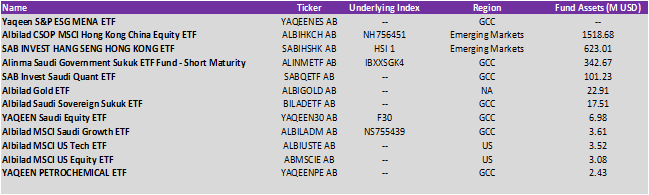
Among these, except Albilad Saudi Sovereign Sukuk ETF, Alinma Saudi Government Sukuk ETF Fund – Short Maturity and Albilad Gold ETF, all are equity ETFs. These equity ETFs give investors an access to large-cap Saudi equities, SMID-cap growth opportunities, and even overseas markets such as the U.S., Hong Kong and China.
In particular, the Albilad MSCI Saudi Growth ETF is tilted toward small- and mid-cap companies, many of which are closely tied to Saudi Arabia’s Vision 2030 agenda. These firms represent the Kingdom’s push to diversify the economy beyond oil and expand the role of SMEs in driving growth.
However, SMID-cap performance has lagged behind large-caps in the past year, with the fund falling more sharply due to its higher exposure to cyclical and less liquid stocks. Year-to-date, the ETF witnessed a return decline of 18.68%.
On the other hand, another fund which is aligned with Vision 2030 is Chimera S&P KSA Shariah ETF. It tracks the 30 most liquid large-cap Shariah-compliant Saudi stocks such as Al Rajhi Bank, Saudi Aramco, STC, Ma’aden, and Alinma Bank. The fund saw a year-to-date decline in return of 2.7%
Apart from this, YAQEEN Saudi Equity ETF, which tracks 30 large-cap, Shariah-compliant companies including some of the Kingdom’s biggest names in banking, petrochemicals, and energy, experienced a year-to-date decline in return of 8.50%. Nevertheless, the fund saw five-year gains of about 7%. This highlights the relative stability and resilience of large-cap exposure in a market that has seen considerable volatility in recent years.
Meanwhile, other major equity ETFs have posted strong double-digit gains year-to-date, including the Albilad CSOP MSCI Hong Kong China Equity ETF (+39.15%), SAB Invest Hang Seng Hong Kong ETF (+36.99%), Albilad MSCI US Tech ETF (+19.96%), and Albilad MSCI US Equity ETF (+10.28%).
Looking Ahead
Saudi Arabia’s investment market is set for further growth, supported by Vision 2030 reforms, new product launches, and rising investor demand for diversification. The Saudi Arabian government targets to increase the industry’s AUM to 40% of the GDP by 2030, a significant jump from 26% in 2024.*
While near-term performance may be shaped by global headwinds, oil price trends, and U.S. monetary policy, ongoing reforms to improve liquidity and attract foreign capital should strengthen Tadawul’s role as a leading emerging market exchange.
*Data sourced from Saudi Exchange, Argaam.com, Fitch rating