
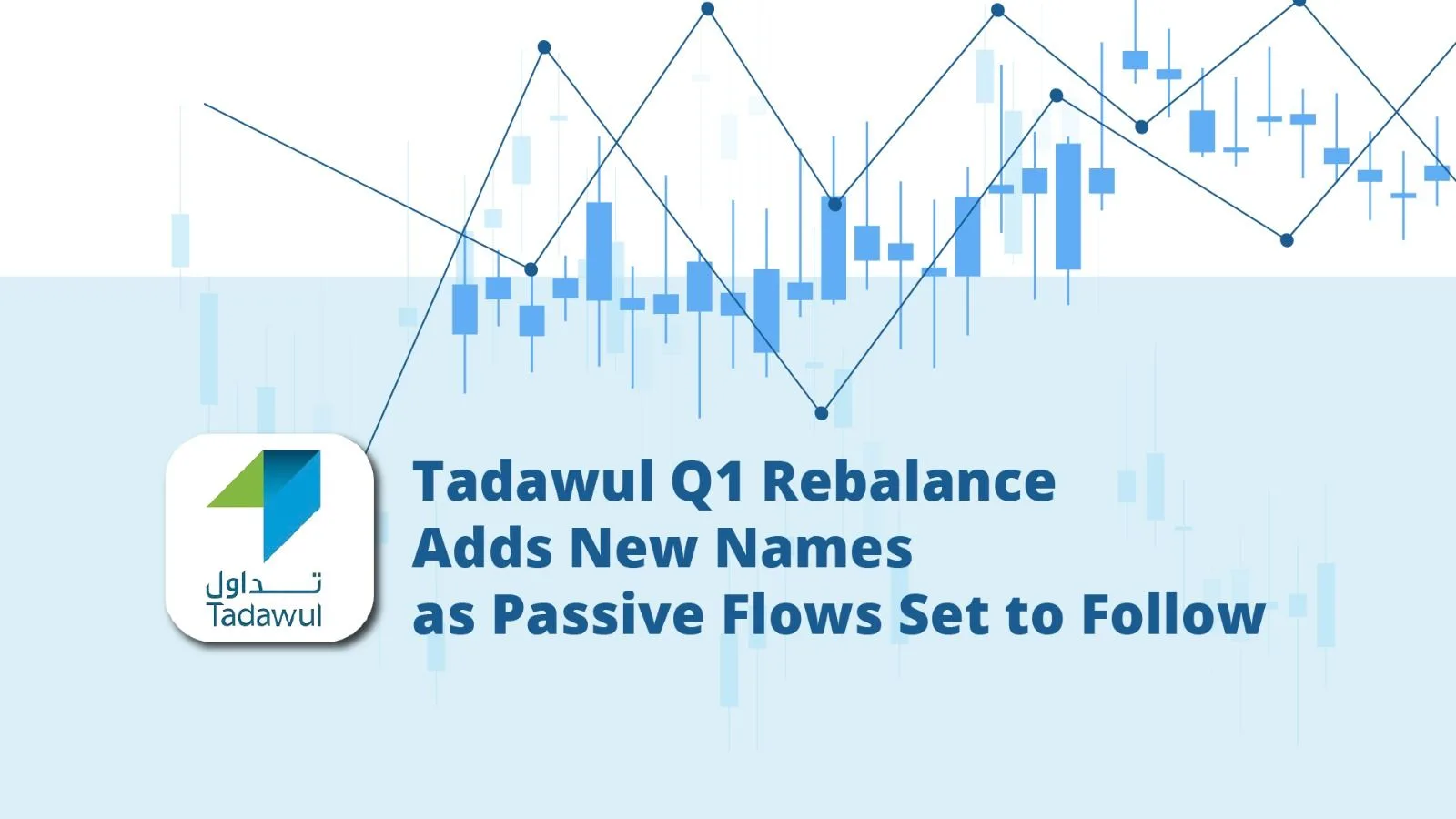
Saudi Exchange (Tadawul) has announced its Q1 2026 index maintenance, confirming a series of additions across its main and parallel market indices, effective from the start of trading on April 5, 2026.
The update primarily reflects adjustments to free float shares, alongside the inclusion of several companies into key benchmarks.
Index Additions
The following companies have been added:
- Nafouz Food Products Company (2288) added to the Tadawul All Share Index (TASI) and Food & Beverages Index
- Alwasail Industrial Company (4148) added to TASI and Capital Goods Index
- Saleh Abdulaziz Al Rashed & Sons Company (1324) added to TASI and Materials Index
- Khaled Dhafer & Brothers Logistics Services Company (9653) added to the Nomu Parallel Market Index
No deletions were explicitly highlighted in the announcement, suggesting the rebalance is driven primarily by inclusion and float adjustments rather than removals.
Alongside these changes, Tadawul also confirmed updates to free float shares across all listed issuers, a key factor that influences index weighting and, by extension, passive capital allocation.
A Mechanical Catalyst for Market Flows
While the additions themselves may appear incremental, the implications are structural. Index rebalancing is one of the most predictable flow-driven events in the Saudi market.
Once changes are implemented, passive and semi-passive funds tracking these benchmarks are required to replicate them, typically executing trades at the closing auction on the effective date. This creates forced buying in newly added stocks, often compressing spreads and increasing liquidity over a short window.
The impact tends to be most visible in mid-cap names, where incremental demand from index trackers can represent a meaningful share of daily trading volume.
ETF Impact: Automatic Rebalancing in Action
For ETF investors, these changes are directly reflected in portfolio holdings. Products such as the Albilad MSCI Saudi Equity ETF and HSBC Saudi Equity ETF will automatically adjust their exposures in line with updated index compositions.
While this ensures tracking accuracy, it also introduces execution-related effects, including short-term volatility and potential price dislocations around rebalancing windows.
Why It Matters in Today’s Market
The importance of these events has grown alongside Saudi Arabia’s deeper integration into global index frameworks. With increasing foreign participation and a rising share of passive capital, rebalancing cycles are becoming more influential in shaping short-term price action.
At the same time, market sensitivity to flows remains elevated. Following a 12.8% decline in TASI in 2025, flow-driven events such as index maintenance can have an outsized impact, particularly when liquidity is uneven across sectors.
The Bottom Line
Tadawul’s Q1 rebalance underscores a broader shift in how capital moves within Saudi equities. What was once a routine technical adjustment is now a market-moving event, where inclusion can drive incremental demand and positioning.
For investors, the takeaway is clear: in a market increasingly shaped by passive flows, understanding index mechanics is becoming as important as understanding fundamentals.