

Saudi Arabia’s stock market remains dominated by oil and national champions. Yet the country’s sovereign wealth fund, the Public Investment Fund (PIF), is betting billions on a very different future. Under Saudi Vision 2030, PIF is building out 13 strategic sectors from renewable energy and health care to entertainment, fintech, and electric vehicles; many of which are represented by small- and mid-cap (SMID) firms rather than the heavyweights of Tadawul. For investors, especially in the GCC, this creates a structural divide: broad Saudi ETFs still skew toward Aramco, banks, and petrochemicals, while a new breed of funds like Albilad Saudi Growth ETF tilt into the very companies aligned with the Kingdom’s diversification drive.
Thirteen Sectors at the Core of Saudi’s Post-Oil Economy
Saudi Arabia’s Vision 2030 is a wholesale economic transformation plan built on the Public Investment Fund’s ambition to become one of the world’s largest sovereign wealth funds.
The PIF Strategy 2021–2025 outlines a roadmap to deploy over USD 1 trillion into 13 strategic sectors, each chosen to reduce reliance on hydrocarbons and create new engines of domestic growth.
These sectors range from utilities and renewables, metals and mining, and health care to consumer goods and retail, telecom/media/technology, entertainment and sports, financial services, real estate, aerospace and defense, automotive, transport and logistics, food and agriculture, and construction and building services.
The immediate focus is on sectors where Saudi Arabia can leverage its scale, geography, and demographics. The Savvy Games Group, with its ~$38 billion war chest, is positioning the Kingdom as a hub for global gaming and e-sports, tapping into one of the world’s fastest-growing industries.
In automotive, PIF’s majority stake in Lucid Motors has already materialized into a new EV manufacturing base at King Abdullah Economic City (KAEC), with a starting capacity of ~5,000 cars a year and plans for eventual expansion into the tens of thousands.
Renewable energy is another anchor, the Kingdom aims to generate 58.5 GW from renewables by 2030, with PIF sponsoring about 70% of projects, turning Saudi Arabia into one of the region’s clean-energy leaders.
Healthcare and consumer demand are equally critical pillars. With the healthcare market projected to hit USD 20 billion by 2030, PIF is seeding private hospital networks and biotech firms, addressing rising domestic demand and aiming to capture regional medical tourism.
On the consumer side, Vision 2030 seeks to lift household spending growth to 4.5% annually, underpinned by a young and urban population nearly two-thirds of Saudis are under 30 whose preferences are driving demand for modern retail, food and beverage brands, leisure activities, and digital services.
The bigger picture is clear
PIF’s investments are laying the foundations for a “new economy” which includes ecosystem tech, health, consumption, and sustainability that complements rather than replaces the traditional oil economy.
Yet for investors, the disconnect is still sharp. The Tadawul remains dominated by national champions, with Saudi Aramco alone representing more than 40% of market capitalization, alongside heavyweights in banking and petrochemicals.
For now, the index reality is anchored in the old economy, while the policy ambition is sprinting toward a diversified future.
This gap is exactly where ETFs like the Albilad Saudi Growth ETF focused on small and mid-caps aligned with Vision 2030 become critical tools for investors who want exposure not just to today’s Saudi Arabia, but to the one that’s being built.
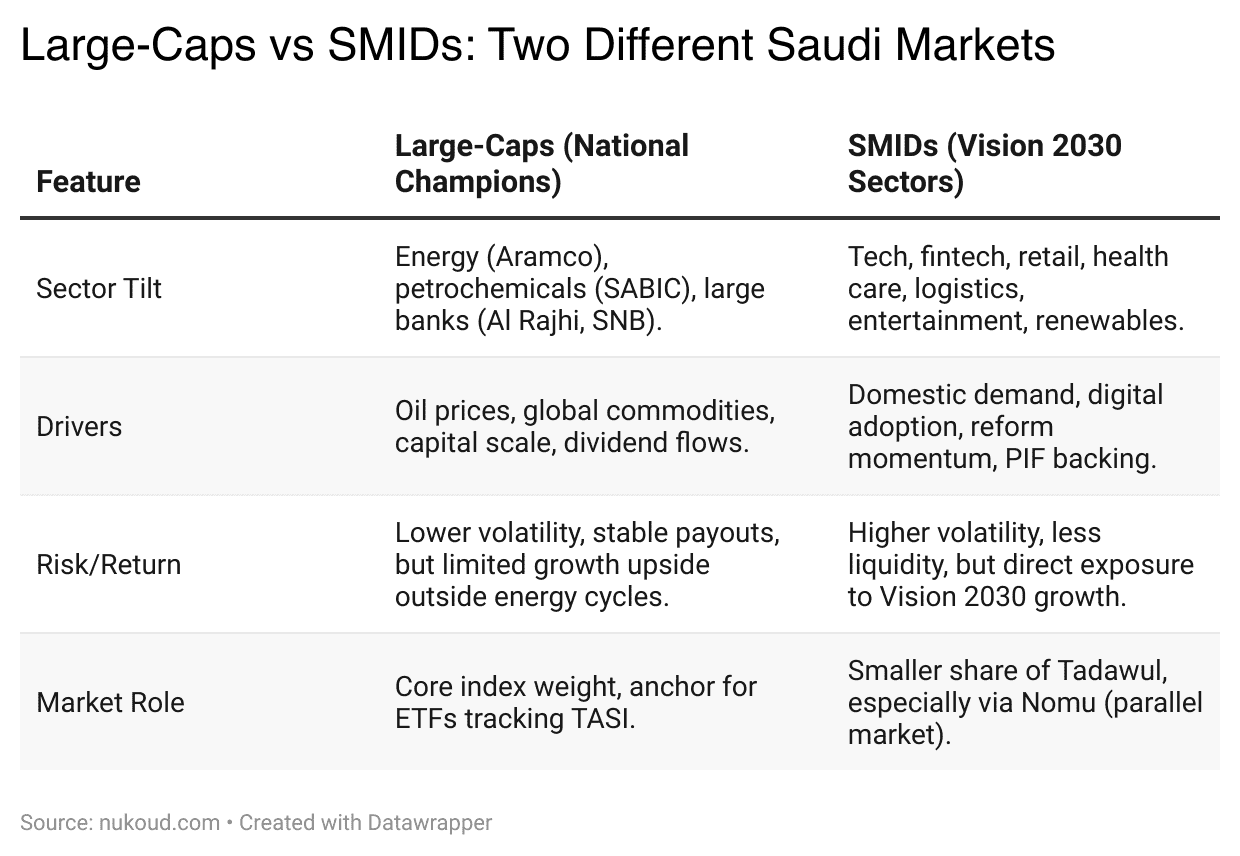
For investors, this creates a barbell market: the large-caps offer scale and defensiveness, while SMIDs provide growth optionality tied directly to the diversification narrative.
The Saudi ETF Shelf Five Funds, Different Tilts
As of September 2025, Tadawul lists five notable equity ETFs:
- Yaqeen 30 ETF (9400) – Broad Saudi equity exposure, tracking the top 30 companies. AUM ~SAR 37.8m; close SAR 46.81.
- SAB Invest Saudi Quant ETF (9402) – Quantitative strategy based on the S&P Saudi Domestic Shariah Index. AUM ~SAR 380.8m; close SAR 43.67.
- Yaqeen Petrochemical ETF (9401) – Sector bet on Saudi petrochemical leaders. AUM ~SAR 8.4m; close SAR 26.18.
- Albilad MSCI Saudi Growth ETF (9408) – The Vision 2030 proxy, tracking MSCI Saudi Arabia SMID Islamic Growth Select Index with exposure to Main and Nomu. AUM ~SAR 13.6m; close SAR 8.50.
- Yaqeen ESG ETF (9409) – Regional exposure via the S&P Pan Arab Composite ESG Shariah Capped Index. AUM ~SAR 10.35m; close SAR 10.39.
All data as of 2025-09-01, source: Saudi Exchange ETF Monthly.
Among these, Albilad Saudi Growth ETF is the clearest reflection of Vision 2030 themes, as it tilts toward SMIDs aligned with domestic demand, fintech, healthcare, and consumption growth. By contrast, Yaqeen 30 and SAB Quant are closer to broad market beta, overweighting large-caps like Aramco and Al Rajhi Bank, while Yaqeen Petrochemical leans entirely into the “old economy.”
Positioning GCC Portfolios for Saudi’s Transformation
For GCC investors, the Saudi ETF market offers a rare chance to play both sides of the Kingdom’s economic transformation. On one side, large-cap funds such as Yaqeen 30 and SAB Quant provide exposure to dividend-paying champions like the banks, petrochemical giants, and Saudi Aramco itself. That continues to anchor the Tadawul. These ETFs offer stability, income, and liquidity, making them natural core holdings in a regional allocation.
On the other side, the Albilad Saudi Growth ETF opens a window into the Vision 2030 sectors, small- and mid-cap companies in technology, retail, healthcare, logistics, and other areas where new growth is emerging.
The trade-off, however, is higher volatility and thinner liquidity. Importantly, all of these ETFs follow Shariah-compliant screening methodologies, ensuring they remain accessible and relevant for regional portfolios. But investors should be mindful that SMID-focused funds carry smaller assets under management and wider bid–ask spreads, which means execution costs and trading discipline become a bigger part of the equation.
Challenges on the Road to Diversification
The risks for investors are real. Smaller companies aligned with Vision 2030 are inherently more volatile and less liquid, leaving them more exposed to policy delays, project setbacks, or shifts in investor sentiment.
Meanwhile, the large-cap universe continues to dominate Tadawul; Aramco, the banks, and petrochemical firms will define index performance until SMIDs grow large enough to shift the balance. Valuations in growth sectors can also be demanding, with market prices often running ahead of earnings delivery.
Finally, at the fund level, investors need to pay attention to practical considerations such as tracking error, fund size, and costs. Most Saudi ETFs carry total expense ratios in the 0.5 — 1% range, which is reasonable but still worth monitoring as competition in the space grows.
Blending Stability and Growth
Saudi Arabia today effectively offers two markets in one.The entrenched large-cap champions tied to oil and banking, and the emerging small- and mid-cap names that represent the spirit of Vision 2030’s diversification push. With Tadawul’s ETF lineup expanding, GCC investors no longer face a binary choice.
They can combine broad-market stability with targeted growth exposure, tailoring allocations to both resilience and ambition. For those who believe in the long-term transformation story, blending a large-cap ETF with the Albilad Saudi Growth ETF may be the most straightforward way to capture today’s Saudi reality alongside the country’s aspirations for tomorrow.