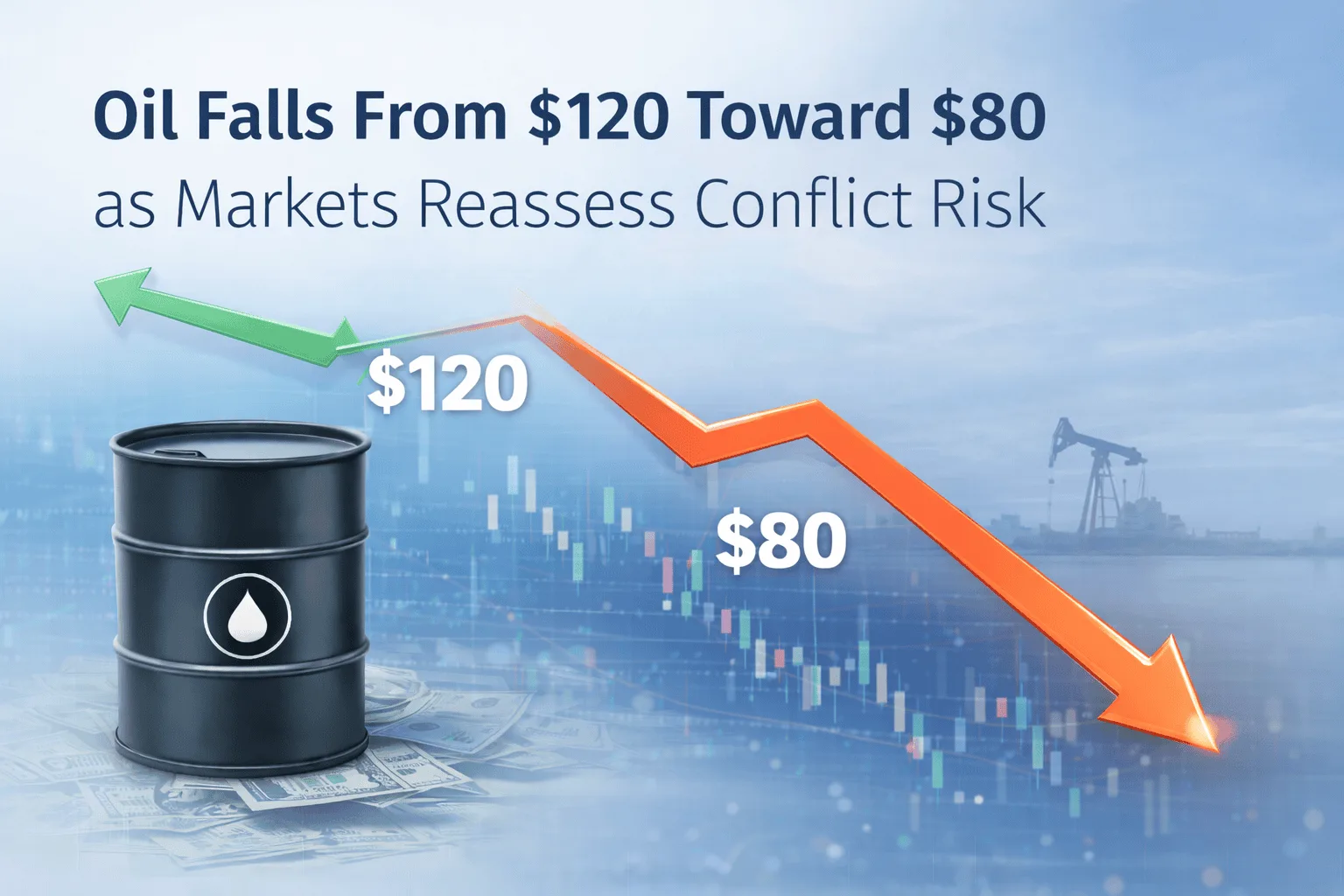
In just 48 hours, global oil prices swung from four-year highs to a sharp retreat driven entirely by signals from the White House. Here is a breakdown of what happened, what the data shows, and why it matters to your wallet.
The Rollercoaster in Numbers
The spike was triggered by a near-halt in tanker traffic through the Strait of Hormuz, the narrow waterway through which roughly one-fifth of the world’s oil flows, after the US-Israel conflict with Iran began on 28 February. Prices began falling after Trump described the war as “very complete, pretty much” in a CBS News interview, suggesting it could end “very soon”:
(Source: BBC News, Indian Express)
The Sanctions Factor
Trump announced plans to ease oil-related sanctions on unnamed countries. Washington currently maintains sanctions on Russia, Iran, and Venezuela. Reuters reported Trump was weighing Russian sanctions relief specifically:
(Source: Al Jazeera)
How Global Markets Responded
Trump’s comments lifted stocks across Europe and Asia, though US markets slipped marginally:
(Source: BBC News ,The Guardian)
Even If the War Ends, Oil Won’t Bounce Back Overnight
A ceasefire would not equal an instant fuel fix. Wood Mackenzie’s Simon Flowers warned that wells shut for prolonged periods could take weeks to restart, while stored product at refineries or ports could move faster. With nearly 1.9 million barrels per day of Gulf refining capacity already offline (IIR), analysts warn that a prolonged closure of the Strait of Hormuz could disrupt more than 20% of global oil supply, making a swift return to pre-war prices unlikely (Source: Global banking and finance).
What the Banks Are Saying
Despite the dramatic price swings in oil markets, several major financial institutions have largely maintained their long-term forecasts, highlighting the high level of uncertainty surrounding the outlook. Goldman Sachs continues to project Brent crude at around $66 per barrel and WTI at $62 per barrel by Q4, according to Global Banking & Finance. However, scenario-based forecasts suggest far more extreme outcomes if supply disruptions escalate. Data analytics firm Kpler noted that in the event of a closure of the Strait of Hormuz, oil prices could potentially reach new all-time highs, as reported by Al Jazeera. Meanwhile, JPMorgan has warned that if the strait remains closed for an extended period, oil prices could surge dramatically to $150–$200 per barrel, according to estimates cited by Global Banking & Finance and Al Jazeera. Together, these projections illustrate the wide range of possible outcomes currently facing global energy markets.
Impact on the GCC Region
The GCC sits at the epicentre of this crisis. The Strait of Hormuz runs through GCC waters, and the near-halt in tanker traffic has had immediate consequences for regional producers. On Tuesday(10th March), the US and Israel launched what the Pentagon described as the most intense airstrikes of the war, even as markets were pricing in a quick resolution (Source: Al Jazeera).
Saudi Arabia announced it had built up sufficient reserves to allow a short-term production cut, signalling careful supply management. The conflict has heightened security concerns across GCC energy infrastructure and shipping routes. If the Strait reopens fully, prices could fall just as quickly as they rose. Early signs were visible on Tuesday when Brent briefly neared $80 (Source: ETF Stream).
Oil ETCs and ETFs
The crisis has played out dramatically in exchange-traded products, with billions flowing in and out of oil ETCs within weeks:
(Source: ETF Stream)
Oil-linked exchange-traded commodities (ETCs) also saw heavy activity during the volatility. The WisdomTree WTI Crude Oil ETC (CRUD) and WisdomTree Brent Crude Oil ETC (BRNT) now manage about €2.5bn in assets, up sharply from just over €1bn at the end of 2025. Individually, CRUD holds roughly €1.4bn, while BRNT manages around €1.1bn.
The products have attracted €520m in net inflows so far this year, with an additional €50m entering in March as investors positioned for rising oil prices. However, the sudden price reversal triggered €54m in outflows in a single day, highlighting how quickly sentiment can shift during periods of energy market volatility.
WisdomTree manages roughly $21bn across its commodity ETC platform, though less than 10% of those assets are currently allocated to energy products. (Source: ETF Stream).
The Bottom Line
Oil remains significantly more expensive than before the conflict, and markets are still highly volatile. DBS Bank noted that both Monday’s surge and Tuesday’s ~15% drop likely represented overreactions in either direction, while InterCapital Energy warned prices will remain “incredibly twitchy” as long as the conflict’s outcome is unclear (Source: BBC News).
G7 ministers stopped short of agreeing on a coordinated reserve release on Tuesday, asking the IEA to first assess the situation. The UK’s OBR has warned inflation could end the year near 3% above the current 2% forecast if energy prices remain elevated (Source: BBC News).
Oil markets remain highly sensitive to developments in the Middle East, and prices could move quickly in either direction depending on how the conflict evolves.