
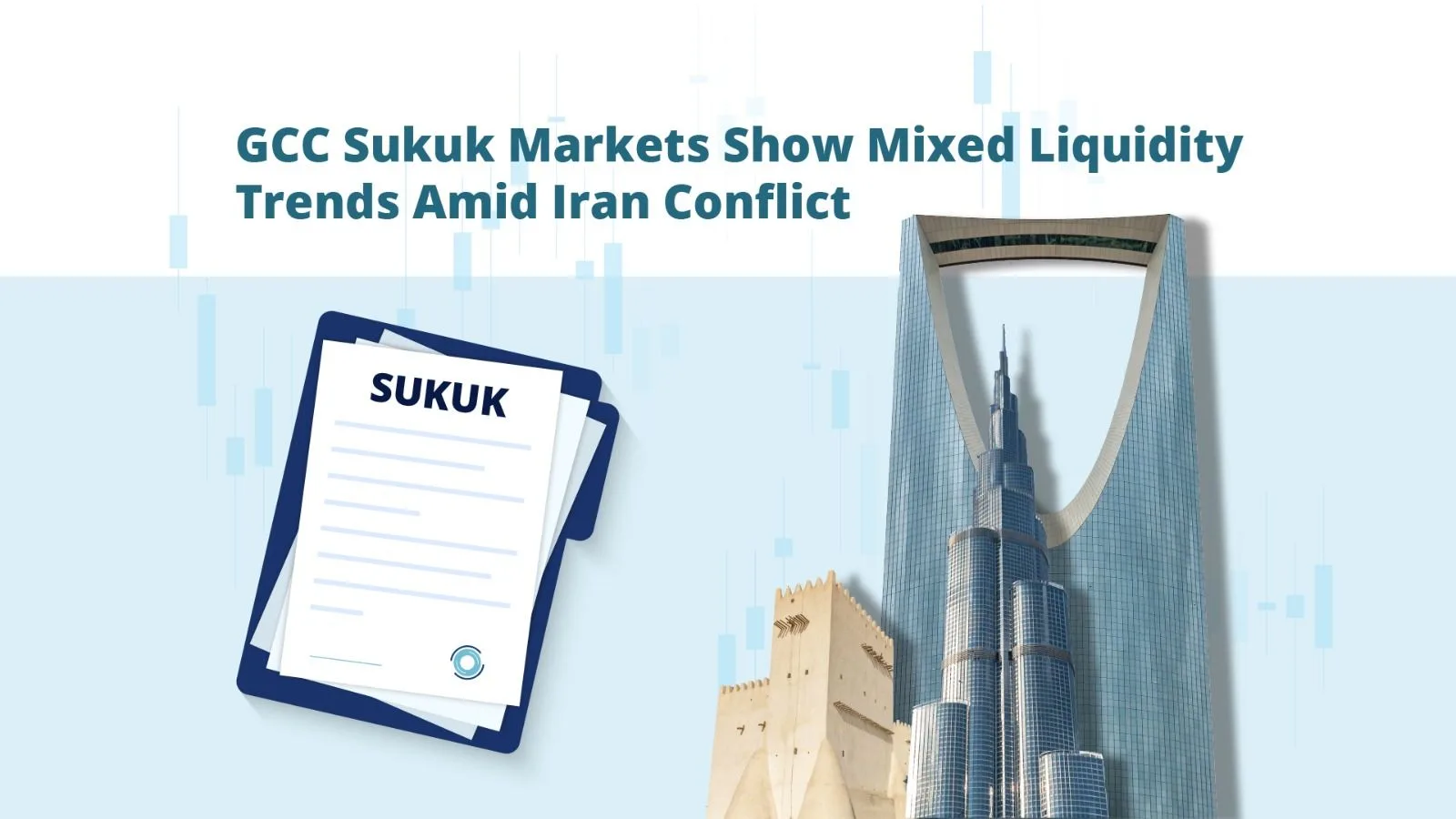
GCC sukuk markets are under pressure but not in crisis. Recent data from Fitch Ratings shows that liquidity has weakened since the Iran conflict began, but the impact is uneven across the market.
High-quality sovereign and investment-grade instruments are holding their ground. Lower-rated corporate and infrastructure sukuk, however, are facing real strain. Understanding where the stress is concentrated and where it is not is essential for fixed-income investors in the region.
How Far Has Liquidity Fallen?
Fitch tracks market liquidity using Bloomberg’s Liquidity Assessment (LQA) scores. These range from 1 (least liquid) to 100 (most liquid), capturing trading volume, transaction cost, and time. The data shows a clear divergence across instrument types since the conflict began.
Speculative-grade sukuk lost 15 LQA points, nearly double the decline seen in investment-grade instruments.
As of March 23, only 64% of Fitch-rated sukuk held an LQA score above 50, down from 82% in January 2025
Which Sectors Are Most Affected?
The liquidity split is visible across sectors, not just credit ratings. The table below shows where the pressure is falling hardest.
Asset-backed sukuk are the standout: their LQA scores have actually increased since the conflict began. Meanwhile, sukuk rated ‘BB’ and ‘B’ globally have recorded the lowest scores and steepest declines of any rated category.
Fitch also compared liquidity across 52 matched sukuk-bond pairs from the same issuers: liquidity was broadly similar in 50% of cases; sukuk were less liquid than their bond equivalents in 31% of cases, and more liquid in 19% of cases. The key variable is not the instrument type; it is issuer quality.
Regional Spillover: Who Else Is Affected?
The pressure is not confined to the GCC. LQA scores have also declined for sukuk issuers in Turkey, Egypt, and Indonesia, reflecting a broader risk-off shift in emerging market debt.
Three markets, however, have shown notable resilience: Malaysia, Oman, and supranational issuers have maintained relatively stable LQA scores. Fitch attributes this to local market structure and a diverse domestic investor base.
Why the Iran Conflict Matters for GCC Debt?
The conflict affects GCC debt markets through three key channels:
- Oil price volatility is affecting fiscal outlooks and government borrowing assumptions
- The Strait of Hormuz risk is that any disruption to this critical energy route would sharply reprice risk premiums across sovereign and corporate sukuk alike.
- Capital outflows from emerging markets are driven by global risk aversion and investor de-risking
Why a Crisis Has Been Avoided?
Despite the pressure, the market’s foundations remain solid. The numbers speak clearly:
Saudi Arabia and the UAE continue to anchor the market, accounting for the bulk of outstanding issuance. Sustained demand from Islamic banks has kept sukuk pricing relatively tighter than comparable conventional bonds, with yields remaining below historic peaks seen during previous regional tension episodes.
As Mohammad Nikkar of Arthur D. Little Middle East noted: “The ongoing Iran conflict has paused but not broken GCC debt capital markets. This is not a liquidity crisis”.
How Do Listed Sukuk ETFs Compare?
For investors looking to gain exposure to GCC sukuk without directly purchasing individual instruments, a range of exchange-traded funds (ETFs) offer diversified, Sharia-compliant access across local and international exchanges.
The table below provides a factual overview of three key GCC-linked sukuk ETFs, including their most recent performance metrics:
Source: Chimera Lunate SUKUK , SP-funds, BlackRock iShares SKUK
† Data as of March 26, 2026. * Data as of March 25, 2026. ‡ 30-Day SEC Yield; As of Feb 28, 2026
All three funds are Sharia-compliant and carry exposure to investment-grade sukuk, the segment that has demonstrated greater liquidity resilience during the current period of geopolitical stress, as detailed in the Fitch data above.
Outlook: What Investors Should Watch?
Fitch is clear that the recovery path will depend on the conflict’s duration and scale, the speed at which investor confidence returns, and whether the Strait of Hormuz faces physical disruption.
For investors, the current environment rewards careful credit selection. Investment-grade, sovereign-linked, and asset-backed sukuk have demonstrated their role as liquidity anchors. Lower-rated corporate and infrastructure instruments carry higher liquidation risk in stress scenarios.
The broader structural case for GCC sukuk, underpinned by Vision 2030 issuances, Abu Dhabi’s regular programme, and deep Islamic bank demand, remains intact.
Key Takeaway
GCC sukuk markets remain fundamentally strong, but liquidity is no longer uniform. In the current environment, investor outcomes will depend heavily on credit quality, sector exposure, and the trajectory of geopolitical risk. Markets are pricing in uncertainty, not signalling collapse.