
Why CRSP matters and why Vanguard looms large
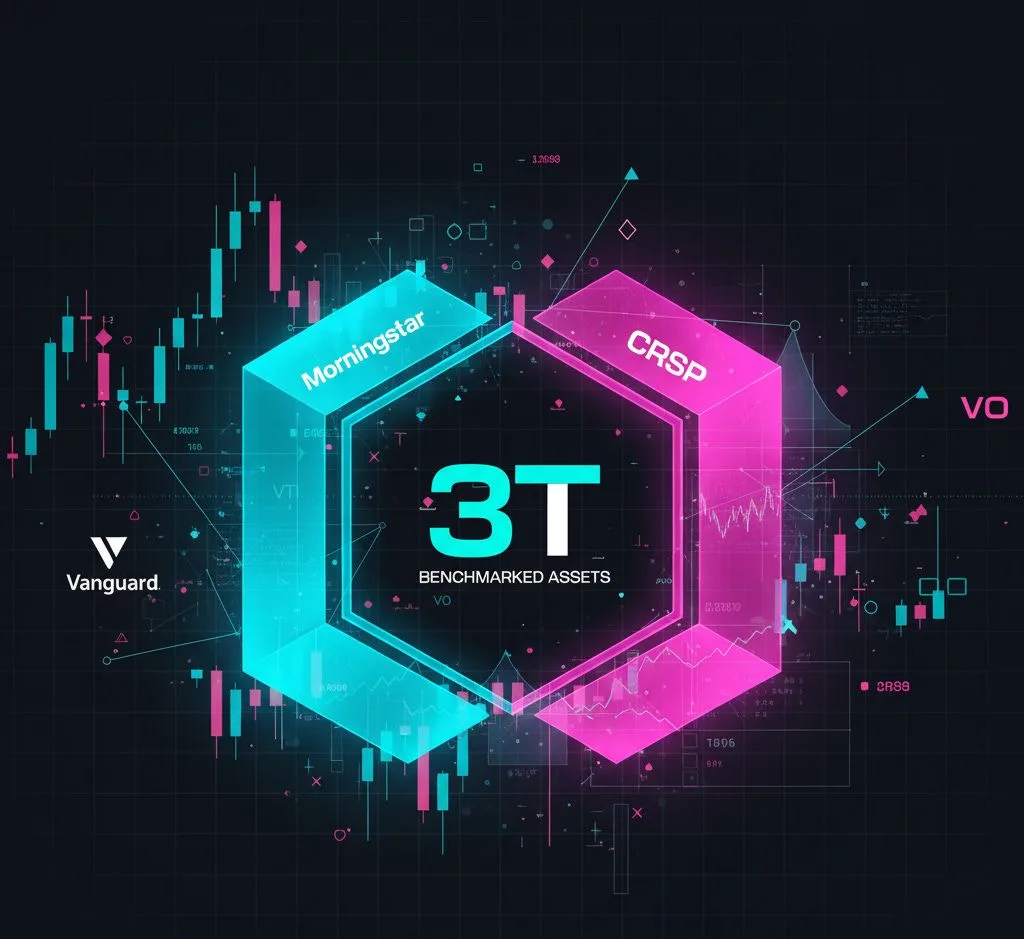
CRSP has been the quiet backbone of “own-the-market” investing since the 1960s first as the canonical U.S. stock database, then (since 2012) as a family of investable market-cap and style indexes. Vanguard migrated key funds to CRSP a decade ago; today, Vanguard Total Stock Market (VTI/VTSAX) tracks CRSP US Total Market, and other sleeves (mid-cap, small-cap, style) sit on CRSP rails. CRSP itself says nearly $3T links to its benchmarks, including ~$1.8T tied to the total-market index alone. That is a meaningful scale for Morningstar in one stroke.
Strategic logic: credibility + cross-sell
Morningstar has been building an index house to complement its data, ratings and research. Buying CRSP brings
(1) instant credibility in U.S. equities,
(2) a sticky client base (Vanguard and others)
(3) synergies across data, analytics, ESG and model portfolios.
The move won’t dethrone the giants, MSCI says $16.9T is benchmarked to its equity indexes, and S&P DJI estimates $13–20T tracks the S&P 500 alone depending on methodology but it does put Morningstar on a much larger stage than its in-house families could reach alone.
Pricing power vs. concentration risk
This isn’t a lay-up financially. CRSP’s ~$55m revenue and a ~7× multiple imply Morningstar must either grow volumes (new products, geographies) or nudge license economics all with the risk that a price push could encourage a major user to self-index.
The Financial Times highlighted exactly that risk: CRSP’s value is immense but customer concentration is real.
Translation: a strategically elegant deal with execution risk if fees become a flashpoint.
Sidebar: Was VettaFi “overpaid” by comparison?
The question is fair and nuanced.
- Price tag: TMX Group completed its purchase of VettaFi in early 2024 for ~$1.03bn in total (including prior stakes), after announcing an $848m deal for the remaining 78% in late 2023.
- Index-linked AUM: At announcement, VettaFi publicly cited ~$31bn in assets linked to its indexes (across Alerian, S-Network, ROBO/EQM families). That’s a tiny base versus CRSP’s multi-trillion footprint.
- Business mix: But VettaFi isn’t just indexing. TMX’s deck emphasized 80%+ recurring revenues, a broad digital distribution/lead-gen engine for ETF issuers, and an integrated content + events platform that drives fund growth for clients. TMX reported C$37.9m VettaFi revenue in Q1 2024 alone (equity-accounted/then consolidated), up 33% YoY in USD terms. In other words: you’re paying for a high-margin, recurring data/marketing workflow, not simply index AUM. CRSP, by contrast, is a plain-vanilla benchmark franchise with huge embedded AUM but less marketing muscle. One is a growth funnel, the other is benchmark plumbing. Different engines, different multiples.
Verdict: On a “price per index-linked AUM” yardstick, VettaFi looks expensive next to CRSP. But that metric is misleading. VettaFi’s value lies in distribution, issuer services and content that help ETFs gather AUM (and thus grow future licensing). CRSP, by contrast, is a benchmark franchise with massive embedded assets.
What it could mean for investors
- Cheaper, broader benchmarking? Morningstar can pair CRSP’s U.S. equity core with its own global and thematic families to create more one-stop frameworks (core + factors + ESG) for asset owners. If competition intensifies, licensing costs on some exposures could drift lower over time.
- More product variants: Expect cross-pollination CRSP methodologies extended to ex-U.S. universes and style/factor spinoffs, and Morningstar indexes packaged into model portfolios and custom mandates.
- GCC/UCITS angle: For many UAE/GCC investors who prefer UCITS funds (withholding-tax and PFIC considerations), the near-term impact is indirect, you won’t suddenly see CRSP on every Ireland-domiciled ETF. But a stronger Morningstar Indexes could spur more UCITS adoptions or cross-licenses, especially for broad U.S. equity exposures where CRSP methodology (e.g., float-adjusted total market) is already a global standard through Vanguard. Over time, more competition among indexers tends to compress TERs and expand menus even outside the U.S.
What to watch next
- Close and integration: Morningstar says the deal should close in 4Q25 subject to approvals; watch for how quickly CRSP’s data and governance processes are embedded into Morningstar’s platform.
- License renewals: Any hints that large users renegotiate fees or, conversely, expand mandates, will telegraph the revenue trajectory post-deal.
- Competitive signaling: MSCI/S&P DJI responses (pricing, new “total market” offerings, custom index pushes) will show whether the giants see Morningstar-CRSP as a real share threat or an adjacent specialist.
Bottom line
At $375m, CRSP looks like a smart bolt-on that buys Morningstar gravitas in U.S. equity indexing at a sales multiple the market will understand. Stack it next to TMX–VettaFi’s ~$1bn price tag and it’s tempting to shout “overpaying” but that ignores how different the businesses are.
CRSP is a trillion-dollar benchmark franchise; VettaFi is a distribution + indexing growth platform. For investors, the immediate win is more competition and, likely, more choice at lower cost over time.