The ETF landscape has fundamentally changed. In 2026, global ETF assets exceeded $13 trillion, with annual inflows surpassing $1 trillion for two straight years. Over 1,100 new ETFs were launched last year alone. These aren’t just bigger numbers; they reflect a structural transformation in how investors build portfolios. Understanding ETF structures, terminology, and mechanics has become increasingly important as portfolios rely more heavily on exchange-traded instruments. Know Your ETF Terms.
Today’s question isn’t whether to use ETFs, but how to use them strategically. Are you truly diversified across regions and macro drivers, or overconcentrated in the same developed-market exposures as everyone else?
This evolution matters because ETFs have moved well beyond passive index tracking. Investors increasingly treat them as precision instruments, assembling portfolios from modular building blocks that address income needs, risk management, liquidity, and targeted growth objectives. Research and forward-looking projections from Morningstar point to rising demand for bond ETFs, active strategies, outcome-oriented products, thematic exposures, and cash-management tools.
Against this backdrop, Morningstar’s 2026 ETF predictions offer a useful framework for understanding where investor behavior is heading and how ETF portfolios are likely to be structured in the year ahead.
Prediction 1: Bond ETFs Move Toward One-Third of the Market
Morningstar forecasts that bond ETFs will reach approximately 33% market share by the end of 2026, up from around 29.6% at the end of 2025. This growth reflects a steady migration away from traditional mutual funds toward exchange-traded fixed-income vehicles.
Bond ETFs have gained share even during periods of weak bond performance, demonstrating that investors increasingly value liquidity, transparency, and intraday tradability over traditional fund structures. The pace of product launches reinforces this trend, with more than 100 new bond ETFs entering the market in a single year.
Allocation takeaway:
Fixed income is no longer a secondary ETF use case. As bond ETFs become a core portfolio sleeve, investors are increasingly evaluating diversification across duration, credit quality, and regional fiscal profiles.
Prediction 2: Cash-Like ETFs Set New Inflow Records
Cash-like and ultrashort-duration ETFs attracted more than $100 billion in inflows in 2025, and Morningstar expects that figure to be exceeded in 2026. Drivers include relatively low bank deposit rates, attractive short-term yields, equity valuation concerns, and persistent macro uncertainty.
These products are increasingly used as tradable liquidity tools rather than temporary placeholders. This shift reflects a broader trend of ETFs functioning as primary liquidity tools rather than secondary allocation vehicles. ETFs Become a Primary Liquidity Tool for Institutions
Allocation takeaway:
ETFs are now competing directly with deposits and money-market instruments, reinforcing their role across both defensive and opportunistic portfolio segments.
Prediction 3: Active ETFs Continue to Proliferate
After nearly 1,000 active ETFs launched in 2025, Morningstar expects further expansion in 2026. Regulatory developments allowing ETF share classes are enabling mutual fund strategies to migrate into ETF structures through conversions and dual listings.
The result is a broader range of discretionary and rules-based active strategies becoming available in an exchange-traded format.
Allocation takeaway:
ETF selection is becoming more strategy-driven, shifting focus from index labels to portfolio role, constraints, and transparency.
Prediction 4: AI and Thematic ETFs Gain a Second Wind
Technology-themed ETFs attracted $10.6 billion in inflows in 2025, with roughly $8 billion directed toward AI and big data strategies. Morningstar expects this momentum to continue in 2026, though with more narrowly defined and specialized themes.
Broad technology exposure is giving way to targeted innovation segments.
Allocation takeaway:
Thematic ETFs are evolving into precision tools, requiring disciplined sizing and clearer integration within diversified portfolios.
Prediction 5: A Fifth of Trading Tool ETFs Will Close
Morningstar expects that around 20% of trading-tool ETFs, leveraged and inverse products could shut down in 2026 if markets experience sharp swings. The universe now exceeds 600 trading tools, roughly half of which were launched in 2025 alone.
These products are designed for short-term trading and tend to struggle to retain assets during periods of volatility. The elevated closure risk highlights the importance of understanding how leveraged and inverse ETFs behave across market cycles. A Closer Look at Leveraged ETFs, Risks, and Rewards
Allocation takeaway:
This anticipated rationalization reinforces the distinction between tactical instruments and long-term portfolio building blocks.
Prediction 6: Structured and Defined-Outcome ETFs Break Out
Buffer and outcome-oriented ETFsdesigned to shape payoff profiles using derivativesare expected to gain traction as lower-cost alternatives to structured notes. These products aim to offer downside protection, income targeting, or capped upside in a transparent ETF format.
Morningstar expects both launches and inflows to rise as investors look for more engineered return profiles without the complexity of traditional structured products.
Allocation takeaway:
ETF usage is expanding from exposure delivery into portfolio engineering, where structure matters as much as asset class.
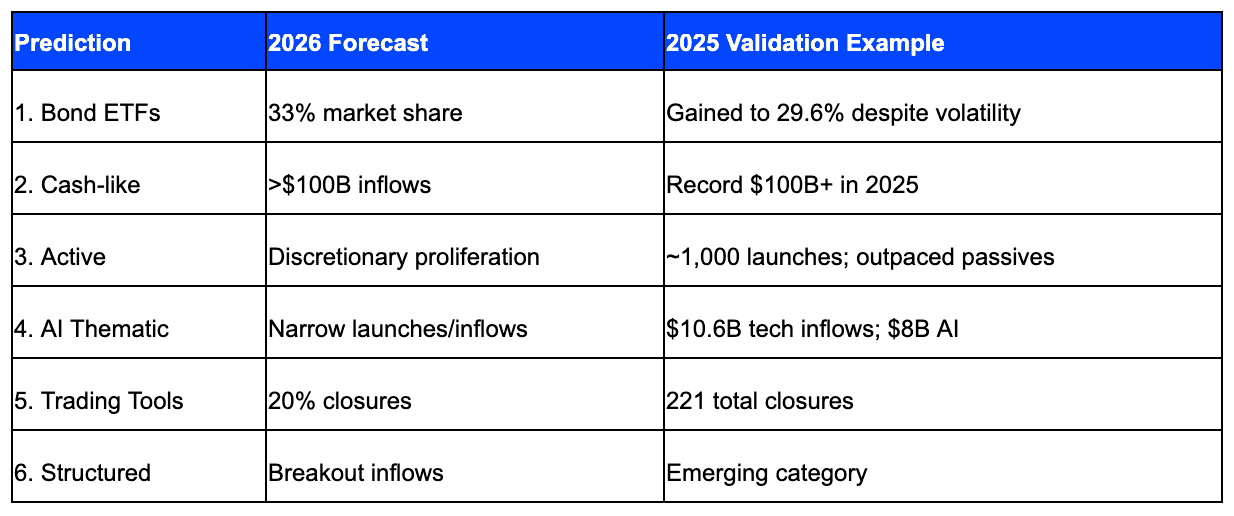
Morningstar’s 2026 ETF Predictions at a Glance
What These Predictions Say About Regional Allocation in 2026
Taken together, Morningstar’s six predictions point to ETF portfolios becoming more intentional, segmented, and allocation-driven. Investors are balancing income, liquidity, growth, and risk management through modular ETF sleeves rather than broad, undifferentiated exposure.
In this environment, regional ETFs function as complementary building blocks, evaluated alongside bonds, cash tools, active strategies, and thematic allocations rather than treated as standalone bets. This framework is particularly relevant as resilience and capital-market reform continue to redefine opportunity across GCC markets.
Global resilience is redefining opportunity across GCC markets and ETFs
How Morningstar’s 2025 Predictions Played Out
- Active ETFs overtook passive ETFs: Active ETFs surpassed passive ETFs in number by June 2025, ending the year with 2,741 active ETFs versus 2,187 passive ETFs, confirming Morningstar’s view that ETFs are increasingly being used to deliver active and rules-based strategies rather than simple index tracking.
- Product rationalization remained elevated: A total of 221 ETFs closed in 2025, nearly matching 2024 levels, highlighting intensified competition and a more selective product landscape even as overall ETF launches remained strong.
- Single-stock ETFs expanded rapidly: Of the 397 single-stock ETFs available by year-end, 296 were launched during 2025, underscoring issuer appetite for specialized and tactical ETF formats.
- Structural milestones reinforced scale dynamics: In February 2025, VOO overtook SPY as the world’s largest ETF, reflecting continued investor preference for low-cost, long-term core exposures.
- ETF share classes became a reality: In October 2025, Dimensional received approval for ETF share classes, validating Morningstar’s expectation of further convergence between mutual fund and ETF structures.
Bottom Line
Morningstar’s validated 2025 track record marked by active ETF dominance, sustained closures, and structural product shifts positions its 2026 predictions as reliable signals for how ETF portfolios are evolving. The message is clear: ETFs are no longer just access vehicles. They are the primary tools through which investors design, diversify, and engineer portfolios in 2026.