
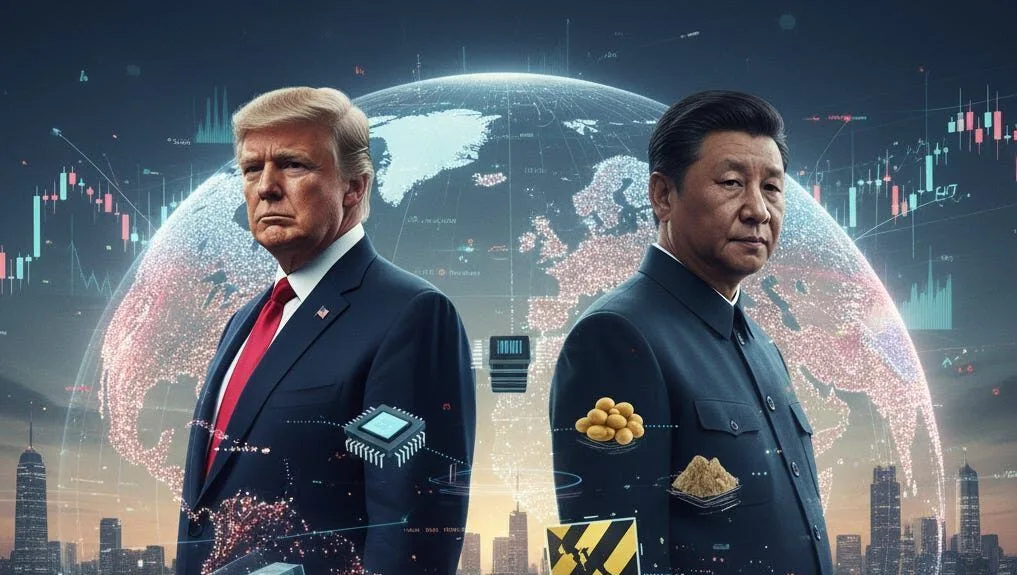
In a landmark meeting on 30 October 2025, Donald Trump and Xi Jinping signalled a renewed détente in the U.S.-China trade war, agreeing to a one-year truce covering tariffs, export controls and port fees. Analysts note this move reduces the effective U.S. tariff rate on Chinese goods from roughly 42% to 32% bringing it inside the previously assumed baseline of 30-50%.
The accord marks a strategic shift from escalation to calibrated compromise between the world’s two largest economies. For GCC-based investors, this truce has tangible implications, less risk of immediate hard decoupling, potential relief for commodity and supply-chain markets, and a reminder that strategic competition remains alive but is entering a more managed phase. Understanding the terms, the remaining issues and the regional ramifications is critical for positioning in a volatile global environment.
What Trump and Xi Actually Agreed To
During their summit in Busan, South Korea, the two leaders agreed to pause a number of escalatory measures for one year. Among the key points:
- The U.S. will reduce its effective tariff rate on Chinese goods to around 32 %.
- Both nations commit to suspend new reciprocal tariffs, port fee hikes and selected export-control roll-outs.
- The U.S. will lower fentanyl-related tariffs from 20 % to 10 %.
- China will delay its October export controls and suspend its retaliatory measures for a year.
- Additional areas of cooperation were discussed, including agriculture trade, supply-chain access for firms like Nvidia and the status of the short-video app TikTok.
Importantly, this is not a comprehensive trade deal; rather it is a truce, a pause in the escalation of measures, rather than full resolution of structural issues.
What the Truce Means for Investors
The renewed U.S.China truce carries meaningful implications across trade, commodities, and market sentiment.
With both powers stepping back from confrontation, short-term risks to global supply chains particularly in rare earths, semiconductor exports, and shipping costs have eased, offering a measure of stability to commodity markets.
The one-year pause also reduces the tail risk of an abrupt trade embargo or hard economic decoupling, at least in the near term. For Gulf markets, which are closely tied to energy demand and cross-border trade flows, this calmer backdrop could support improved investor sentiment and potentially steadier export dynamics if Chinese demand strengthens.
Yet, the truce represents a reset rather than a resolution. Strategic competition between Washington and Beijing remains deeply entrenched, meaning that regional investors should stay alert to renewed flashpoints in technology, geopolitics, and enforcement once the temporary calm fades.
Market Reaction: Before, During, and After the Talks
Global markets tracked the U.S.-China summit closely, swinging from caution to relief as the tone of negotiations shifted. In the week before the Busan meeting, sentiment was subdued amid speculation that new export controls and tariffs could reignite tensions. China’s CSI 300 Index fell 1.8 %, while the Shanghai Composite lost 1.3 % after Beijing announced additional rare-earth export restrictions, a move that rattled regional equities and commodity prices.
As diplomatic signals improved, risk appetite recovered. On 27 October, optimism over a possible truce lifted global benchmarks: the S&P 500 gained 1.2 %, the Nasdaq Composite rose 1.8 %, and Japan’s Nikkei 225 advanced 2.5 %. Oil prices also firmed, reflecting expectations of steadier trade flows and manufacturing demand.
During the summit itself, reactions were more restrained. Markets initially climbed on confirmation of a one-year tariff truce but soon settled as traders assessed the limited scope of the deal. Analysts described the outcome as “a pause, not peace,” noting that while short-term risks had eased, deeper structural frictions remained unresolved.
In the aftermath, equity and commodity markets held onto modest gains, suggesting cautious relief rather than exuberance. The measured response underscored a broader market view: the agreement reduced near-term volatility but stopped short of restoring confidence in a full normalization of U.S.–China trade relations.
China ETFs Regain Momentum Amid Tariff Truce
Geopolitics has long cast a shadow over Chinese equities. The year began on a high note for China’s markets, driven by optimism around artificial intelligence and hopes for post-pandemic recovery. That momentum faltered briefly around the Liberation Day holiday, when renewed policy uncertainty and export-control tensions unsettled investors. The Busan truce between Washington and Beijing has since steadied expectations, raising the question of whether easing trade pressures can sustain China’s outperformance.
Two of the most widely tracked U.S.-listed vehicles, the iShares MSCI China ETF (MCHI) and the KraneShares CSI China Internet ETF (KWEB), have both delivered strong gains in 2025. As of 29 October 2025, MCHI is up approximately +40.5% year-to-date, while KWEB has advanced +38.0%, reflecting renewed interest in Chinese large-cap and technology stocks. After heavy redemptions earlier in the year, U.S.-listed China ETFs have attracted more than US $400 million in net inflows since mid-May 2025 signalling a cautious but notable return of investor confidence as trade tensions eased.
The ripple effect of that optimism has extended into Gulf markets, where locally listed China-linked ETFs have benefited from rising demand for Asia exposure and cross-border diversification.
- Albilad CSOP MSCI Hong Kong China ETF (Tadawul: 9410) The largest China-focused ETF in the GCC, with AUM of roughly SAR 5.57 billion (≈ US $1.5 billion). Jointly managed by Albilad Capital and CSOP Asset Management, it offers Sharia-compliant access to Chinese and Hong Kong equities.
- SAB China ETF: Managed by SABB Investment, this fund provides diversified exposure to China’s equity market and represents part of the ongoing expansion of GCC-based ETF offerings aligned with Asia’s growth story.
- Chimera S&P China ETF (ADX): Tracks the S&P China BMI Shariah Index, giving UAE investors a compliant and liquid route to China’s stock market via the Abu Dhabi Securities Exchange.
- Falcom China Equity ETF (Tadawul): Offers direct Saudi-listed access to Chinese equities, reflecting the deepening economic and capital-market ties between Riyadh and Beijing.
Together, these funds underscore how GCC markets are increasingly integrating with China’s financial narrative giving regional investors access to one of the world’s fastest-moving equity stories through locally traded, Sharia-compliant vehicles.
Whether the current détente translates into durable performance remains uncertain, but ETF flows and returns suggest the truce has reopened a meaningful window for China-related equities to regain momentum both globally and within the Gulf.
Key Risks and Limitations
While the truce marks progress, it remains both time-limited and conditional. Neither side has relinquished leverage, and enforcement mechanisms are still unclear. Analysts have described the outcome as more of a pause than a lasting resolution.
Strategic competition continues, with critical issues such as technology controls, rare-earth export dominance, and supply-chain restructuring merely placed on hold rather than settled. For our investors, this suggests that while the likelihood of a sudden escalation has eased, the deeper structural shifts in global trade and technology competition remain firmly in play.
Final Takeaways
The Busan summit between President Trump and President Xi ushers in a new truce phase in U.S.-China economic relations. The most immediate benefit is a reduced risk of trade disruption, along with potential stabilization in global trade flows and commodity markets. However, with many underlying disputes unresolved and strategic rivalry still active, caution remains warranted. The short-term tension may have cooled, but the broader contest for economic and technological influence continues just beneath the surface.