
The Chinese markets have faced an extended period of uneven performance in recent years, largely due to a combination of internal and external risks. However, there are growing signs that this may be a turning point.
Recent policy shifts and a renewed focus on stabilizing key risks are providing a more favorable environment for a potential rebound, leading to believe that this time, the market’s trajectory could be different.
In a recent interview, Anthony Sassine, Head of MENA and Senior Strategist at KraneShares, says that the Chinese market is currently outperforming most Asian economies despite ongoing risks and U.S. involvement due to several key factors.
- Chinese stocks had been trading at very low valuations, and while growth wasn’t negative, sentiment was subdued. Gradual improvements are evident each month, including state-driven initiatives to address immigration challenges and stimulate broader economic activity.
- Major tech giants like Alibaba, Tencent, and Baidu are thriving, benefiting not just from AI innovation but also from strong growth in cloud services, solidifying China’s tech leadership and fuelling market optimism.
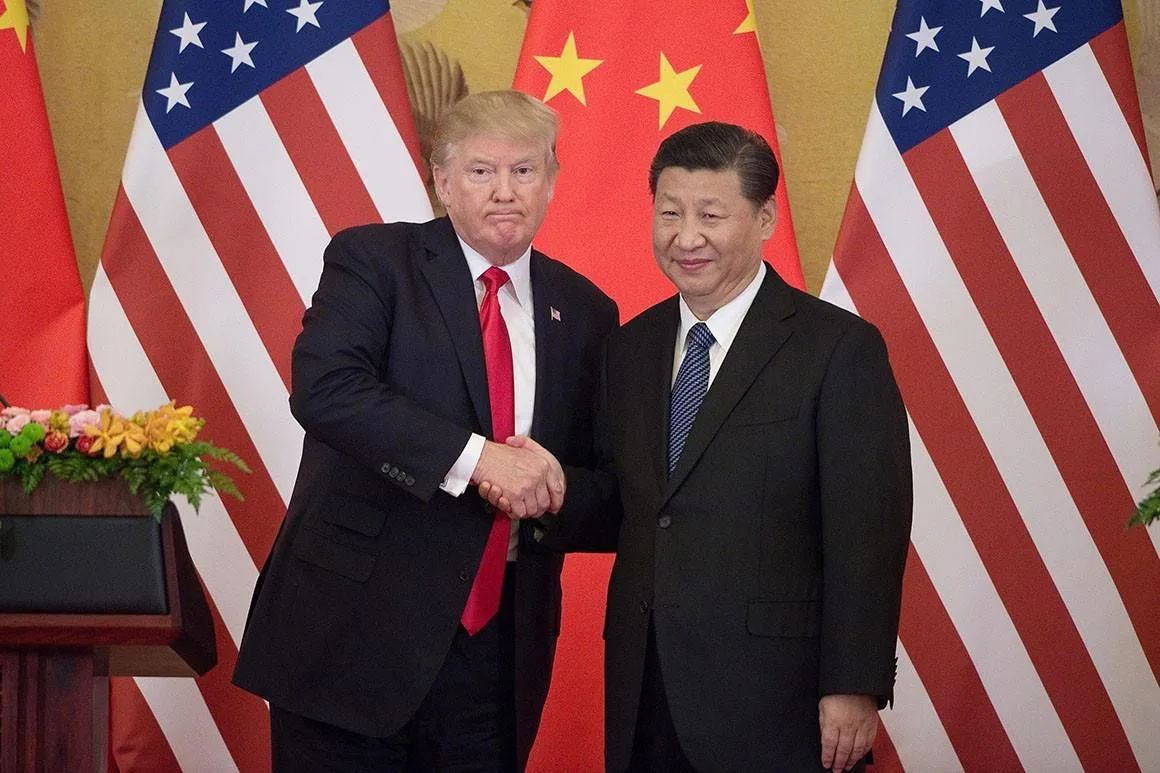
- Earlier strategy of holding prices back was geopolitics, particularly after Trump’s return, which caused markets to dip following January’s DeepSeek-driven rally and again after Liberation Day. However, the steady rebound reflects investor optimism over improving U.S.-China relations, which could support higher valuations and future growth.
- A weakening U.S. dollar is further contributing to rising prices and strengthening market momentum.
AI Wave In China
DeepSeek‑R1: The launch of DeepSeek’s AI model in January 2025 highlighted China’s attractiveness as a global AI hub. As per the initial Deutsche Bank report, developers claimed that DeepSeek can run without cutting-edge hardware, threatening the earnings outlook for major AI chipmakers and infrastructure firms, which have been the biggest winners of the AI boom.
As per Forbes report, DeepSeek is built with exceptional efficiency and released as open-source tools, which can pose a strong challenge to major players such as OpenAI, Google, and Meta.
Last month, DeepSeek launched its V3.1 model optimized for domestically made chips. This boosted confidence in China’s efforts toward AI independence, coinciding with U.S. chip giant Nvidia’s decision to stop producing its China-exclusive H20 chip.
Alibaba – Qwen Series: Along with the launch of DeepSeek in January, Alibaba released an updated version of its Qwen 2.5 AI model, called Qwen2.5-Max. As per the Guardian reports, Alibaba Cloud stated that Qwen2.5 Max outperformed OpenAI’s GPT-4o, DeepSeek-V3, and Meta’s Llama-3.1-405B on selected benchmarks.
Baidu – Ernie Family: Following ChatGPT’s launch in November 2022, Baidu became the first Chinese company to introduce a competing product, unveiling Erniebot in March 2023, later rebranded as Wenxinyan for its mobile app. As per Financial Times, while Baidu’s chatbot initially gained traction in China, it was eventually surpassed in popularity by ByteDance’s Doubao and DeepSeek’s chatbot.
Tencent – Yuanbao AI: Business Insider highlighted Tencent’s Yuanbao chatbot as highly accessible through WeChat, positioning it as a strong competitor to DeepSeek and ByteDance’s offerings. As per Bloomberg report, Yuanbao remained among the top most downloaded AI chatbots in March 2025.
CNY vs. USD Performance
As of September 2 2025, CNY rose 2.3% this year to around ¥7.14 per USD, marking the yuan’s strongest level since the 2016 U.S. presidential election. Strategists noted that the currency’s rise could play a key role in Beijing’s trade talks with Washington.
As the renminbi has held steady while the U.S. dollar has weakened, it has fallen on a trade-weighted basis, boosting China’s vast export industry and increasing strain on manufacturers in other countries.
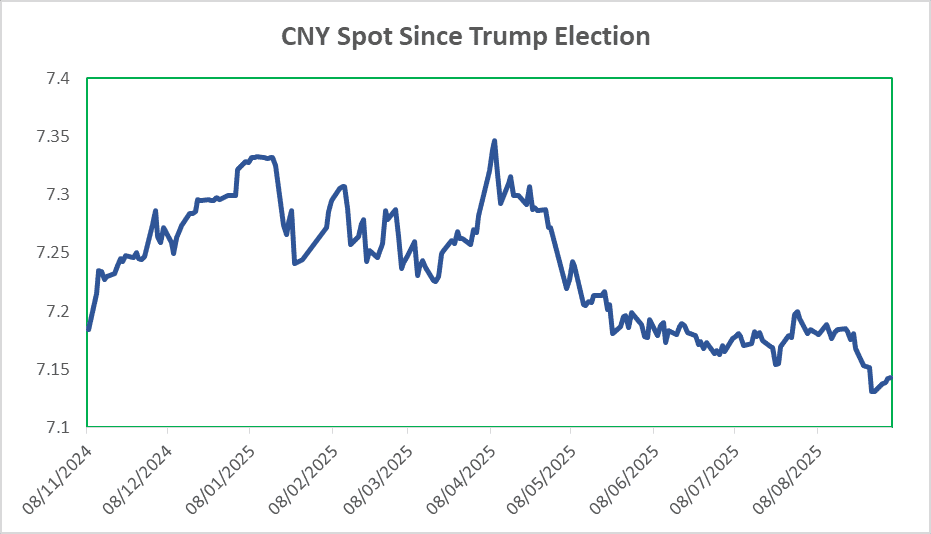
As per the Financial Times, Nathan Venkat Swami, head of Asia-Pacific FX trading at Citigroup commented that “There is an accumulation of unhedged dollars sitting with Chinese exporters. As the fixing drops and the currency follows . . . that also encourages some more people to come out and hedge and this drives these moves,”
Alibaba Earnings
Chinese e-commerce giant Alibaba Group Holding Ltd recently beat earnings with flying colours. Alibaba shares were up around 19% on Monday (September 1, 2025). On August 29, the company reported a revenue beat but earnings per share came below the street estimate thanks to strong performance of the cloud computing unit and the unveiling of a new AI chip.
Alibaba’s recent earnings, driven by strong AI-related growth, underscores its central role in advancing China’s tech ambitions. With its scale, infrastructure investments, and solid investor backing, the company is positioned as a key force in fueling innovation and shaping the country’s long-term AI strategy.
There are 143 ETFs which contain Alibaba, among which KraneShares CSI China Internet ETF and iShares MSCI China ETF are GCC listed China ETFs.
Performance of Major Global and GCC listed China ETFs
KraneShares CSI China Internet ETF (KWEB): As of August 31, 2025, KWEB’s year-to-date (YTD) annualized return reached around 30.57%, and its 1-year annualized return clocked in around 53.6%. YTD, KWEB saw a net asset value (NAV) of approximately +20.26% YTD and a whooping +71.27% since inception in July 2013. As of June 30, KWEB delivered a 16.01% return, outperforming the S&P 500 which gained only about 6.16% during the same period.
iShares MSCI China ETF (MCHI): As of August 31, 2025, MCHI’s YTD annualized return was about +32.11%. As per BlackRock data, MCHI’s NAV-based YTD return came in at +29.26% as of August 28, 2025. According to Schwab’s ETF performance data (as of July 31, 2025), MCHI witnessed a substantial 1-year return of around +42%, which suggests that the ETF had already begun its upward trajectory prior to January 2025, but the AI-driven enthusiasm likely accelerated gains into the new year.
Chimera S&P UAE Shariah ETF (UAEA): As of September 2025, the fund saw a YTD annualized return of +25%, which, along with 1-Year total gains exceeding +40%, indicates a robust rebound and sustained growth. As of August 28, 2025, UAEA’s NAV-based YTD return Saudi Arabia ETF stood at around +22.71%. Since its Inception in July 2020, UAEA has generated a massive cumulative return of roughly +161.88%.
Albilad CSOP MSCI Hong Kong China Equity ETF (9410): Launched on October 30, 2024 on Tadawul (Saudi Exchange), the fund raised over $1.2 billion, making it the largest Islamic ETF in the Middle East at the time of the launch. Since the DeepSeek launch, the fund has witnessed YTD annualized returns of about +36.60%, reflecting investor interest and positive Chinese market momentum.
SAB Invest Hang Seng Hong Kong ETF (9411): The fund launched on October 31, 2024, with an initial listing price of SAR 10 and generated a YTD annualized return of around +30.41% as of September 1, 2025. The fund’s NAV appreciated about +28% YTD.
Major Index Performance
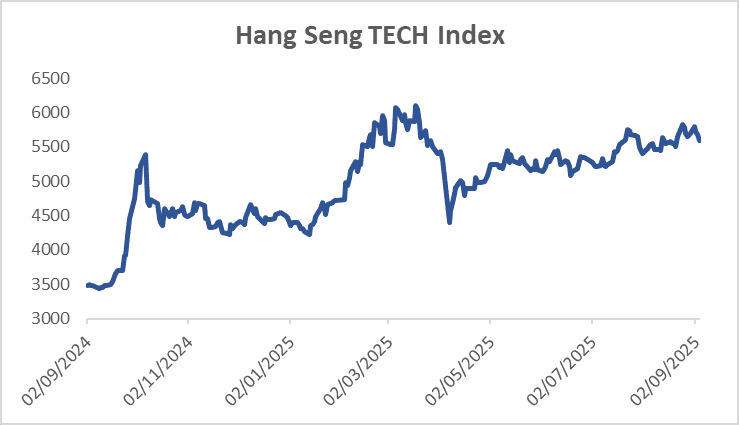
All these ETFs mostly outperformed Hang Seng Index performance, which rallied around 25% (as per Reuters) YTD. On September 1, the Hang Seng Index closed up by 2.2% at 25,617.42, marking its largest gain since mid-August 2025.
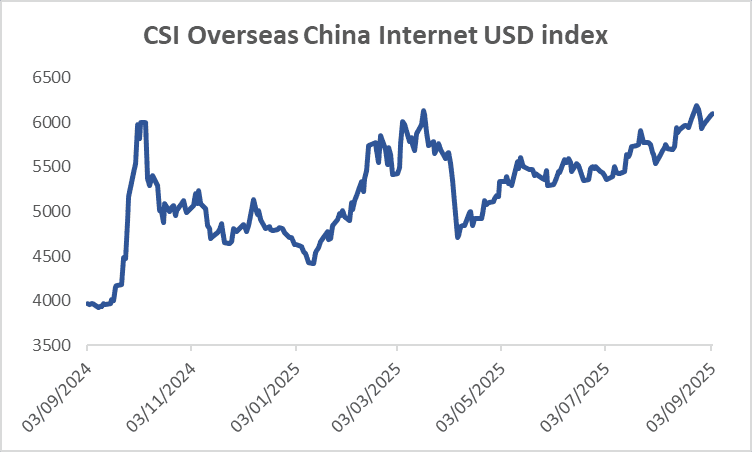
Also, CSI China Overseas Internet Index rebounded from its lows of early 2023, rallying through 2024 into 2025. As of September 2, 2025, the index stood at 5,683.95, which is below the recent 52-week high (6,237.22), but substantially above the 3-year low of 3,911.89. Overall, the index’s three-year trajectory reflects a substantial recovery and renewed investor interest in offshore-listed Chinese internet and e-commerce companies.
Meanwhile, on August 21, the Shanghai Composite Index closed at its highest level in a decade, with the index rallying to 3,771.10. The momentum reflects improved market sentiments on easing U.S.–China trade tensions, strong gains in fintech and stablecoin-related stocks.
Notably, a Reuters report suggested that China may allow yuan-backed stablecoins, signaling a major shift from its 2021 ban on crypto trading and mining. The news led to an increase in the CSI Fintech Theme Index which was up 0.78%, with Brilliance Technology soaring 12.6% and Tansun Technology climbing 4.75%.
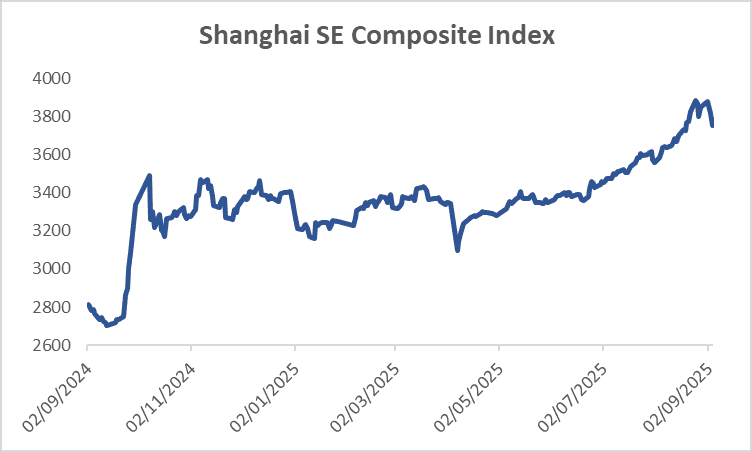
Overall, improving sentiment, a weaker dollar, and inflation dynamics may also shift capital from U.S. firms to Chinese equities, positioning China as a top destination for future growth.
Impact on GCC Market
China is actively expanding its financial ties with the Middle East, particularly through ETF partnerships. Last year, the Shenzhen Stock Exchange and the Dubai Financial Market penned a memorandum of understanding to foster cross-border investment between China and the United Arab Emirates, specifically in the ETF domain.
Overall, the strong performance of Chinese ETFs can serve as both a catalyst and model for GCC ETF markets, spurring cross-border integration, boosting investor demand, and accelerating product development.