
A landmark ruling by the U.S. Supreme Court on former President Donald Trump’s tariff policy has materially reshaped expectations for global trade and growth. The decision, which limits the executive branch’s ability to impose tariffs under emergency powers, introduces new legal constraints on U.S. trade strategy while offering short-term relief to China and export-oriented Asian markets.
Markets reacted immediately. Hong Kong equities rallied sharply, led by technology stocks, as investors recalibrated expectations around trade escalation risk and tariff volatility.
Impact on the US
On Friday, the Supreme Court ruled that tariffs imposed under the International Emergency Economic Powers Act (IEEPA) were unlawful. The decision forces the rollback of approximately $175 billion in tariffs affecting global companies and supply chains.
IEEPA had provided the administration with a powerful and flexible mechanism to impose tariffs quickly, often with limited procedural friction. With that authority curtailed, the U.S. must now rely on more traditional trade tools such as Sections 201, 301, and 232 of U.S. trade law. These mechanisms require formal investigations and structured review processes that can take several months, significantly reducing the administration’s ability to deploy tariffs overnight as a negotiation tactic.
In response to the ruling, Trump issued an executive order imposing a temporary 15% tariff under Section 122 of the Trade Act of 1974, citing balance-of-payments concerns. However, this measure is limited to 150 days, reinforcing the view that future tariff actions will be slower, more procedural, and subject to greater scrutiny.
The ruling introduces an added layer of uncertainty to the U.S. fiscal and trade outlook. The rollback exposes the government to lower tariff revenues and the possibility of repaying previously collected duties. The U.S. dollar weakened following the announcement, reflecting market concerns around revenue assumptions and policy disruption.
While the revenue implications are notable, the decision is unlikely to materially alter the Federal Reserve’s expected rate trajectory in 2026. Tariff revenues, while meaningful in trade policy discussions, are not a primary driver of monetary policy.
More immediately, the ruling complicates ongoing trade negotiations. Temporary tariff measures applied broadly risk creating friction with allies, particularly if interim rates differ from previously negotiated arrangements.
Impact on China
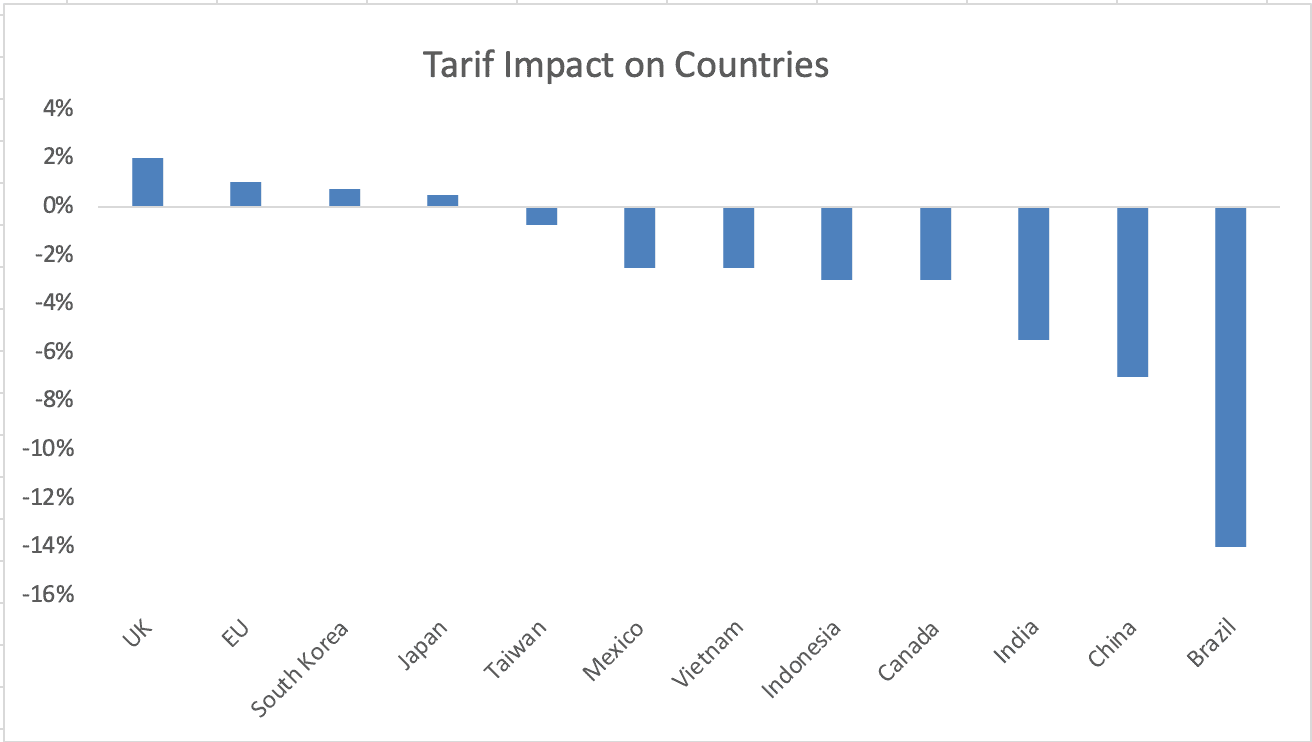
For China, the immediate outlook improves modestly. Average effective U.S. tariffs on Chinese exports are estimated to decline from roughly 37% to around 30% following the rollback. Tariffs imposed during the 2018 trade conflict remain in place, as do sector-specific levies on industries such as solar and strategic technologies. Structural tensions between Washington and Beijing are unchanged.
However, the most significant development is procedural. The removal of emergency tariff authority reduces the risk of sudden, unpredictable tariff escalations. This improves visibility for Chinese exporters and global supply chains.
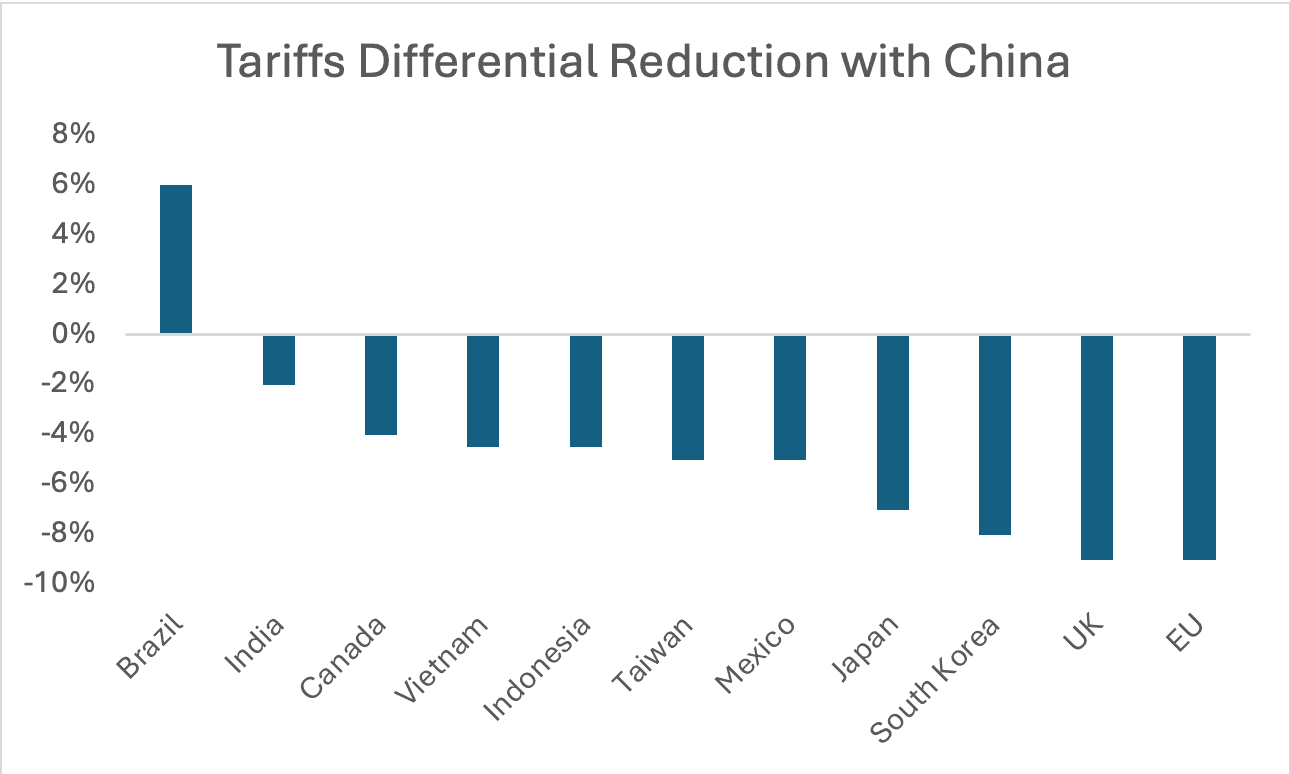
China also benefits from a narrowing tariff differential relative to regional competitors such as Japan, South Korea, Taiwan, and Vietnam, improving its relative export positioning in the near term.
That said, bipartisan consensus in Washington on maintaining economic pressure on China remains intact. Future tariffs or restrictions are still possible, but the key difference is timing. U.S. trade actions will now require investigations and formal processes, while China retains the ability to respond more rapidly if necessary.
The ruling comes just weeks before Trump’s expected visit to Beijing on March 31. With both sides invested in ensuring a constructive summit outcome, near-term escalation appears unlikely.
Hong Kong markets responded decisively to the news. The Hang Seng and Hang Seng Tech indices advanced strongly, led by major platform and technology names including Tencent, Alibaba, Trip.com, and Hong Kong Exchanges & Clearing.
The rally reflects reduced immediate trade risk, improved visibility for export-oriented sectors, and a moderation of worst-case tariff scenarios.
Accessing China Exposure from the GCC
GCC listed China ETFs

For GCC investors, the move in Hong Kong equities is particularly relevant given the growing availability of China-focused investment vehicles on regional exchanges.
On the Abu Dhabi Securities Exchange, the KraneShares CSI China Internet ETF provides exposure to leading Chinese internet and technology companies. The Chimera S&P China HK Shariah ETF offers Shariah-compliant access to Hong Kong-listed Chinese equities.
In Saudi Arabia, investors can access China exposure through the Albilad CSOP China ETF, as well as active strategies such as the SAB Hong Kong Equity Fund.
These vehicles allow regional investors to participate in China’s equity recovery through local market infrastructure and, in some cases, local currency trading.
The Supreme Court ruling represents a structural shift in U.S. trade policy implementation. While long-term strategic competition between the U.S. and China remains firmly in place, the removal of emergency tariff authority reduces near-term escalation risk and introduces procedural friction into future trade actions.
For markets, that distinction matters. In the short term, reduced unpredictability is supportive for Chinese equities, Hong Kong technology stocks, and China-focused ETFs accessible to GCC investors