
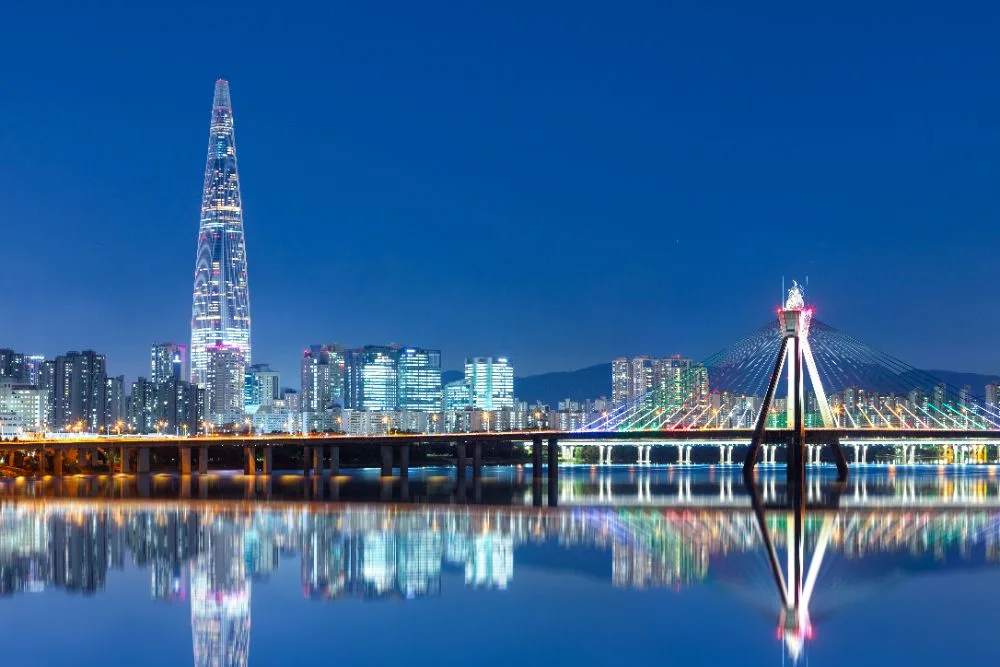
South Korea is in crisis after President Yoon Suk Yeol declared martial law on December 3, citing “anti-state elements” and accusing the opposition of North Korean ties. The move sparked widespread protests, military deployments, and restrictions, leading to market declines. Opposition lawmakers nullified the decree in an emergency vote, forcing Yoon to retract it, but unrest persists.
Impeachment proceedings are underway, labor strikes have begun, and senior advisors have resigned, intensifying instability. The Kospi fell 1.44% to 2,464, and the Kosdaq dropped 1.98% to 677.15, recovering slightly after earlier losses. The international community remains concerned about South Korea’s democratic stability.
Trade, Tech, and Politics: South Korea’s Tumultuous Landscape
Besides the current “brouhaha”, South Korea is currently grappling with multiple macroeconomic and political challenges, compounding uncertainty in its markets. A key issue is the underperformance of Samsung and SK Hynix, which together make up 33% of the stock index.
On the political front, the turmoil surrounding recent developments could take 6 to 9 months to fully resolve, drawing parallels to the lengthy impeachment proceedings of Park Geun-hye in 2016. This delay could disrupt government budgets and consumption, a critical driver of GDP growth, particularly as Korea continues to struggle with sluggish consumer demand both domestically and in key markets like China.
While the situation presents a bleak outlook in the short term, with Samsung’s stock alone down 33% and accounting for 21% of the index, analysts suggest that South Korea’s issues, though severe, remain solvable in the long term.
Trump’s Tariff Threats: South Korea’s Economic Challenge
Donald Trump’s second administration poses significant challenges for South Korea, especially in trade and economic policy. Proposed U.S. tariffs of 10-20% on imports could cost South Korea $22 to $42 billion in annual exports and reduce GDP growth by 0.5%. With South Korea’s trade surplus with the U.S. at record levels, the country is a likely target for such measures.
Trump may also push for a renegotiation of the Korea-U.S. Free Trade Agreement (KORUS FTA), threatening South Korea’s trade advantages over competitors like Japan and Taiwan. Additionally, potential changes to the Inflation Reduction Act (IRA) and CHIPS Act could disrupt South Korean firms’ U.S. investments in semiconductors and batteries.
The shift from global trade liberalization to reciprocity under Trump further challenges South Korea’s trade-dependent economy. Bilateral deals may replace multilateral agreements, making it harder for South Korea to navigate global markets.
President Yoon faces the task of protecting South Korea’s interests through diplomacy and advocating for a return to a fortified global trade system under the WTO. Strategic adjustments and proactive policies will be essential for South Korea to mitigate risks and sustain economic stability in a more protectionist U.S.-led global economy.
Why EWY ETF is Buzzing
Foreign investors are closely watching South Korean ETFs, eager to capitalize on potential market rebounds following the resolution of recent political instability.
Among the 78 ETFs globally offering exposure to South Korean equities, 60 are domiciled in South Korea, while seven are listed in the U.S. and seven in Europe. However, the spotlight is on the iShares MSCI South Korea ETF (EWY), the largest South Korea-focused ETF outside the country, boasting $3.85 billion in assets under management (AUM). It is also the second-largest South Korean equities ETF worldwide.
EWY has declined by 13% year-to-date (as of December 3rd, 2024). Despite recent outflows of $344 million over the past month, the ETF has still attracted net inflows of $317 million so far in 2024.
Managed by iShares (BlackRock), EWY tracks the MSCI Korea 25/50 Index, which applies a capping methodology to limit the weight of a single “group entity” to 25% and the combined weight of entities above 5% to 50%. As of December 3rd, 2024, EWY has significant allocations in the technology (35%), industrials (16%), financials (15%), consumer discretionary (10%), and healthcare (8%) sectors.
With 93 holdings, the top 10 stocks account for 50% of assets, including Samsung Electronics (22%) and SK Hynix (8.44%). EWY trades on NYSE Arca, has a 0.59% expense ratio, and remains a key choice for investors looking to capture South Korea’s market rebound.