
NukoudYour Home for ETF News in the GCC
Sign in
ETF Trends
ETF Education
Investing & Themes
Markets & Data
ReportsVideos
ETF Screener
Nukoud
ETF Trends
ETF Education
Investing & Themes
Markets & Data
ReportsVideos
ETF Screener
Sign in

Advertisement

KraneShares 728x90
Markets & Data

DFM Lowers Tick Size on ETFs. Here’s Why This Is Positive for Investors

Explore DFm fees and how the new tick size regime can lower trading costs for ETF investors in Dubai's financial market.

Karim Al Moghraby
April 1, 20262 min read
DFM Lowers Tick Size on ETFs. Here’s Why This Is Positive for Investors

Market structure changes rarely make headlines, but they often matter more than they seem, particularly for ETF investors. The Dubai Financial Market (DFM) has introduced a revised tick size regime effective April 6, 2026, quietly lowering the cost of trading across listed securities, including ETFs.

At its core, the reform introduces greater granularity in price increments, particularly in the mid-cap range where trading activity and many ETF underlying holdings are concentrated.

Tick Size Structure: Before vs After
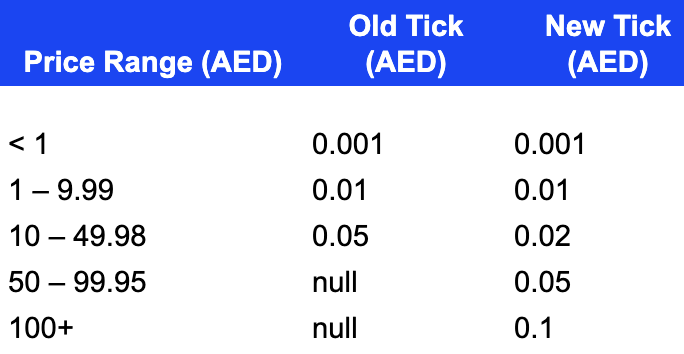
The key shift is in the AED 10-50 band, where tick size drops by 60%, from 0.05 to 0.02 directly compressing the minimum possible spread.

What This Means for Trading Costs

A useful way to estimate minimum trading cost is:

(Tick Size ÷ Price ÷ 2)

This approximates half the bid-ask spread in a one-tick market.

Before vs After: Cost Comparison
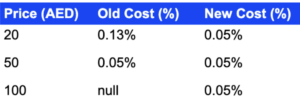
Example (AED 20):

  • Before: 0.05 ÷ 20 ÷ 2 = 0.125%
  • Now: 0.02 ÷ 20 ÷ 2 = 0.05%

This represents a 60% reduction in minimum trading cost for stocks in that range.

Why This Matters for ETF Investors

For ETF investors, this is a direct and positive development.

ETFs rely heavily on secondary market liquidity, where investors trade units on exchange. Lower tick sizes translate into:

  • Tighter bid-ask spreads
  • Lower execution costs
  • Reduced slippage when entering or exiting positions

Because ETFs derive liquidity from their underlying securities, improvements at the stock level feed directly into ETF pricing efficiency. In other words, cheaper trading in underlying equities helps tighten ETF spreads.

What stands out in the new framework is the normalisation of trading costs. Whether a security trades at AED 20 or AED 100, minimum costs now converge around ~0.05%. This suggests deliberate calibration by DFM to standardize trading efficiency across price tiers rather than applying a blanket reduction.

The Bigger Picture

This move brings DFM closer to global best practices, where dynamic tick sizing is used to balance liquidity provision with pricing precision. While smaller ticks reduce costs, they must remain large enough to incentivise market makers, a balance DFM appears to be targeting.

For investors, particularly those active in ETFs, the takeaway is straightforward: lower ticks mean lower hidden costs. These changes may not be immediately visible like brokerage fees, but they compound over time improving execution quality and overall portfolio efficiency.

In that sense, DFM’s update is less about changing how markets look, and more about improving how they function, quietly reducing friction, one basis point at a time.

GCCMarkets & Data

Related Articles

KWIN and AGIX ETFs Receive CMA Approval
etf trends/etf launches

KWIN and AGIX ETFs Receive CMA Approval

Explore the new KWIN AGIX ETF approved by the Capital Market Authority, offering innovative investments in AI and technology.

April 7, 2026
What GCC Scenario could play out if US-Iran talks fail by Trump’s new deadline?
investing themes/gcc

What GCC Scenario could play out if US-Iran talks fail by Trump’s new deadline?

GCC markets fell amid rising US-Iran tensions and Hormuz disruption risks. Here’s what happens if talks fail. Read More.

April 6, 2026
GCC ETF Market Monitor: Q1 2026 Review
Reports

GCC ETF Market Monitor: Q1 2026 Review

The GCC ETF market entered Q1 2026 in a consolidation phase, with activity remaining elevated but growth slowing. Total assets held broadly steady over the quarter, while trading levels pointed to continued repositioning and as a reaction to geopolitical news rather than a meaningful new capital deployment. Global macro conditions set a challenging backdrop.

April 3, 2026
Why the Magnificent 7 Are Dragging Down Tech ETFs
ETF Trends

Why the Magnificent 7 Are Dragging Down Tech ETFs

Magnificent 7 losses in 2026 are dragging tech ETFs lower—here’s what’s driving the selloff and its impact on investors.

April 2, 2026

Quote Lookup

Popular ETFs

KWEB

—
EGX30ETF

—
ALBIGOLD

—
BILADETF

—
View All ETFs

Tools

ETF Screener

Filter & compare ETFs

ETF Compare

Side-by-side comparison

Portfolio Builder

Coming soon

Popular ETFs

KWEB

—
EGX30ETF

—
ALBIGOLD

—
BILADETF

—
View All ETFs

Tools

ETF Screener

Filter & compare ETFs

ETF Compare

Side-by-side comparison

Portfolio Builder

Coming soon

Footer

Nukoud

Your home for ETF news in the GCC. Independent coverage of exchange-traded funds, investing themes, and market trends across the Gulf Cooperation Council.

Nukoud does not provide investment advice.

Sections

  • ETF Trends
  • ETF Education
  • Investing & Themes
  • Markets & Data
  • GCC
  • Reports

Tools

  • ETF Themes
  • ETF Screener
  • ETF Compare
  • Portfolio Builder

Company

  • About
  • Contact
  • Careers

Legal

  • Privacy Policy
  • Terms of Service
  • Cookie Policy
  • Disclosures

All content on Nukoud is provided for informational purposes only and does not constitute investment advice, a recommendation, or an offer to buy or sell any security. Past performance is not indicative of future results. Readers should conduct their own research and consult qualified financial professionals before making investment decisions.

© 2026 Nukoud LLC. A Sharjah, UAE registered company. All rights reserved.

Advertisement

KraneShares 728x90

Advertisement

KraneShares 336x280