
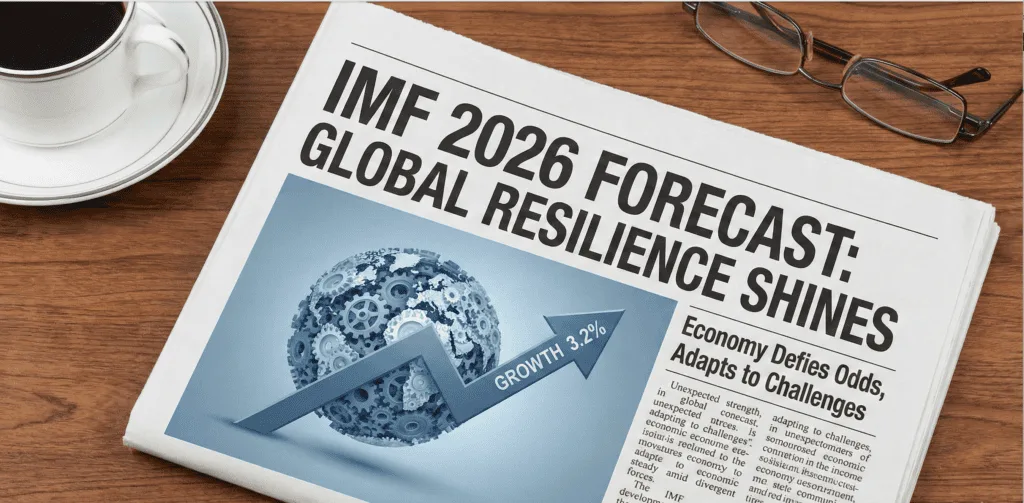
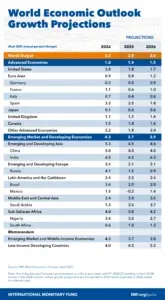
The global economy is entering 2026 with an unexpected degree of resilience. Despite persistent trade policy uncertainty, geopolitical tensions, and uneven regional momentum, growth has held steady rather than slowed sharply. The International Monetary Fund projects world output to expand 3.3% in 2026 and 3.2% in 2027, broadly matching the pace of growth seen in 2025.
What makes this cycle distinctive is not the absence of risk, but the presence of powerful offsetting technology-led investment, adaptive private sectors, and supportive financial conditions that are cushioning global activity. For investors, this resilience shifts the focus from short-term volatility to a more strategic question: where is growth becoming structurally stronger and investable in a fragmented world? Increasingly, attention is turning toward the Gulf Cooperation Council (GCC).
Why are GCC economies well-positioned in today’s global economy?
The IMF’s projections highlight an important structural divide. While advanced economies are expected to grow a modest 1.8% in 2026 and 1.7% in 2027, emerging market and developing economies are projected to expand at a much stronger 4.2% and 4.1%, respectively.
Within this emerging-market universe, the Middle East and Central Asia region stands out, with growth projected at 3.9% in 2026 and 4.0% in 2027, comfortably above the global average. This resilience is not cyclical alone; it reflects years of fiscal consolidation, structural reform, and investment in non-oil growth engines.
For global investors seeking stability within emerging markets, the GCC increasingly represents a low-volatility growth pocket in an otherwise fragmented world.
From macro strength to market opportunity
As global growth stabilizes rather than accelerates, capital markets are becoming the primary channel through which resilience is expressed. Investors are rotating away from crowded, concentrated exposures and toward regions offering a balance of growth, stability, and diversification.
GCC capital markets are increasingly meeting these criteria. Improved governance, higher foreign ownership limits, and deeper equity and fixed-income markets have expanded the region’s investability. Yet for many investors, how to access GCC markets remains as important as why.
This is where ETFs move to the forefront. Rather than relying on single-country or single-stock positions, ETFs allow investors to participate in the GCC’s growth story through diversified, liquid, and transparent vehicles, a critical advantage in a volatile global environment.
How do ETFs provide access to GCC growth and stability?
Recent data highlights how GCC ETFs are increasingly offering differentiated exposure across growth, income, and stability profiles.
The Chimera S&P UAE UCITS ETF (UAED UH), with assets under management of USD 43.0 million, has delivered a 21.7% one-year return and 13.7% annualized over three years, alongside a 3.5% trailing yield. Its exposure to UAE financials, real estate, and consumer sectors reflects the country’s role as a regional business and capital hub benefiting from sustained inflows and strong domestic demand.
For investors seeking ethical allocations, the Chimera S&P UAE Shariah ETF (UAEA UH) provides Shariah-compliant exposure with USD 40.8 million in AUM and steady performance, generating 17.2% over one year and 11.8% over three years. Its growth underscores the expanding depth and liquidity of Islamic equity markets in the region.
Saudi Arabia’s transformation story is captured through the Chimera S&P KSA Shariah ETF (SAUDIA UH). With USD 25.6 million in AUM, the fund has experienced short-term volatility, posting a -5.8% one-year return, but remains positive over three years at 2.1%, alongside a 2.1% yield. This performance dispersion reflects broader market adjustments as investors recalibrate expectations around reforms and earnings normalization.
Meanwhile, the Chimera S&P Kuwait Shariah ETF (KWTI UH) has emerged as a standout performer, delivering a 31.3% one-year return and 9.7% over three years, despite a smaller asset base of USD 8.7 million. Supported by Kuwait’s fiscal strength and stable financial sector, it offers a more defensive complement within a diversified GCC allocation.
Why does GCC ETF sit in the current global narrative
The IMF emphasizes that global resilience remains fragile, with downside risks ranging from a reassessment of technology-driven growth expectations to renewed geopolitical tensions. In such an environment, investors are increasingly focused not just on returns, but on how exposure is structured.
GCC ETFs align naturally with this mindset. They provide:
- Exposure to economies growing above the global average
- Diversification away from crowded global equity trades
- Liquidity and flexibility to adjust positioning as conditions evolve
By capturing the GCC’s reform momentum and macro stability in a single instrument, ETFs allow investors to express regional conviction while managing risk.
What Is Supporting GCC Resilience Beneath the Surface?
GCC economies enter this phase of global resilience from a position of relative strength. Strong sovereign balance sheets, disciplined fiscal frameworks, and years of diversification have reduced vulnerability to external shocks. Governments across the region continue to invest heavily in technology adoption, energy transition, logistics, and financial-market development, reinforcing long-term growth visibility.
Crucially, the GCC is no longer viewed solely through the lens of hydrocarbons. Non-oil sectors, including financial services, industrial manufacturing, tourism, and digital infrastructure, are playing a growing role in GDP and corporate earnings.
How Is Technology Acting as the New Shock Absorber?
One of the defining features of the current global cycle is the role of technology, particularly AI-related investment, offsetting traditional growth headwinds. In earlier cycles, trade restrictions or policy uncertainty would likely have triggered sharper slowdowns in investment and confidence. This time, however, large-scale spending on digital infrastructure, semiconductors, automation, and productivity-enhancing technologies has helped sustain demand and corporate earnings, especially in the United States and parts of Asia.
Global trade has not collapsed; instead, it has recomposed. Technology-related exports continue to expand briskly, compensating for slower growth in other goods categories. This shift matters for global capital markets, as it supports earnings visibility, stabilizes equity valuations, and keeps cross-border investment channels open, albeit more selectively than in pre
What does cooling inflation mean for policy, portfolios?
Another supportive factor is the gradual easing of inflation. Global headline inflation is expected to fall from 4.1% in 2025 to 3.8% in 2026 and 3.4% in 2027, creating room for policy normalization in many economies.
Lower inflation volatility and more predictable policy paths tend to encourage portfolio reallocation toward growth and income assets, particularly in regions offering macro stability and improving market depth conditions increasingly associated with the GCC.
Bottom line
The IMF’s January 2026 outlook confirms that global growth is resilient but fragile. In this setting, regions combining macro stability, reform momentum, and market accessibility are best positioned to attract sustained capital flows. The GCC stands out in all three dimensions.
GCC-focused ETFs provide the most seamless way to translate this regional strength into portfolio exposure, aligning global resilience with regional opportunity. As investors reposition for a world shaped by technology, adaptability, and selective risk-taking, GCC ETFs are moving from a niche allocation to a core regional strategy.