
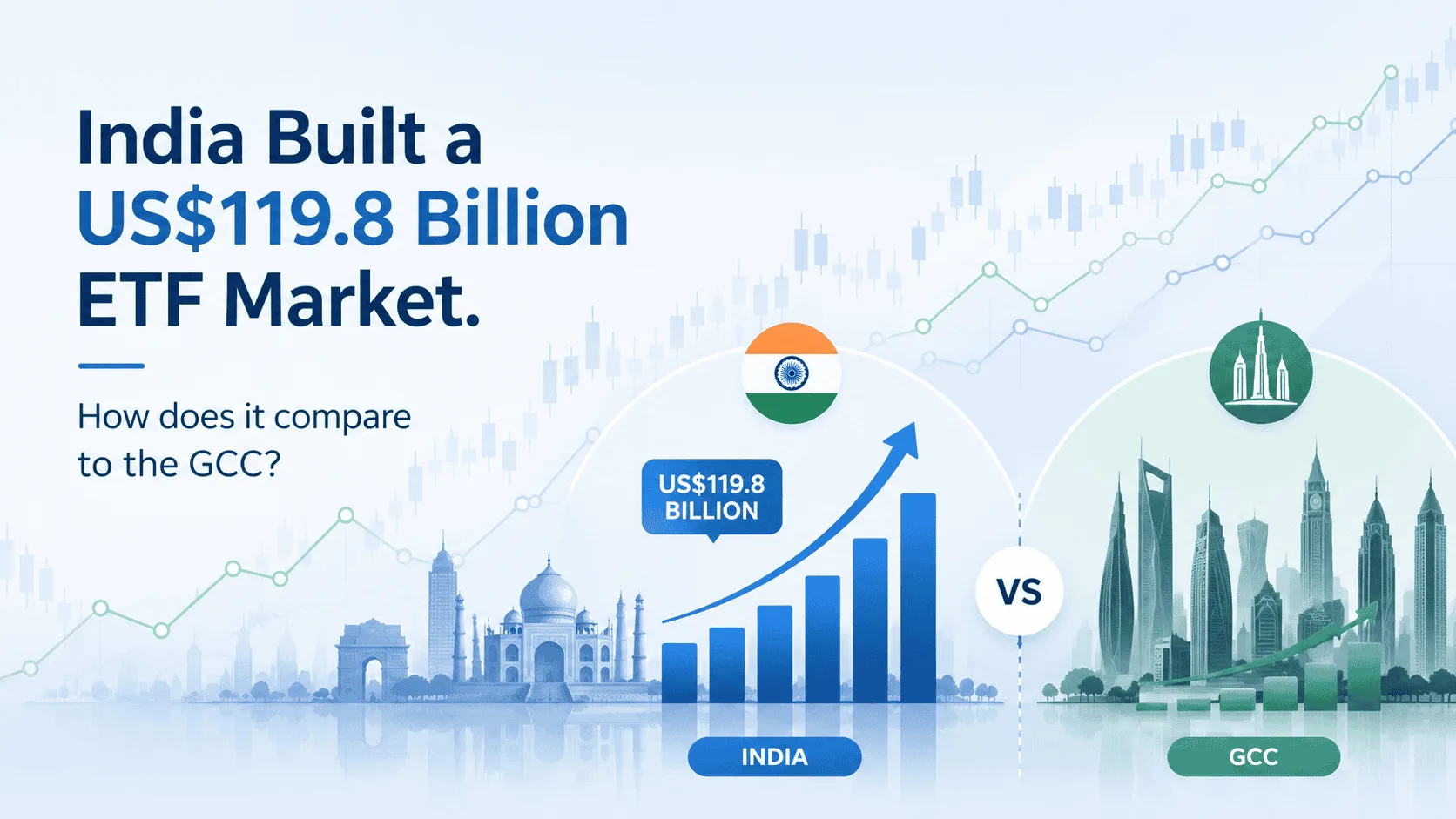
India's ETF market has crossed US$119.8 billion in assets under management (AUM), managing assets across more than 300 products as of March 2026. Non-gold ETF AUM grew 14.8% over the past year and 84.7% over the previous three years, making India one of the fastest-growing ETF markets globally.
While the GCC's ETF industry remains significantly smaller, many of the forces that transformed India's market are increasingly visible across the Gulf. Rising retail participation, mobile-first investing, growing demand for low-cost solutions, and expanding product innovation are reshaping the region's capital markets.
For GCC investors, India's ETF evolution offers a compelling case study of how passive investing can move from a niche segment to a mainstream vehicle.
How Does the GCC ETF Market Compare with India and the World?
The comparison highlights both the scale gap and the opportunity. India's ETF market is more than ten times larger than the GCC's, yet its ETF penetration remains only around half the global average, suggesting substantial room for growth in both markets.
What Is Driving India's ETF Boom?
India's growth has been powered by a fundamental shift in how households save and invest. The number of trading accounts has reached 216 million, around 15% of the population. Since the pandemic, individual investor holdings in NSE-listed companies have grown at an annualised rate of 34%, with individuals now accounting for 18.5% of stock market ownership.
Much of this expansion has been mobile-first. App-based brokers now serve around 80% of retail investors, allowing participation to spread well beyond traditional financial centres into smaller cities and emerging urban areas. India's young, smartphone-native population has made digital-first investing the norm, not the exception.
India's retail revolution
A fundamental shift is underway in how Indian households save and invest. The number of trading accounts has reached 216 million, representing around 15% of the country's population. In the five years since the pandemic, individual investor holdings in NSE-listed companies grew at an annualised rate of 34%, with individuals now holding 18.5% of the stock market.
Much of this growth is mobile-first. App-based brokers serve around 80% of all retail investors, a natural consequence of a young population that grew up with smartphones as its primary gateway to the internet. Market participation has also broadened geographically, moving beyond traditional wealth centres to a more diverse range of urban areas.
Why Are Investors Increasingly Choosing ETFs Over Active Funds?
India's ETF boom has not been driven by technology alone. Active managers have struggled to consistently outperform large-cap benchmarks after fees, prompting investors to reassess the value of paying for active management. Low-cost passive strategies have become the natural beneficiary.
Competition has intensified as technology-led asset managers have lowered fees, encouraging investors to move beyond traditional Nifty 50 trackers. Demand is increasingly shifting toward smart beta strategies, Target Maturity Funds, and commodity-backed ETFs such as gold and silver, reflecting a more mature and diversified ETF market. This evolution offers a useful blueprint for GCC markets as their ETF ecosystems continue to develop.
Are Similar Trends Emerging Across GCC Markets?
Many of the conditions that supported India's growth are increasingly visible in the Gulf. The GCC neobrokerage and digital investment platform segment is estimated at approximately US$1.2 billion in 2026, with mobile-first investing becoming the dominant channel for younger investors.
GCC-listed ETFs managed approximately US$11.5 billion in assets in 2025. While small by global standards, the market has grown steadily in the broader Middle East and Africa ETF market, reaching US$22.11 billion in 2025 and is projected to grow to US$28.7 billion by 2030 at a 5.37% CAGR.
Like India several years ago, the GCC remains primarily institution-driven, but retail participation is steadily increasing.
Why Did 2025 Become a Turning Point for GCC ETFs?
If one trend defined the GCC ETF market in 2025, it was the arrival of thematic investing. The region recorded six ETF launches during the year, including four thematic products. The most significant development was not the quantity of launches but the growing diversity of exposures they introduced.
Cross-listings of KraneShares' KWEB (China internet) and KRBN (global carbon credits) ETFs on ADX gave regional investors direct access to global themes, China technology, carbon markets, and digital infrastructure through locally traded, local-currency products. ADX's ETF market capitalisation grew 120% year-on-year as of October 2025, mirroring India's early-phase trajectory.
The GCC is also evolving into both an ETF issuer market and a distribution hub. Cross-listings allow global managers to access Gulf investors without launching standalone local products, lowering barriers for international issuers and broadening the shelf available to local investors.
How Are Sovereign Wealth Funds Supporting ETF Growth?
India's growth story has been largely retail-led. The GCC's development path is different, and that difference is an advantage.
Sovereign wealth funds across the region, PIF, ADIA, Mubadala, ADQ, and QIA, collectively manage more than US$5 trillion in assets and ranked among the top 10 global dealmakers in 2024, investing a record US$82 billion. While these institutions are not primarily ETF buyers, their activity deepens domestic capital markets, improves liquidity, and attracts international issuers. Lunate, the Abu Dhabi-based manager behind the Chimera ETF range, illustrates this dynamic, as it is itself part of Abu Dhabi's sovereign investment ecosystem.
This institutional depth creates a more fertile environment for ETF growth than India had in its early years, potentially compressing the timeline to mainstream adoption.
Bottomline
India's ETF journey shows how quickly passive investing can grow when digital access, investor participation, and product innovation come together. For the GCC, the key takeaway is that the foundations for similar growth are already emerging through rising retail investing, expanding Shariah-compliant and thematic products, and improving market infrastructure. While ETF adoption remains at an early stage, the region appears well-positioned for continued expansion in the years ahead.