
In February 2026, Invesco launched the Invesco MSCI ACWI Islamic M-Series UCITS ETF (MWIM), the first European-listed ETF to offer true all-world equity exposure under Islamic investment principles. Listed on the London Stock Exchange with a TER of 0.35%, MWIM tracks the MSCI ACWI Islamic M-Series Index, a Shariah-screened benchmark covering large- and mid-caps across both developed and emerging markets.
How the Shariah Filter Reshapes the Portfolio
The MSCI ACWI Islamic methodology applies two core screens. First, companies deriving more than 5% of revenue from prohibited activities, such as conventional banking, alcohol, gambling, tobacco, adult entertainment, and pork-related products, are excluded. Second, firms with excessive leverage or material interest-based income are removed, with debt-to-equity ratios capped to align with Islamic finance’s prohibition of riba (interest). Any non-compliant portion of dividends is deducted and donated to charity through purification adjustments.
The most visible portfolio consequence is sector rotation. Financial exposure falls dramatically from roughly 19% in standard MSCI ACWI to just 0.4%, shifting risk drivers toward technology, healthcare, industrials, and energy.
MWIM Sector Allocation
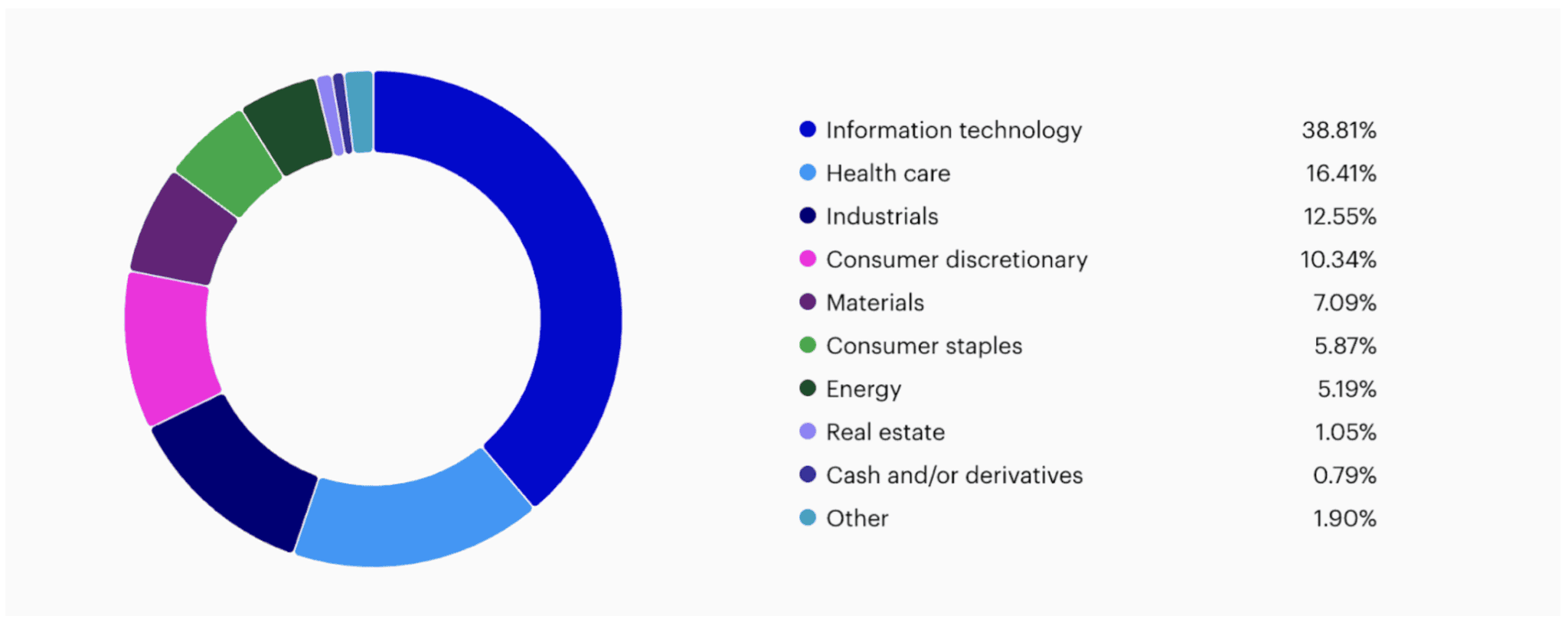
This allocation highlights a defining characteristic of Islamic equity strategies: technology and healthcare emerge as dominant exposures, while financials, typically one of the largest sectors globally, remain structurally absent.
Building on a Strong Foundation
MWIM complements Invesco’s earlier Invesco Dow Jones Islamic Global Developed Markets UCITS ETF (IGDA), launched in 2022. Now Europe’s largest Islamic equity UCITS ETF, with approximately US$1.1 billion in assets, IGDA focuses on developed markets at a TER of 0.35%. MWIM extends that reach by incorporating emerging markets, eliminating the need to assemble multiple region-specific strategies for global coverage.
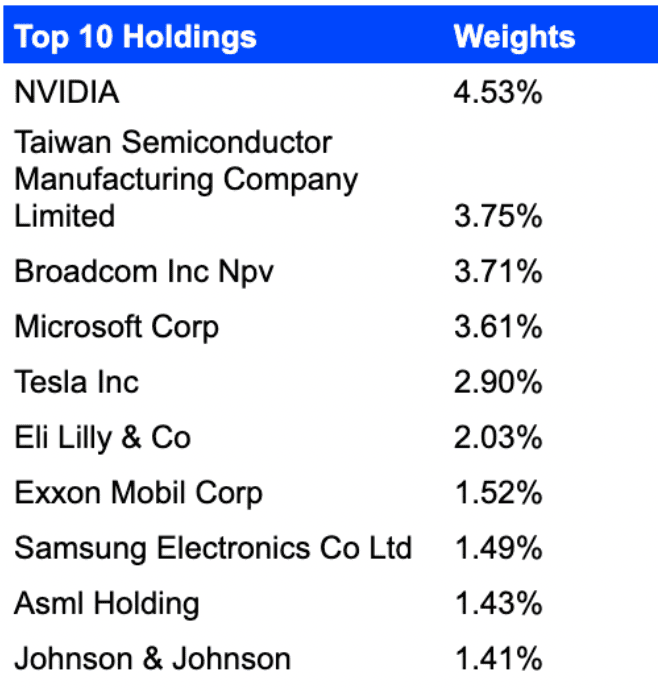
MWIM Top Holdings
The fund’s holdings illustrate how Islamic screening still results in exposure to many of the world’s most influential growth companies:
A Rapidly Expanding Global Landscape
The launch reflects a broader structural trend: Islamic investors increasingly favour ETFs for their transparency, liquidity, and cost efficiency. In the United States, products such as SP Funds’ SPUS and Principal’s HLAL have attracted significant assets, with Islamic ETF expense ratios typically ranging from 0.45% to 0.50%, making MWIM’s 0.35% TER competitively priced. Fintech-driven asset managers have also entered the segment, broadening the menu of passive Shariah investment vehicles.
The GCC: A Dynamic Shariah ETF Ecosystem
While Europe marks a milestone, the Gulf Cooperation Council has already built a robust Islamic ETF landscape. Abu Dhabi’s Chimera Investment has led regional development, launching the Chimera S&P UAE Shariah ETF in 2020, followed by the Chimera S&P KSA Shariah ETF on ADX in early 2022, which drew roughly AED 72 million in its first week, and a Chimera S&P Kuwait Shariah ETF shortly after. Together, these products give Gulf investors Shariah-aligned exposure to their home markets within an index-based framework.
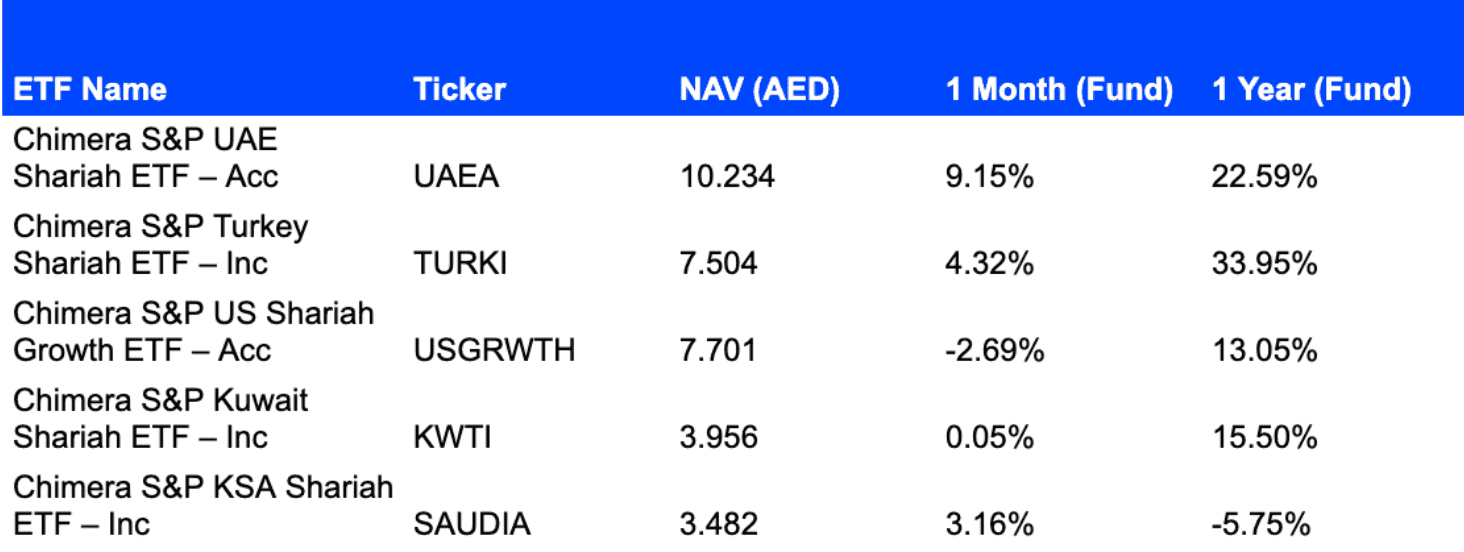
Performance dispersion across these funds underscores that returns remain market-specific even within screened universes.
The broader GCC ETF market is expanding rapidly. Total on-exchange ETF assets across Gulf exchanges now stand at approximately US$1.6 billion, with Saudi Arabia and the UAE emerging as regional hubs. A deeper breakdown of regional ETF growth, listings, and structural shifts can be found here:GCC ETF market monitor – 2025 annual review. The year of thematic ETFs
The scale of international appetite for Gulf exposure is illustrated by the first Saudi-focused ETF listed in Hong Kong, which quickly accumulated around US$1.34 billion in assets. GCC regulators have actively encouraged this growth, viewing cross-border ETFs as tools to attract international capital, with Abu Dhabi’s exchange leadership noting they “promote unique growth opportunities.” Recent industry reports point to rapid growth in ETF listings, Shariah innovation, cross-border partnerships, and rising investor participation across Saudi Arabia, the UAE, Qatar, and beyond.
How MWIM Complements GCC Allocations
MWIM complements rather than competes with GCC-listed Islamic ETFs. Regional funds inherently carry geographic concentration risk tied to local economic cycles and energy markets. Its UCITS structure means it can be accessed through international brokerage platforms, making it readily available to Gulf and international Muslim investors alike. Combining MWIM with regional holdings gives investors global growth exposure, broader sector diversification, emerging-market access outside the GCC, and consistent Shariah compliance throughout, mirroring conventional asset-allocation logic within a faith-aligned framework.
The result is a portfolio architecture investors can now build entirely within screened universes: all-world Islamic equity, country-specific GCC allocations, emerging-market strategies, sukuk instruments, and factor-tilted Islamic ETFs.
Bottom line
The Invesco MWIM launch reinforces a critical structural shift: Shariah compliance and global portfolio efficiency are no longer mutually exclusive. Global asset managers increasingly see rising demand for Islamic equity exposure that aligns with both faith principles and broader ESG values. For GCC investors already supported by a growing suite of regional Islamic ETFs, an all-world Shariah vehicle meaningfully enhances flexibility, risk management, and long-term diversification, deepening Islamic finance’s integration into global capital markets.