

The World Bank, in its latest Global Economic Prospects report, forecasts that the UAE economy will expand by 5.0% in 2026, accelerating further to 5.1% in 2027. At a time when policy uncertainty, trade frictions, and geopolitical risks continue to cloud the global outlook, this projection places the UAE firmly among the world’s most resilient and structurally robust growth stories.
Global Growth and Uneven Recovery Dynamics
To appreciate the significance of the UAE’s outlook, it is important first to understand the broader global context. The World Bank expects global growth to moderate to 2.6% in 2026, before edging up to 2.7% in 2027. While this represents resilience amid external shocks supported in part by stronger-than-expected performance in the United States, the medium-term picture remains constrained.
The report cautions that the 2020s could still emerge as the weakest decade for global growth since the 1960s. Beneath headline stability lies a sharply uneven recovery: advanced economies have largely regained or exceeded pre-2019 income levels, while nearly one in four developing economies remains poorer than before the pandemic. Growth across emerging and developing markets is projected to slow to about 4.0% in 2026, with only a modest recovery in 2027 as investment conditions gradually improve.
Against this fragmented global landscape, economies capable of delivering both scale and stability stand out, and this is where the UAE becomes particularly compelling.
Why the UAE Outlook Matters More Than the Headline Numbers
The UAE’s projected growth is not cyclical luck; it reflects a structural transformation that has been underway for years. A defining feature of the 2026–27 outlook is the dominance of non-oil growth engines, operating within a supportive regional and global environment.
Tourism has not only recovered but expanded beyond pre-pandemic levels, supported by global connectivity, premium hospitality investment, and a year-round calendar of events. At the same time, sustained infrastructure spending across transport, logistics, housing, and industrial zones continues to act as a powerful multiplier, reinforced by productivity gains from digital transformation.
Regionally, the backdrop is equally supportive. GCC economies are expected to grow by around 4.4% in 2026 and 4.6% in 2027, with the UAE among the top performers. The broader MENAP region is also set to accelerate from 3.6% to 3.9%, reinforcing regional demand, capital flows, and trade linkages.
Crucially, these growth drivers coincide with moderating inflation (around 2.6%) and stabilizing commodity prices, creating a rare alignment of robust expansion and macroeconomic stability conditions that markets tend to reward.
UAE Economic Outlook, What the Numbers Say (2026–27)
The strength of the UAE story becomes clearer when the World Bank’s medium-term projections are viewed together. The table below summarizes the official macroeconomic outlook through 2027, highlighting the combination of accelerating growth, low inflation, and strong fiscal and external balances.
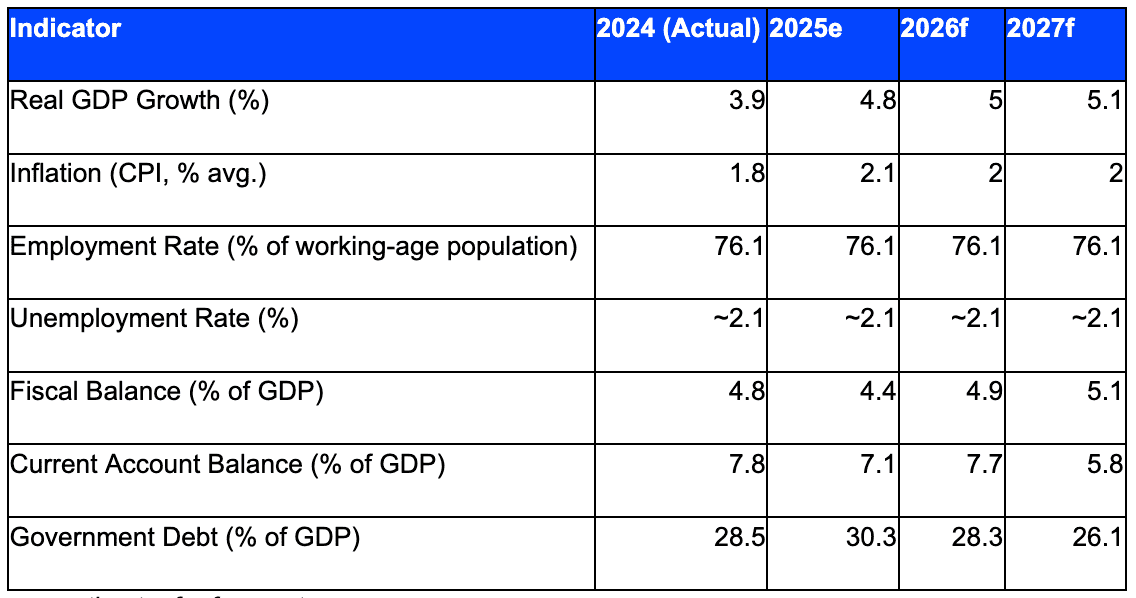
e = estimate, f = forecast.
What stands out is not just growth above 5%, but the quality of that growth: inflation anchored near 2%, unemployment structurally low, fiscal balances firmly in surplus, and public debt declining into 2027.
How Can Investors Access the UAE Growth Story Through ETFs?
This is where investors’ preferences are shifting. Rather than relying on single-stock exposure, investors could favour diversified, transparent, and liquid instruments that allow them to express macro conviction efficiently.
Among the most direct beneficiaries of the UAE growth narrative are ETFs offered by Chimera Capital, which has built a strong footprint in UAE- and GCC-focused strategies.
Chimera’s UAE ETF Suite
Among the most direct beneficiaries of the UAE growth narrative are ETFs offered by Chimera Capital, which have built a strong footprint in GCC and UAE-focused strategies.
Key UAE-linked ETFs include:
Chimera S&P UAE Shariah ETF (UAEA)
This ETF tracks the S&P Shariah Dubai All Share Index and is designed for investors seeking Shariah-compliant exposure to UAE equities. As of January 2026, it manages $40.81 million in AUM, carries a 0.70% expense ratio, and has delivered a 17.23% one-year return. The fund benefits directly from growth in banking, real estate, and consumer-linked sectors while aligning with ethical investment principles.
Chimera S&P UAE UCITS ETF (UAED)
UCITS-compliant and globally accessible, UAED tracks the S&P UAE Exchange CAP Index. With $43.02 million in AUM, a lower 0.60% expense ratio, and a strong 21.66% one-year return, it offers broad-based exposure to the UAE equity market. For international investors positioning for 2026–27 growth, UAED functions as a core allocation vehicle.
Other Notable GCC ETFs Supporting UAE Allocations
While Chimera dominates UAE-specific ETF listings, broader GCC ETFs complement UAE exposure by offering regional diversification.
The Chimera FTSE ADX 15 ETF (CHADX15) provides a more concentrated approach, tracking the FTSE ADX 15 Index. With $64.22 million in AUM and a 15.24% one-year return, it targets the largest and most liquid Abu Dhabi-listed companies, making it particularly sensitive to domestic economic strength and institutional flows.
For investors seeking diversification beyond the UAE, products such as the Al Rayan Qatar ETF (QATR) offer exposure to neighbouring GCC markets. QATR manages $127.84 million in AUM with a 0.50% expense ratio, though its 1.26% one-year return highlights the UAE’s relative outperformance within the region.
Platforms and allocators such as Lunate further support ETF adoption by integrating these products into institutional and sovereign portfolios, reinforcing liquidity and long-term demand.
ETF Performance Snapshot (Jan 2026 Data)
Across 36 GCC-listed ETFs, total assets stand near $11.5 billion, with average expense ratios around 0.68% and rising traded values. Recent data shows a 30-day average trading volume of over 18,000 shares, signaling improving liquidity and market depth.
Building Balanced Portfolios Around the UAE Core
Importantly, the UAE growth story does not exist in isolation. Investors often complement UAE equity exposure with thematic and defensive ETFs.
Gold ETFs, such as the Albilad Gold ETF, continue to play a stabilizing role amid global uncertainty, while regional bond and ESG-linked ETFs benefit from strong sovereign balance sheets and sustainability-linked issuance. Together, these instruments allow investors to construct balanced, growth-aligned portfolios anchored by UAE equities.
What 2026-27 Could Look Like for Investors
If the World Bank’s projections materialize, the implications could be far-reaching. Corporate earnings are likely to remain resilient, particularly in banking, logistics, utilities, and consumer sectors tied to domestic demand and infrastructure spending. As foreign ownership deepens and liquidity improves, the potential for valuation re-rating increases.
At the same time, ETF assets under management are expected to accelerate as institutional investors continue shifting toward cost-efficient, rules-based exposure. Deeper markets should gradually reduce volatility and tighten bid–ask spreads, enhancing overall efficiency.
Most importantly, the UAE’s growth now appears structural rather than cyclical, a rare and valuable trait among emerging and frontier markets.
Bottomline
The World Bank’s forecast of 5% growth in 2026 and 5.1% in 2027 reinforces the UAE’s position as one of the world’s most compelling growth economies. With non-oil sectors driving expansion, inflation moderating, and capital markets deepening, the investment case is becoming clearer and more accessible.
For investors, UAE-focused ETFs, particularly those from Chimera, complemented by broader offerings from Lunate and other regional issuers, offer a practical way to align portfolios with this transformation.
In an environment where global growth is scarce, policy uncertainty is high, and capital seeks stability with upside, the UAE’s outlook stands out. The next two years may well define how international investors permanently reweight the Emirates within global portfolios.