
When the Dow Jones Industrial Average crossed 50,000 points in early February 2026, the move was widely interpreted as a clear confirmation of U.S. equity strength. Inflation data had moderated, policy rhetoric appeared more constructive, and earnings across many large U.S. companies were coming in ahead of expectations. On the surface, the rally looked orderly, broad, and reassuring.
Dig a little deeper, however, and the milestone reveals a more nuanced picture of how markets are actually behaving.
What drove the move
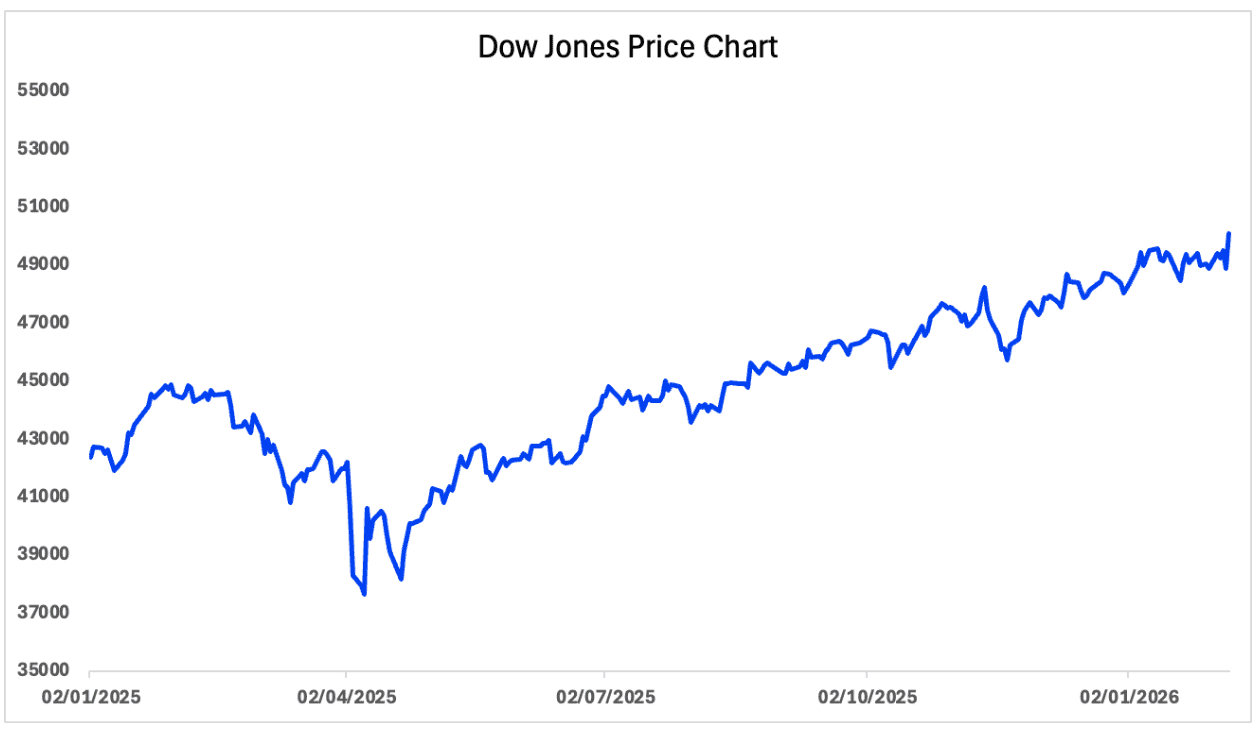
Top Performing sectors
Unlike earlier phases of the post-pandemicrally that were dominated by a narrow group of mega-cap technology stocks, the Dow’s climb to 50,000 reflected contributions from several sectors. Industrials, financials, and healthcare were among the strongest performers, benefiting from improving economic expectations, resilient consumer demand, and stable margins.
Industrials gained support from infrastructure spending and capital expenditure tied to automation and reshoring trends. Financials were buoyed by solid net interest income and improving capital markets activity, while healthcare provided defensive ballast through steady earnings and pricing power.
Technology also played a role, though more selectively. AI-related semiconductor and infrastructure names such as Nvidia and Broadcom helped support sentiment, reflecting confidence in sustained investment in data centers and compute capacity. However, their influence within the Dow is more muted than in market-cap-weighted indices.
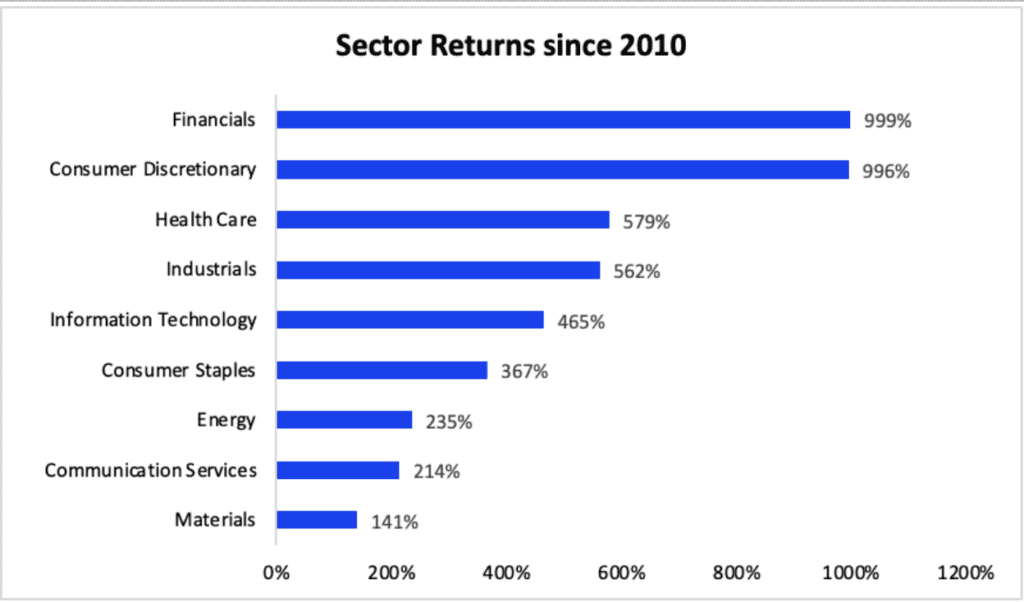
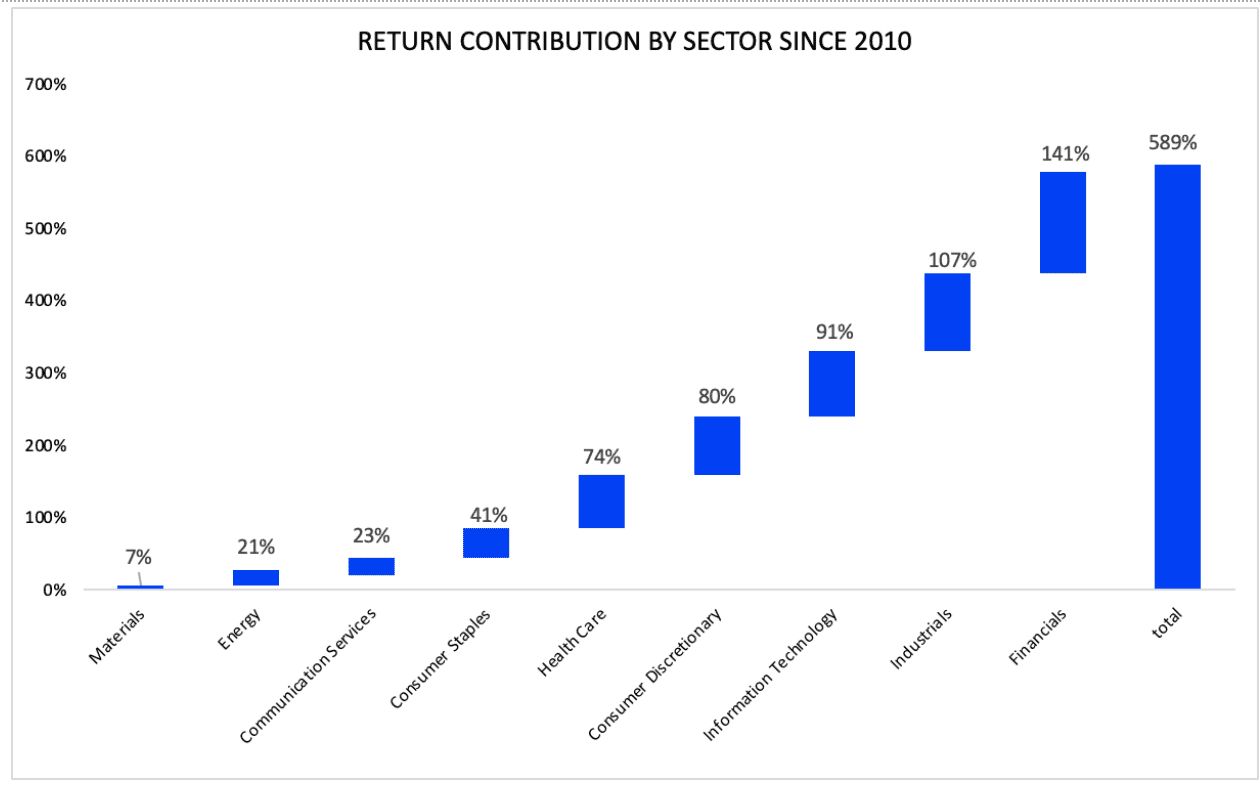
Financials were the largest contributor with 141% contribution to the Dow’s 586% total return since 1 January 2010, reflecting both strong sector performance and a consistently high index weight. Consumer discretionary, health care, and industrials were also major contributors.
Materials, communication services, and energy contributed the least, with 7%, 21%, 23% returns respectively. Since lower average weights and more cyclical, volatile returns limited their overall impact on the index’s long-term gains.
Understanding the Dow’s structure
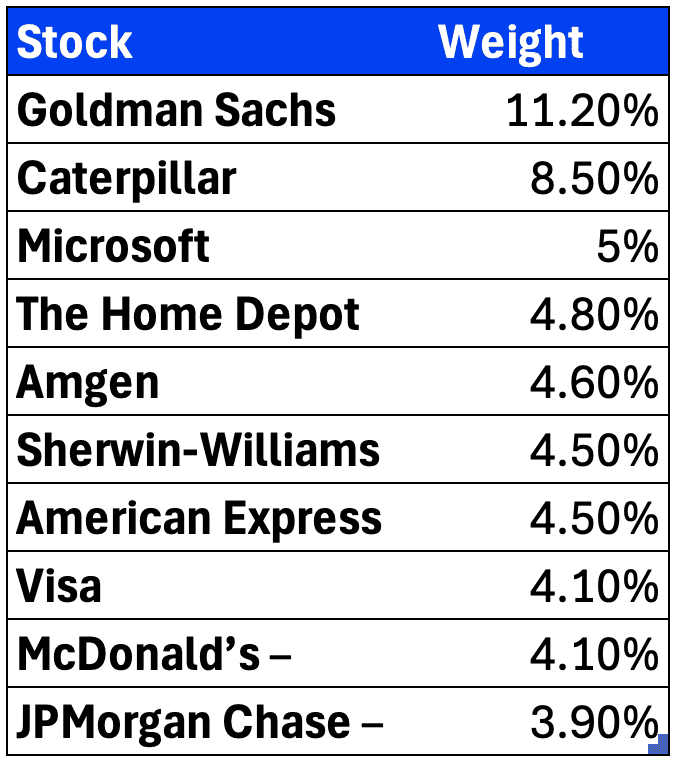
One reason the Dow can send a different signal than the broader market lies in its construction. The index tracks just 30 large, established U.S. companies and is price-weighted, meaning higher-priced stocks have a larger impact on index movements regardless of their market capitalization.
As a result, industrial leaders, large banks, and legacy consumer names can exert outsized influence relative to newer growth companies. This makes the Dow particularly sensitive to moves in traditional sectors and explains why its recent performance has diverged at times from the S&P 500 and Nasdaq.
Top 10 Dow Stocks by Weight
Signals beneath the surface
While equities pushed to record highs, other parts of the market painted a more mixed picture. Investor positioning remained cautious, with substantial assets still held in cash-like instruments. Volatility, meanwhile, eased but did not disappear, instead oscillating between calm periods and sharp, headline-driven moves.
Credit markets told a different story again. Investment-grade spreads stayed near historically tight levels, implying confidence in corporate balance sheets and limited default risk even as equity markets showed growing dispersion between winners and laggards.
Taken together, these signals suggest a market that is functioning smoothly, but not uniformly. Participation is broad, yet outcomes are increasingly differentiated at the company and sector level.
What this means for investors
Dow 50,000 is best viewed as a marker of market conditions, not a verdict on future direction. It highlights the renewed role of industrials, financials, and healthcare in driving U.S. equity performance, while also underscoring the importance of index construction in shaping headlines.
A note of caution: record levels can coexist with underlying complexity. For investors particularly those in the UAE and wider GCC accessing U.S. markets via ETFs, understanding sector composition, index mechanics, liquidity, and structure matters as much as tracking the headline number itself.