
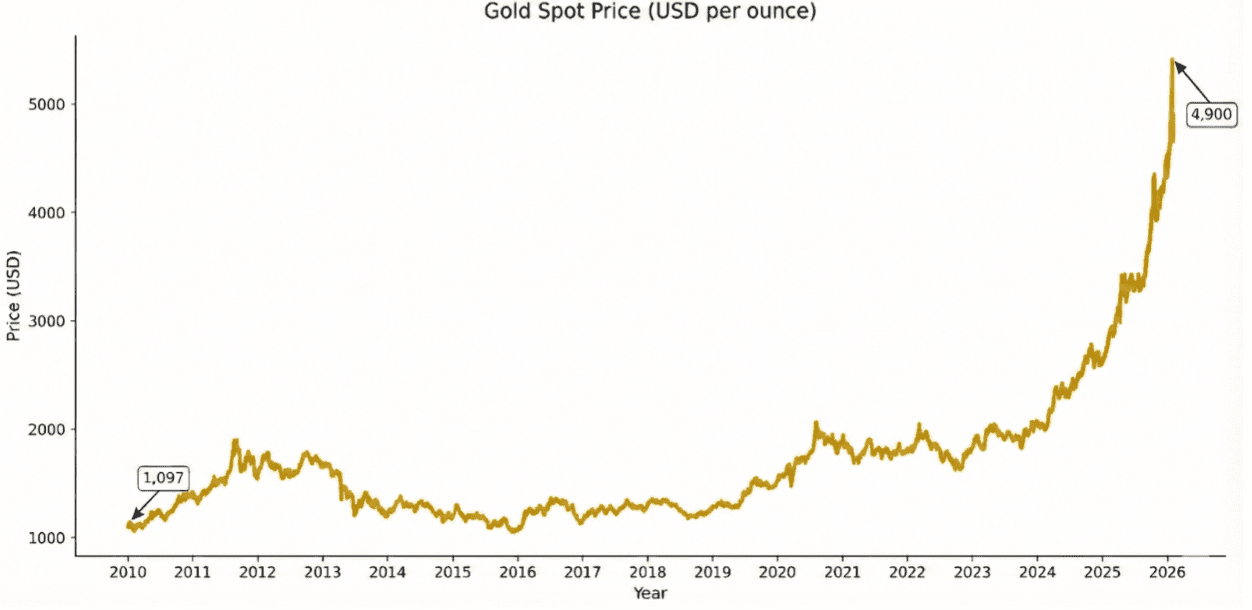
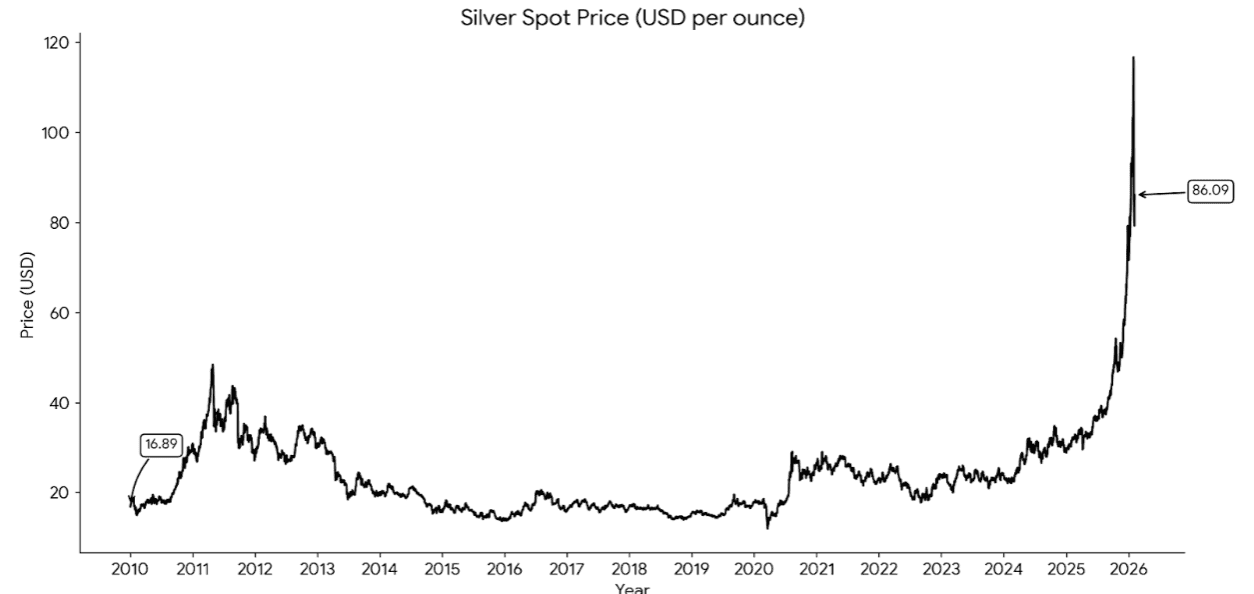
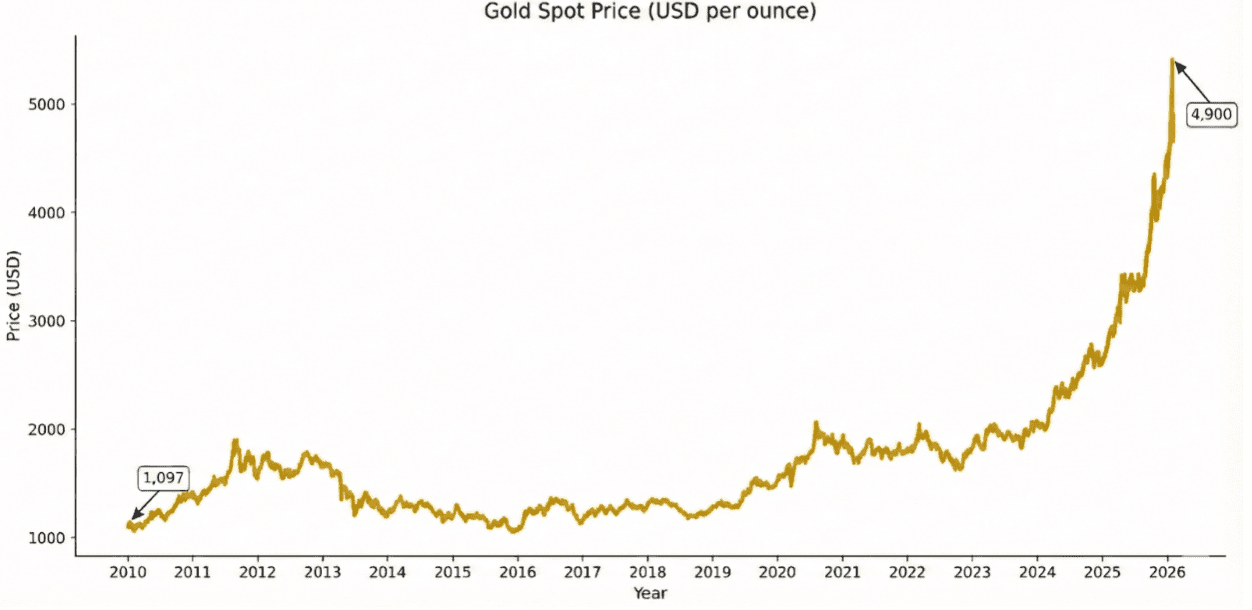
Gold’s abrupt slide and silver’s record volatility have rattled global markets and forced investors to confront an uncomfortable reality: even assets designed to protect portfolios can become sources of risk when positioning grows crowded. Over just a few sessions, spot gold fell nearly 9%, briefly sinking around 10% from recent highs, after last week’s rally to all-time peaks near $5,600 per ounce, while silver suffered its sharpest drop on record, plunging as much as 27-36% at the lows before trimming losses. This correction followed a period of exceptional momentum, explored in Gold Breaks $5,000: A Brief Moment That Says a Lot.
Spot gold recovered somewhat to trade below $4,800 per ounce, and silver rebounded from around $72-$80 per ounce, but the intense swings wiped out trillions in market value and spilled across equities, commodities, and crypto as leveraged positions were unwound.What matters now is not just the price action in precious metals, but what this episode reveals about how gold exposure should be structured as investors position portfolios for 2026. The focus is shifting away from short-term price moves and toward the structure and discipline of gold exposure during periods of heightened volatility.
A Familiar Pattern in Precious Metals
In November 2025, gold exhibited a pattern similar to early 2026, where safe-haven positioning drew prices higher before volatility trimmed gains, a dynamic examined in Gold’s 2025 super cycle: from trading screens to the gold souk. Over the month, spot gold rose about 5.2% (to roughly $4,210 per ounce), marking its fourth straight monthly gain. At the same time, it experienced notable intramonth swings, rallying as much as ~1.8% on sessions tied to expectations of Federal Reserve rate cuts and then pulling back approximately 1% on days when macro risk eased, such as after U.S. political developments that reduced immediate stress on markets.
These moves occurred against a backdrop where gold was already up around 50-60% year-to-date, reflecting extended safe-haven positioning headed into the year-end. This dynamic, an early rally followed by profit-taking and corrective setbacks, reflected positioning adjustments, not structural breakdowns, and foreshadowed the sharper repricing in early 2026.
Similar patterns have played out in earlier episodes, from gold’s sharp correction in late 2025 after a prolonged rally to larger drawdowns during the 2008 financial crisis and the post-2012 sell-off. In each case, safe-haven assets corrected sharply as positioning unwound or sentiment shifted, even in the absence of a fundamental demand shock. These episodes underscore that gold’s defensive role does not make it immune to volatility when trades become crowded.
Importantly, such corrections did not mark the end of gold’s longer-term uptrend. In each historical episode, prices stabilised once positioning reset, before moving higher again. Volatility, in this sense, has consistently been a feature of gold’s long-term rallies rather than evidence that the underlying investment thesis is broken.
Decoding the Gold and Silver Correction
The scale and speed of the correction caught markets off guard. Gold tumbled approx 9% to around USD 4,465 per ounce, retreating sharply from recent highs near USD 5,600. Silver fell between 27-36%. The catalyst was not a collapse in fundamentals, but a shift in expectations. US President Donald Trump’s nomination of Kevin Warsh to lead the Federal Reserve was interpreted as reinforcing institutional independence and a firmer monetary stance. Markets read this as a signal that policy accommodation would be more limited than previously assumed.
That perception triggered a rapid unwind of crowded safe-haven positions, a move amplified by a strengthening US dollar, which rose around 0.16% against a basket of major currencies. Margin requirement increases on metal futures further drained liquidity, accelerating forced selling.
Importantly, this was a positioning reset rather than a structural breakdown. Gold remains up roughly 65% year-on-year, and several global banks continue to forecast higher prices over the medium term. Yet the episode highlighted how vulnerable even defensive assets can become when too much capital crowds into the same trade.
Gold Spot rate
Silver Spot Rate
Global Market Ripples Spread Quickly
The sell-off did not stop at precious metals. Industrial metals such as platinum and copper fell 9-10%, while oil prices declined around 5% to approximately $64.80 per barrel, aided by signs of de-escalation in US-Iran tensions. Risk assets also came under pressure, with bitcoin shedding about 9% over the weekend.
Equity markets reacted in tandem. Futures on the S&P 500 pointed to losses near 0.9%, while the UK’s FTSE 100 slipped 0.4%, led lower by precious-metal miners such as Fresnillo, which fell more than 5%. The pan-European STOXX 600 also eased 0.4%.
Pressure intensified after CME margin requirements on metal futures were raised, thinning liquidity and forcing leveraged positions to unwind. Gold recorded its steepest one-day drop since 1983, while strategist indicators showed positioning cooling rapidly, from near 8/10 to around 4/10, suggesting weaker hands had exited the trade. Asian equities followed Wall Street lower as the risk-off mood spread ahead of earnings and central bank meetings.
The Allocation Lesson for 2026
Recent volatility in gold highlights the difference between diversification and short-term price behavior. Over longer horizons, gold proxied by GLD has maintained low correlations with US and global equities, while correlations with global bonds have remained moderate and consistent with historical norms. Equity markets, by contrast, continue to show high correlations with one another, reinforcing gold’s differentiated role in diversified portfolios.
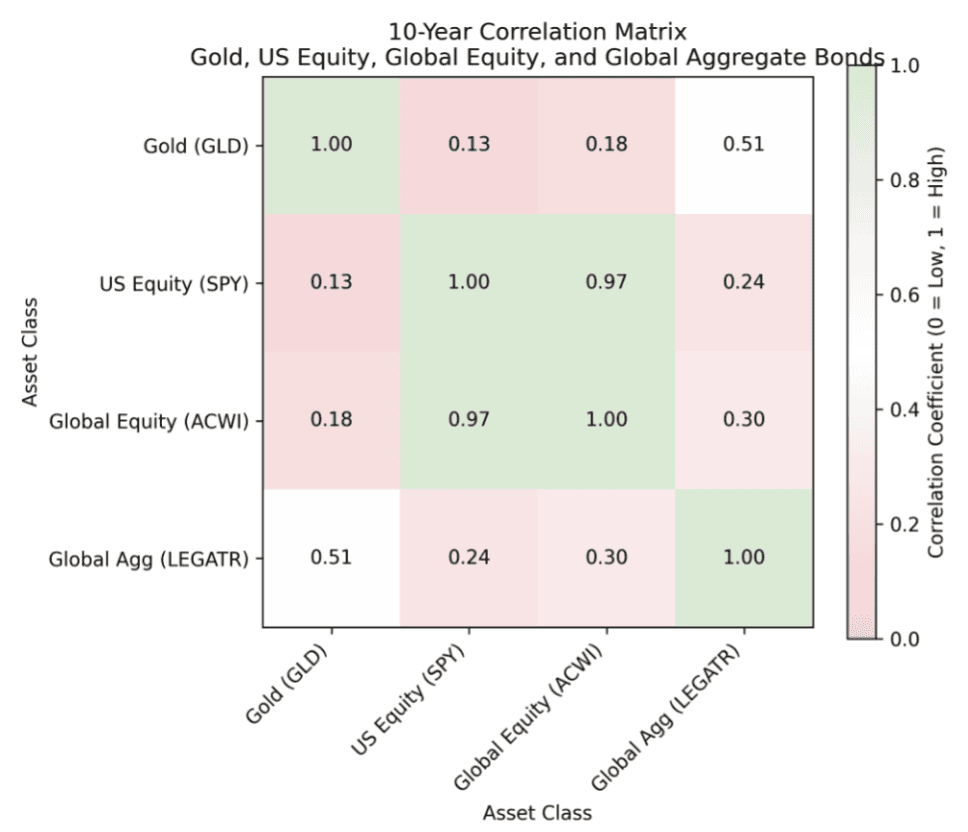
Gold maintains low long-term correlations with equities, supporting stable diversification characteristics.
Short-term correlations can fluctuate during periods of market stress, as reflected in the 1-year correlation matrix. These temporary shifts tend to coincide with elevated volatility and positioning adjustments rather than a structural change in gold’s relationship with other asset classes.
Short-term correlations vary during volatile periods, reflecting market conditions rather than diversification breakdown.
Taken together, the data indicate that diversification remains intact. The challenge for investors is therefore managing volatility, not reassessing gold’s role within diversified portfolios.
This distinction places renewed emphasis on the structure of gold exposure, particularly during volatile market conditions.
Staying Invested in Gold Without Amplifying Volatility
For investors seeking to maintain gold exposure without trading price swings, transparent and physically backed vehicles become especially relevant. Rather than reacting to short-term corrections, the focus shifts to holding gold in a way that aligns with long-term portfolio objectives.
This is where the Albilad Gold ETF fits naturally. As of January 2026, the fund manages approximately USD 40 million in assets, with a low expense ratio of 0.75%, supporting efficient long-term ownership. Importantly, the ETF has delivered a one-year return of ~64.9% and a three-year return of ~31.7%, reflecting gold’s strong multi-year performance despite interim volatility.
Liquidity has also improved, with a 30-day average trading volume of over 100,000 shares, helping investors maintain flexibility without relying on leverage or derivatives.
Why Structure Matters in Volatile Gold Markets
Sharp corrections often tempt investors to either overreact or abandon exposure altogether. History suggests that neither approach is optimal. Gold has repeatedly experienced deep pullbacks within broader uptrends, only to stabilise once positioning resets.
Structured products like Albilad Gold ETF help reduce behavioural risk by removing margin calls, forced selling, and timing pressure. By maintaining direct exposure to gold prices through a regulated ETF format, investors can stay aligned with gold’s long-term fundamentals while avoiding the amplification effects seen in futures and leveraged trades.
Bottom Line
Gold’s recent turbulence is not a signal to exit, but a reminder to be deliberate about exposure. As markets adjust to tighter liquidity conditions and shifting rate expectations, gold continues to play a meaningful role in diversified portfolios.
Maintaining that exposure through simple, unleveraged, and cost-efficient vehicles such as Albilad Gold ETF allows investors to stay invested in the metal’s long-term thesis without being forced into reactive decisions during periods of heightened volatility.