


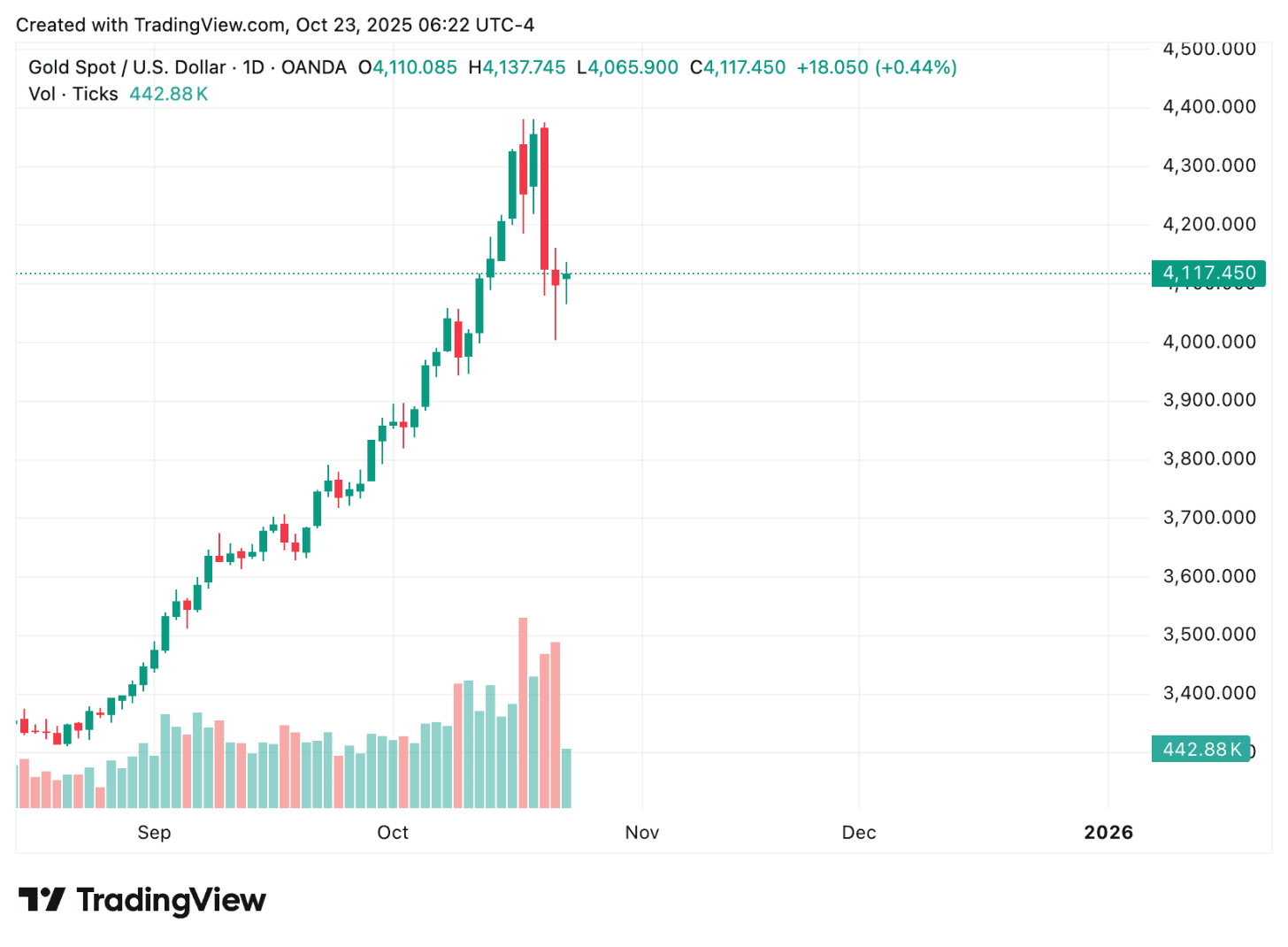
As of October 22, 2025, after an extraordinary climb that pushed spot gold beyond US $4,300 per ounce in early October, the precious metal has finally met resistance. Prices have eased to around US $4,240, down about 1.5% for the week, as investors adjust to a firmer dollar and reassess the timing of future U.S. Federal Reserve rate cuts. The pullback follows months of near-vertical gains that made gold one of 2025’s standout assets and now one of its most volatile.
A Dollar Rebound and a Fed Rethink
The primary catalyst behind gold’s retreat is the rebound in the U.S. dollar, which has recovered from its summer lows as traders tempered expectations for additional Fed easing. Only a few weeks ago, futures markets were pricing in two more rate cuts before year-end. But stronger-than-expected September inflation data, 3.2% year-on-year and persistent wage growth have shifted sentiment.
At its October meeting, the Federal Reserve signaled caution. According to minutes released on October 16, 2025, policymakers noted that “progress on inflation has slowed” and emphasized the need to maintain restrictive policy “for longer if necessary.” That tone, echoed in subsequent Bloomberg and Reuters reports, lifted Treasury yields across the curve, with the 10-year yield briefly touching 4.75%, its highest level since August. For gold, which yields nothing, higher real rates translate directly into opportunity cost.
The stronger dollar compounds the pressure. The DXY index climbed above 107 in mid-October, its best level since May. For holders of other currencies, this effectively raises the local-currency cost of gold, dampening demand.
Short-Term Volatility Amid a Long-Term Uptrend
The pullback unleashed a bout of short-term volatility across global commodity desks. Algorithmic and momentum traders, who had built leveraged long positions through September’s rally, were quick to unwind. That produced a two-day correction of roughly 2%, modest in historical context but enough to spook latecomers to the trade.
Still, there’s little sign of structural weakness. Physical demand remains robust, especially from central banks in China, India, and the Gulf, which continue to diversify away from U.S. Treasuries. According to World Gold Council data, global official-sector purchases have exceeded 800 tonnes year-to-date, setting a modern-era record.
In futures markets, speculative net-long positions on the COMEX have dipped only slightly, suggesting traders see this as a consolidation phase rather than a reversal.
Inflation Keeps the Bullish Case Intact
Even with the dollar’s rebound, the inflation story still underpins gold’s appeal. Prices remain well above central-bank targets globally, and real interest rates nominal yields that are adjusted for inflation are near zero or negative in most developed markets. That keeps gold competitive as a store of value.
Fiscal conditions add another layer. U.S. debt issuance has surged amid ongoing budget deficits and political gridlock, a combination that undermines confidence in sovereign paper. For many reserve managers, gold is emerging not just as an inflation hedge but as a neutral reserve asset, immune to counterparty and sanction risks.
ETF-Anchored Perspectives: Local and Global
For GCC and global investors, gold exposure can be accessed through both physically backed and equity-linked ETFs, each reflecting a different dimension of the gold trade.
The Albilad Gold ETF (ALBIGOLD AB), listed on the Saudi Exchange, remains the Gulf’s flagship Sharia-compliant gold fund. As of October 22, 2025, it has delivered a +38.9% year-to-date return and a +40.7% one-year return, with assets under management of about US $25 million.
It carries an expense ratio of 0.75% and trades in Saudi riyals (SAR), offering local investors physical gold exposure without cross-border custody risk.
For investors seeking equity leverage to the gold cycle, the VanEck Gold Miners ETF (GDX) provides global exposure to major mining companies such as Newmont, Barrick Gold and Agnico Eagle. As of October 22, 2025, GDX is up roughly +56% over the past year and about +35% year-to-date, according to Bloomberg data, supported by robust margins and improving free-cash-flow profiles across the mining sector.
Meanwhile, the SPDR Gold Shares (GLD) from State Street Global Advisors, the world’s largest physically backed gold ETF, continues to dominate with more than US $78 billion AUM. It has returned around +34% YTD and +37% over the past 12 months, closely tracking spot-market moves. GLD remains the preferred global liquidity benchmark for institutional investors.
Together, these funds illustrate the range of vehicles through which gold’s current dynamics play out from regional Sharia-compliant exposure to global equity proxies and high-liquidity bullion trackers.
A Pause, Not a Pivot
From a technical standpoint, gold’s recent softness looks more like a breather than a breakdown. After gaining roughly 38% year-to-date, the metal was overdue for some digestion. Its relative-strength index (RSI) has cooled from overbought territory, while key moving averages remain in bullish alignment. Analysts view the US $4,200–4,250 range as near-term support.
Short-term turbulence may persist while markets recalibrate around the Fed and the dollar, but the longer-term trajectory still points upward. Fiscal strain, lingering inflation, and sustained central-bank buying remain powerful structural drivers.
The Global Takeaway
The latest dip in gold prices is best read as the market catching its breath after a historic run. The metal’s role as an inflation hedge, reserve diversifier, and geopolitical hedge remains undiminished. In the short term, tighter financial conditions and a firmer dollar can restrain momentum; in the long term, the same fiscal and political uncertainties that propelled gold past $4,000 in the first place are still with us.
Put simply, this is gold pausing for balance, not losing its luster.
Disclaimer: Nukoud is not a licensed financial advisor, and the information provided is for general informational and educational purposes only.