Retail investors in Germany placed ETF trades worth nearly €1.4bn a day in the first nine months of 2026. That was 40% above the €991m average daily value traded over the same period in 2025. The figure shows how quickly individual investors are becoming a bigger force in Europe's ETF market.
The growth in retail trading comes alongside broader expansion in Europe's ETF market. Nukoud's analysis of Morningstar's Q2 2026 report found that Europe's active ETF market reached EUR 108.3 billion in assets in the first half of the year.
European retail ETF trading surges across major markets
Retail ETF trading accelerated across Europe
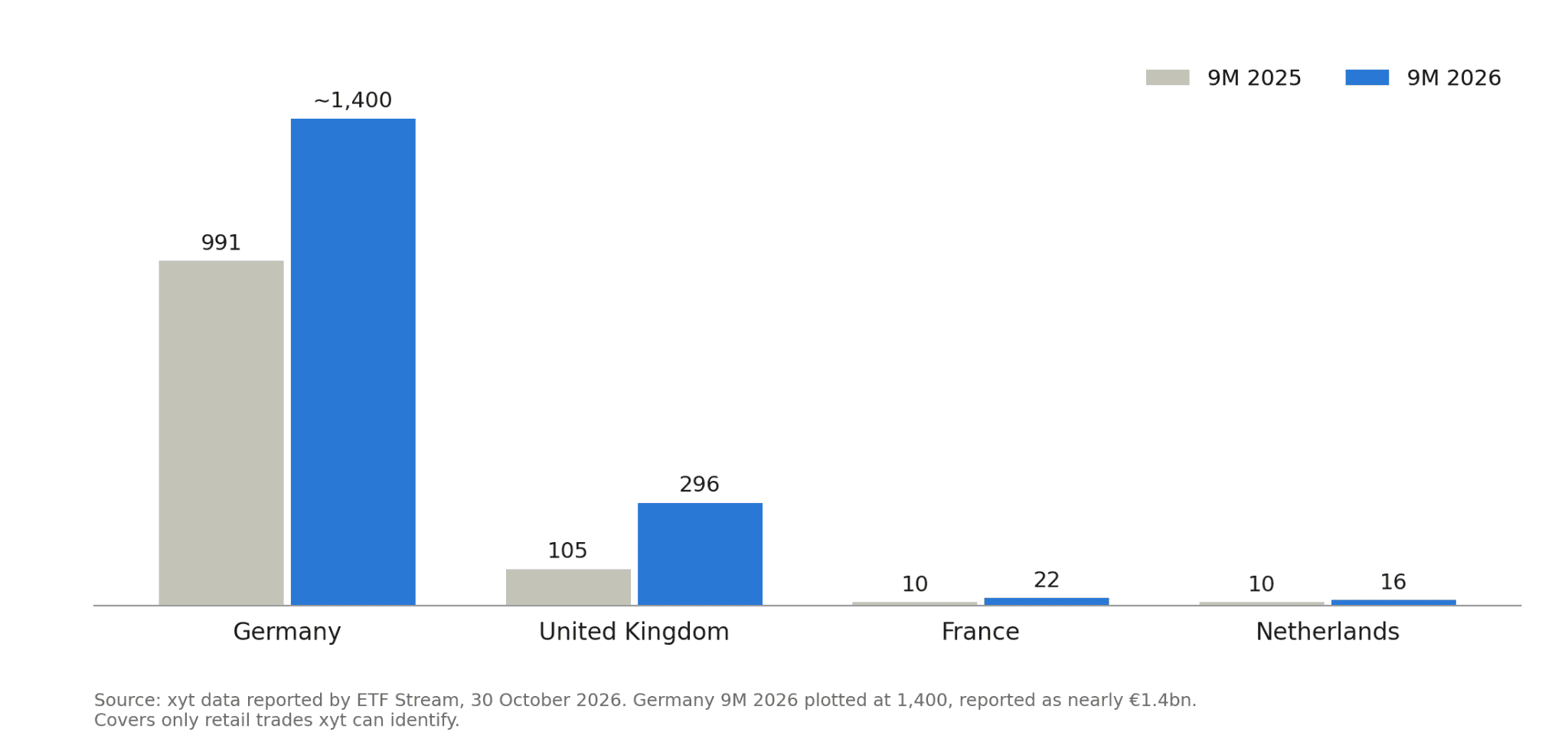
UK retail activity very nearly tripled, France more than doubled, and the Netherlands rose by around 60%. The data does not capture every retail ETF trade. It covers 14 European exchanges and trading venues, while some venues are still unable to identify and flag retail activity, meaning the figures provide only a partial picture of retail participation.
Retail investors are becoming a bigger source of ETF liquidity
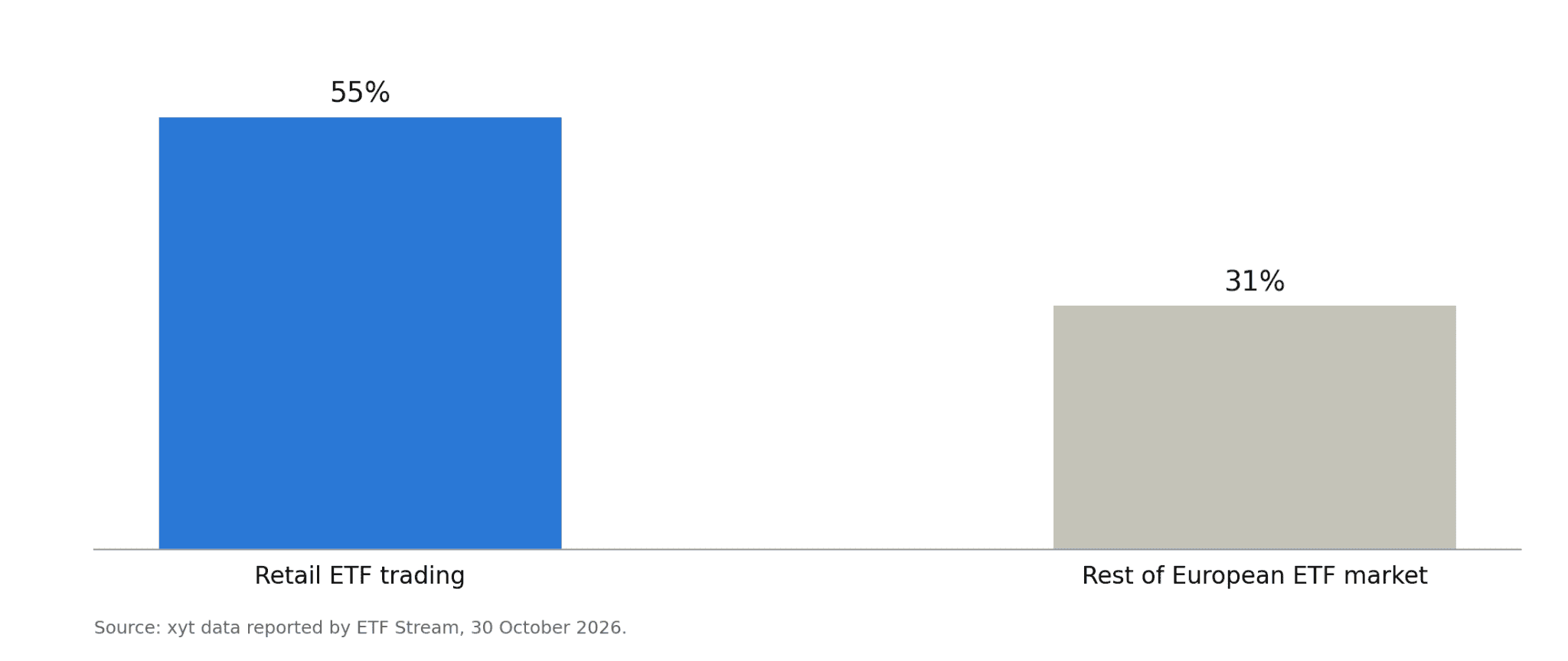
Across Europe, the average daily value of ETFs traded by retail investors rose 55% in the first nine months of 2026, compared with 31% for the rest of the European ETF market. In January, retail trades made up 10.4% of overall European ETF liquidity, the largest monthly share of the year so far.
Retail ETF trading growth outpaced Europe's broader ETF market
Retail investors are becoming a structural part of ETF liquidity rather than simply a source of activity around institutional flows. They were net buyers of ETFs in every month of the year to date. In March, they bought while non-retail investors sold equity, commodity and crypto ETFs, providing a partial counterweight. However, European retail demand has not yet been tested in a severe market downturn.
Zero-fee ETFs and retirement savings could drive further growth
DWS and Scalable Capital are waiving the management fee on a new distributing share class of the Scalable MSCI AC World Xtrackers UCITS ETF (SCWX) until the end of 2027, repeating a similar offer first made in December 2024. SCWX has accumulated around €850m in assets in less than two years, helped by its earlier zero-fee launch offer. The new fee waiver could provide another boost to asset growth.
The new distributing share class is intended to appeal to savers expected to use Germany's Altersvorsorgedepot, a government-backed, tax-efficient retirement savings scheme that ETF Stream reported is due to begin early next year. Scalable will also credit investors for SCWX management fees held in the scheme after the waiver expires.
The development shows how an asset manager, a digital investment platform and a government-backed savings framework can reinforce one another. Low fees attract investors, digital platforms simplify access, and retirement incentives can encourage regular long-term contributions. DWS has distribution partnerships with several dozen neobrokers that compete with Scalable, so rivals face pressure to match the offer.
How retail investors are changing ETF trading hours
Many retail investors trade in the evening, and exchanges responded with longer hours. Deutsche Börse, Euronext and SIX Swiss Exchange now offer extended evening trading. In Germany, ETF trading outside regular hours rose 29% to €289m per day in the first nine months of 2026, and more than a fifth of activity on regional and retail venues took place outside core hours. The growth coincided with extended trading hours introduced on Xetra in December 2025.
Liquidity can be thinner outside core hours, potentially resulting in wider spreads, an issue that less experienced retail investors may not fully consider when placing trades. Xetra's price improvement service applies only during regular hours.
What Europe's retail ETF boom means for ETF issuers
Retail investors are no longer a marginal source of ETF activity in Europe. Montgomery argued that issuers and market makers should view retail flow separately from their other ETF business. Vanguard told attendees at ETF Stream's Ecosystem Unwrapped event in May that it expected 100 million European citizens to be using ETFs by 2035, close to one fifth of the combined population of the UK and EU.
Why Europe's ETF growth matters for the GCC
Europe's retail ETF growth offers useful insights for GCC markets as regional ETF offerings and investor access continue to expand. Connectivity between European and GCC ETF markets is also growing through cross-listings. The Boreas Solactive Quantum Computing UCITS ETF (QUANTM), Boreas S&P AI Data, Power & Infrastructure UCITS ETF (AIPOWR) and Boreas S&P Absolute Luxury UCITS ETF (LUXURY) are listed on both ADX and Deutsche Börse's Xetra platform.
ADX has also expanded its international ETF offering through cross-listings of the KraneShares CSI China Internet ETF (KWEB) and KraneShares Global Carbon Strategy ETF (KRBN) in December 2025, followed by AGIX and KWIN in April 2026. The exchange reported AED 155m in ETF trading value during Q1 2026, up 228% year on year.
Broader investment trends point to growing retail participation across the region. BCG data showed that GCC retail assets under management grew 14% in 2025, compared with 9% for institutional assets. Retail investors still accounted for around 7% of total regional assets, indicating scope for further growth.
European equity ETFs available to GCC investors
GCC investors can access European equity markets through exchange-traded funds (ETFs) such as the Vanguard FTSE Europe ETF (VGK), iShares Core MSCI Europe ETF (IEUR) and HSBC MSCI Europe Islamic Screened UCITS ETF (HIEU). As of 30 October 2026, VGK held $37.17 billion in assets, with an expense ratio of 0.06%, while IEUR held $9.49 billion, with an expense ratio of 0.10%. HIEU, which applies a Shariah screen to its European equity exposure, held $171.38 million in assets and had a management fee of 0.30%.
The funds also differ in liquidity. HIEU's average bid-ask spread was 0.206%, compared with 0.013% for VGK. This highlights why investors should consider trading costs and liquidity alongside management fees when comparing ETFs. Availability depends on broker access and the investor's country of residence.
Bottomline
Europe's retail ETF boom highlights how changing investor preferences are reshaping the ETF industry. Low-cost products, digital investment platforms and retirement savings schemes are creating new channels for participation, while growing retail activity is influencing liquidity, trading hours and competition among ETF providers.
For GCC markets, these developments offer a potential roadmap for the next phase of ETF growth. Expanding product choice, easier access through digital platforms and greater integration with long-term savings solutions could help broaden retail participation. As regional exchanges attract more listings and ETF activity increases, the ability to engage individual investors will become an important factor in the market's continued development.