

On September 24, Saudi Arabia’s equity market recorded its sharpest one-day gain in nearly five years, underscoring renewed investor confidence in the kingdom’s economic outlook. The benchmark Tadawul All Share Index (TASI), the largest stock exchange in the Arab world, climbed roughly 5% to 11,426.5 points, marking its highest close since May. This compares with MSCI All Country World index’s gain of around 17%.
TASI’s Trading volume surged to more than 598.3 million shares, valued at approximately 14.5 billion Saudi riyals ($3.86 billion), nearly 195% above the 90-day average, according to EFG Hermes.
The rally was sparked by reports that the Capital Market Authority (CMA) is considering revisions to the existing rules limiting foreign ownership in listed companies to 49%. Although no official announcement has been made, the speculation alone has triggered robust buying across multiple sectors. Investors view potential easing of foreign ownership restrictions as a transformative step that could draw substantial international capital into Saudi Arabia’s market.
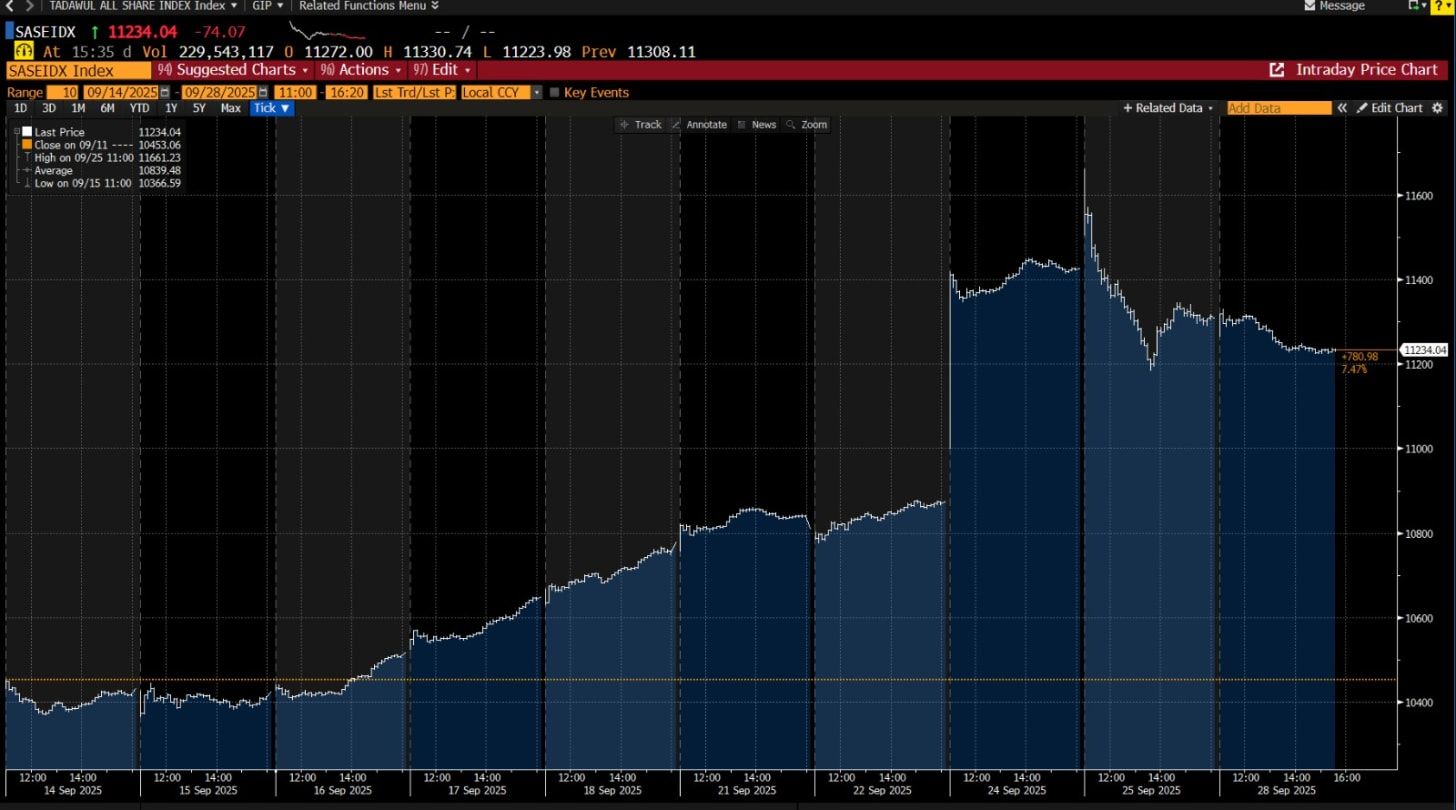
Impact of Potential Reforms
Relaxing the foreign ownership cap could significantly enhance Saudi Arabia’s appeal to overseas investors. Analysts suggest that inflows from global investors could increase the kingdom’s weighting in major indices, including MSCI and FTSE Russell. While the exact cap has not been finalized, allowing foreign investors to hold a majority stake would mark a historic change, potentially opening doors for a wave of institutional investment.
Should the CMA allow foreign ownership of up to 100%, JPMorgan and EFG Hermes project inflows of approximately $10 billion. Analysts at JPMorgan also highlighted that this would raise Saudi Arabia’s weight in the MSCI Emerging Markets Index from about 3.3% to roughly 4%, boosting its visibility among global fund managers.
The potential policy change is expected to reinforce ongoing efforts under Vision 2030, Saudi Arabia’s long-term economic diversification plan, which seeks to reduce reliance on oil and broaden the investment base of the kingdom.
Banks Leads the Charge
The financial sector was at the forefront of the September 24 rally. Al Rajhi Bank shares surged 10%, positioning it as the primary beneficiary of investor optimism. Saudi National Bank and Alinma Bank also posted strong gains, reflecting broader confidence in the banking sector. The surge in banking stocks underscores expectations that regulatory reform could attract significant international capital, further enhancing liquidity and trading activity in the sector.
Energy stocks, led by Saudi Aramco, saw more modest gains, with the kingdom’s oil giant advancing about 0.8%. MSCI’s Tadawul 30 Index, which includes Al Rajhi, Aramco, Saudi National Bank, and SABIC among its largest constituents, jumped around 5%, highlighting the broad-based nature of the rally across key sectors.
The rally also extended to Saudi-listed exchange-traded funds (ETFs), underscoring renewed investor appetite for exposure to the kingdom’s equity market. Funds such as the Albilad MSCI Saudi Select ETF and Yaqeen S&P ESG MENA ETF benefited from the surge in trading volumes, as investors sought diversified access to leading Saudi names like Al Rajhi Bank, Saudi National Bank, and Aramco.
The performance demonstrates that while financials may be the primary beneficiaries, investor enthusiasm has spilled over into multiple industries, signaling growing confidence in the overall market structure.
Looking Forward
Despite these prospects, the Saudi market has faced challenges this year, including international economic pressures, domestic policy uncertainties, and lower investor confidence. TASI fell about 4.4% in mid-2025, underperforming regional peers such as Dubai and Kuwait. Analysts believe that easing foreign ownership rules could help reverse this trend by improving liquidity and enhancing market sentiment. Read more about it here.
However, analysts remain optimistic that anticipated regulatory reforms will reverse this trend and position Tadawul as the Arab world’s largest and most attractive stock exchange for international capital.
These developments align closely with Saudi Arabia’s Vision 2030 agenda, which aims to diversify the economy, reduce oil dependence, and increase the assets under management (AUM) in the investment sector to 40% of GDP by 2030, up from 26% in 2024.
While near-term market performance will continue to be influenced by global economic trends, oil price movements, and U.S. monetary policy, the ongoing reforms signal a positive trajectory for Saudi equities. Market experts suggest that these measures could not only enhance the kingdom’s global investment profile but also strengthen Tadawul’s long-term role as a leading emerging-market exchange in the region.
*Data source: Reuters, Bloomberg, National News, Economic Times