
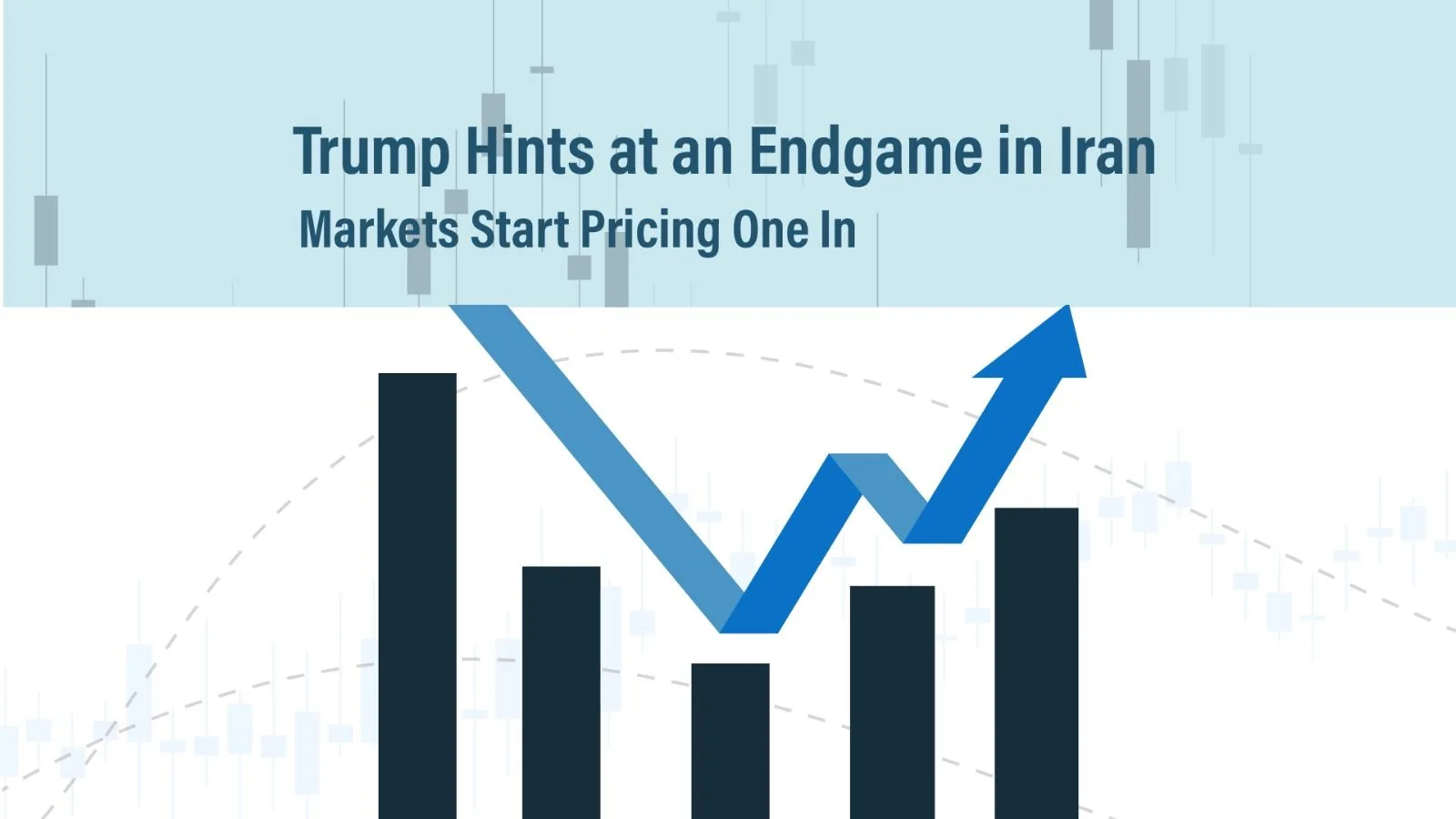
President Donald Trump’s latest message on Iran was contradictory but market-moving: the war, he said, could end “very soon,” yet the U.S. would not relent until Iran’s leadership and military apparatus were decisively defeated. Investors heard the first part loudly enough to begin stripping out some of the extreme risk premium that had built across oil, gold, and equities over the past week.
That shift was visible almost immediately. Oil, after surging above $119 a barrel on Monday at the height of supply fears, fell more than 7% on Tuesday. Stocks, which had been hit by stagflation worries and war-risk headlines, rebounded. In the Gulf, most major equity markets turned higher, while sovereign credit-default-swap spreads narrowed from Monday’s stress levels.
The catch is that the move looks more like a repricing of worst-case odds than a clean all-clear. Iran’s Revolutionary Guards said Tehran would “determine the end of the war” and threatened to stop regional oil exports if attacks continued. In other words, markets have moved from pricing catastrophe to pricing uncertainty.
Oil: Global Benchmarks Fall, but Gulf Crudes Still Signal Stress
Oil remains the clearest barometer of the conflict. On Tuesday, Brent fell to about $92.21 a barrel and WTI to around $88.36, both down nearly 7% after the prior session’s spike above $119 on fears that a prolonged closure around Hormuz could choke global supply. Reuters reported that volumes were unusually light, suggesting many traders are still unwilling to take strong directional bets.
But the more important GCC signal is not Brent alone. According to DBS, quoted by Reuters, Murban and Dubai grades were still well above $100 per barrel even after the global pullback, implying that the physical risk premium in Middle Eastern crude has not really disappeared. That matters for Gulf investors because Murban is Abu Dhabi’s flagship export grade and a key benchmark for Asian buyers. Middle East crude premiums have also spiked as Asian refiners compete for barrels available outside the Strait.
Looking ahead, oil’s path hinges on logistics more than rhetoric. If shipping resumes more normally and emergency supply measures convince traders that barrels will keep moving, prices could continue to retreat. But if Hormuz remains effectively constrained, the recent drop could prove temporary. Goldman Sachs, notably, did not change its fourth-quarter 2026 forecast despite Tuesday’s plunge, arguing that the situation remains fluid.
Gold: Less Panic, Still Plenty of Support
While the oil market eased some inflation fears, gold still rose on Tuesday, helped by a weaker dollar and lower Treasury yields. Spot gold traded around $5,178.60 an ounce, while U.S. gold futures for April were about $5,188.60.
That tells you something important, even if oil stops screaming “worst case,” investors are not abandoning hedges. Gold is now being supported less by raw panic and more by the possibility that growth slows while rates eventually move lower. For GCC investors wanting local-market access, Albilad Gold ETF remains the region’s best-known listed route, it is a Shariah-compliant ETF on Tadawul designed to track the DGCX spot gold price (DGSG), with fund documents showing assets of about SAR 146.5 million as of the end of December 2025.
The implication is straightforward. If the war genuinely de-escalates, gold may lose some crisis momentum. But if the market narrative shifts from “oil shock” to “policy uncertainty and slower growth,” bullion can remain well bid.
Crypto: Bitcoin Breaks Back Above $70,000
Crypto markets also reflected the shift in sentiment as well, with Bitcoin climbing back above $70,000, recovering from the sharp selloff that followed the initial escalation of the conflict.
The rebound highlights a pattern that has emerged in recent geopolitical shocks: crypto often behaves like a high-beta risk asset, falling sharply during periods of uncertainty before rallying once investors begin pricing a more contained outcome.
Institutional flows have also supported the recovery, with spot Bitcoin ETFs seeing renewed activity as traders reposition portfolios amid volatility across traditional markets.
Equities: Relief Rally Globally, Selective Rebound in the GCC
Equities have reacted as if Trump’s comments reduced, rather than removed, the probability of a deeper regional shock. On Wall Street, all three major indexes staged a late reversal on Monday: the Dow rose 0.50%, the S&P 500 0.83%, and the Nasdaq 1.38% after earlier weakness tied to soaring crude and stagflation fears. Still, Reuters noted that homebuilders, banks, and aerospace/defense lagged, showing investors remain cautious about the macro backdrop.
In the Gulf, the rebound was real but uneven. Reuters reported that on Tuesday Dubai’s main index jumped more than 3%, led by an 8.1% rise in Emirates NBD and a 6.3% gain in Dubai Islamic Bank. Abu Dhabi gained 0.9%, Qatar rose 1.5%, Saudi Arabia added 0.6%, and Kuwait was up 1.1%, while Bahrain slipped 0.2%. At the same time, SICO Bank’s research head cautioned that investors are reassessing UAE assets because their pre-war rally had compressed risk premiums.
ETFs: How Investors Are Positioning for the Next Phase
This is where ETFs become useful. In periods like this, investors are less interested in perfect foresight than in flexible exposure.
For U.S. equity exposure via GCC listings, Chimera S&P US Shariah Value ETF, Income offers a listed route on ADX into dividend-oriented U.S. equities through the S&P High Yield Dividend Aristocrats U.S. Shariah 35/20 Capped Index. Chimera says the fund is designed as a “single access point” to U.S. equities; as of March 9, its top holdings included Microsoft and Exxon Mobil.
For higher-growth exposure, investors in the region have also been using tech-linked products such as the Albilad MSCI US Tech ETF, which Albilad says gives Saudi-riyal access to U.S. technology companies tied to internet, digitization, industry, and digital health care.
In other words, if the market is right that the conflict is moving toward containment, cyclical and growth assets may rebound further. If the market is wrong, gold and energy-linked exposure could regain leadership fast.
What to Expect Next
Trump’s remarks have changed the market narrative from “escalation spiral” to “possible off-ramp.” That is enough to cool oil, steady Gulf credit risk, and bring buyers back into equities. It is not enough to erase the fact that Hormuz remains the central pressure point, Gulf crude benchmarks still carry a heavy premium, and Iran’s own rhetoric remains openly confrontational.
The next move is likely to be less about headlines alone and more about evidence: Are tankers moving? Are producers restoring normal flows? Are Gulf bourses holding gains?
Until those answers turn clearer, markets will keep trading in the awkward space between hope and hedging.