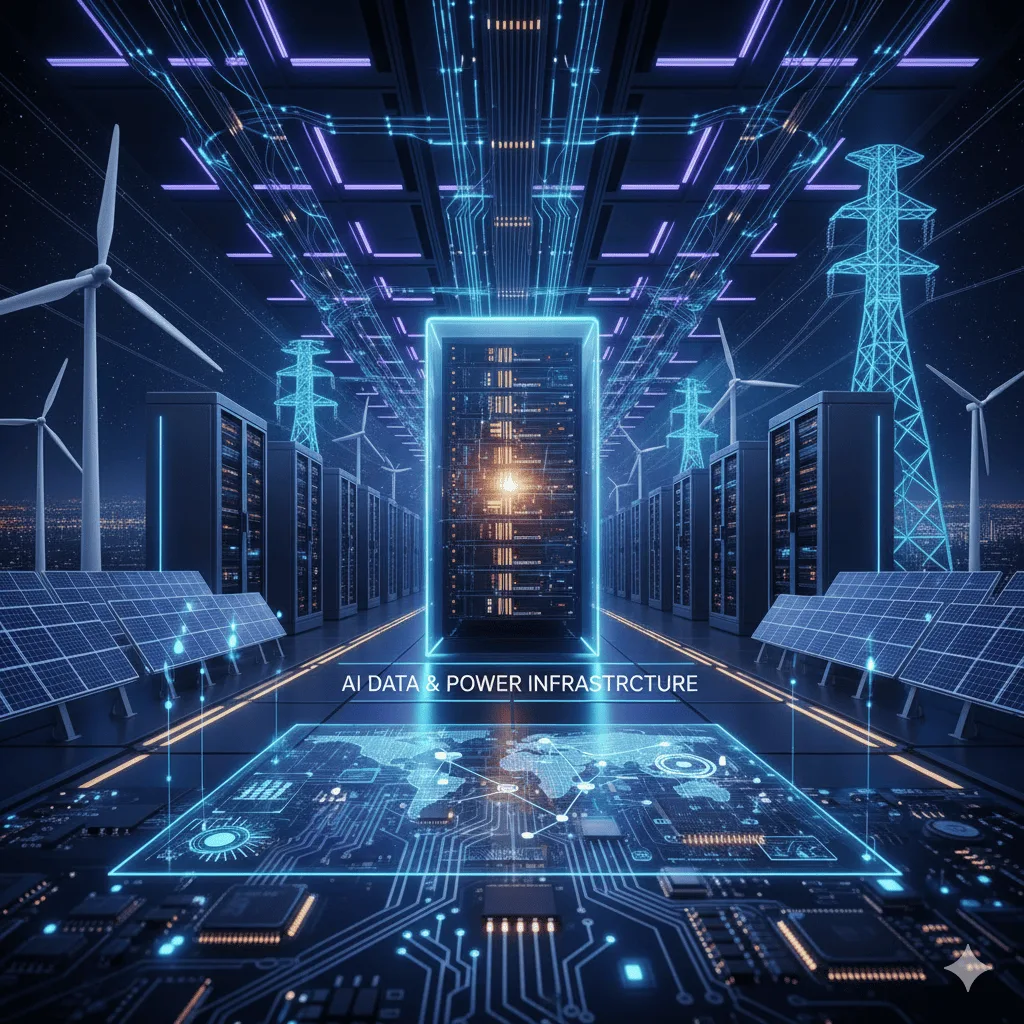
The global race for Artificial Intelligence (AI) dominance is shifting focus from solely developing advanced models and chips to building the critical infrastructure that powers them. Data centres, high-performance compute clusters, resilient power systems and fast fibre networks form the core infrastructure behind every AI breakthrough.
In the Gulf Cooperation Council (GCC) region, a growing investor base and sophisticated financial landscape are aligning with this global trend, leading to the launch of specialized financial products designed to capture the infrastructure layer of AI-driven growth.
Lunate’s AIPOWR: A Smart Angle on AI Investing
In this context, the recent announcement that Lunate Capital Limited (via its Boreas platform) will launch the thematic ETF AIPOWR — the “Boreas S&P AI Data, Power & Infrastructure UCITS ETF” — on the Abu Dhabi Securities Exchange (ADX) on 25 November 2025 is notable. This ETF marks Lunate’s second thematic product (after its quantum-computing ETF).
The Boreas S&P AI Data, Power & Infrastructure UCITS ETF invests in companies that build the physical backbone for AI, from power generation to data centres. Its constituents fall into three main groups: Utilities (e.g., NextEra Energy) for power supply, Industrial Firms (e.g., Eaton) for data centre equipment, and Hyperscalers (e.g., Microsoft) for cloud infrastructure. The fund’s exposure is well-balanced across these sectors: 35% in utilities, 31% in industrial equipment, and 34% in hyperscalers/operators. Read more about it
Global Leaders in AI Infrastructure
The STOXX Global AI Infrastructure Index, which tracks companies supplying the essential “picks and shovels” of AI, ranging from semiconductors to cloud computing and big data technologies, has climbed around 30% percent year-to-date 2025.
Also, the STOXX Global AI Adopters and Applications Index, which tracks companies using AI to improve products and operational efficiency, has gained 14%, while iShares AI Infrastructure UCITS ETF has gathered $126 million in assets under management, while the iShares AI Adopters & Applications UCITS ETF has reached $200 million, as of September 2025.
The STOXX Global AI Infrastructure Index comprises some major tech giants like Nvidia, Broadcom, Palantir, Amazon and TSMC. Of these, Nvidia remained the dominant GPU provider for large-scale AI training and inference and has recently crossed the $5 trillion mark.
Meanwhile, Palantir has emerged as a major software company primarily through AI advancement is its Artificial Intelligence Platform (AIP), which focuses on operationalizing AI and Large Language Models (LLMs) by integrating them directly into the decision-making and workflows of large organizations. Apart from this, Amazon continues to see strong demand in AI and core infrastructure, as evident from recent earnings results. Read more about it.
The GCC’s Strategic Move into the AI Backbone
In the GCC region, the AI-infrastructure opportunity is accelerating as global firms supply core hardware while regional players advance localization. Abu Dhabi–based G42 is building cloud and data-centre capabilities to strengthen sovereign AI capacity in the UAE, while Saudi Arabia’s HUMAIN, backed by the Public Investment Fund, is targeting next-generation AI models and compute infrastructure through global partnerships.
This alignment is clearly demonstrated by the introduction of thematic Exchange Traded Funds (ETFs) on regional exchanges, giving local and international investors exposure to this specialized theme. In GCC, funds such as the Albilad MSCI US Tech ETF in Saudi Arabia have benefited from strong performance among U.S. tech giants leading AI innovation and risen around 31% year to date.
Also, the Chimera S&P UAE Shariah ETF has gained traction, rising around 18% year to date, as Gulf investors seek exposure to diversified, Shariah-compliant equities amid rising interest in digital transformation.
AI infrastructure Growth Opportunity
J.P. Morgan expects companies to spend more than $5 trillion on global data centre + AI infrastructure over the next five years (2026–2030).
The installed base of datacentre power is expected to climb to 242 GW by 2028, reflecting a robust 27% CAGR between 2025 and 2028. This surge in power needs is expected to drive total datacentre electricity usage to roughly 1,100 TWh by 2028, equal to 3%–4% of global electricity demand, compared with about 1.5% in 2024.
The supporting hardware markets are set for similarly rapid expansion: the datacentre power-supply-unit segment is projected to grow at a 64% CAGR over the same period, while the liquid-cooling market is forecast to expand at a 51% CAGR. Power requirements for AI silicon are also accelerating quickly, with total consumption expected to grow at a 63% CAGR from 2025 to 2028, reaching nearly 39,213 MW. Within this category, ASIC-based AI chips are expected to see the fastest rise, with an 84% CAGR, while high-end AI GPUs are projected to grow at a 47% CAGR.
Looking Forward
For GCC investors, the infrastructure side of the AI boom is a story worth watching. With the launch of the AIPOWR ETF on ADX, the region gains a new instrument aligned to that story.
The International Monetary Fund (IMF) has identified the UAE as one of the Gulf region’s most advanced countries in terms of readiness for artificial-intelligence adoption. Jihad Azour, Director of the IMF’s Middle East and Central Asia Department, noted that ‘Saudi Arabia, Qatar, and the UAE stand out as the most prepared GCC economies. He added that AI’s influence will reach far beyond the technology sector, reshaping work dynamics across industries and potentially affecting around 40% of the workforce.
The UAE has set aggressive targets to position itself as a global hub for AI. Driven by ambitious national strategies for economic diversification and digital transformation, AI is projected to add up to $320 billion to the Middle East economy by 2030. As per Emirates NBD report, AI will make up 13.6% UAE’s GDP by 2030, the highest share in the GCC and ahead of Saudi Arabia at 12.4% percent and 8.2% in the rest of the GCC.