

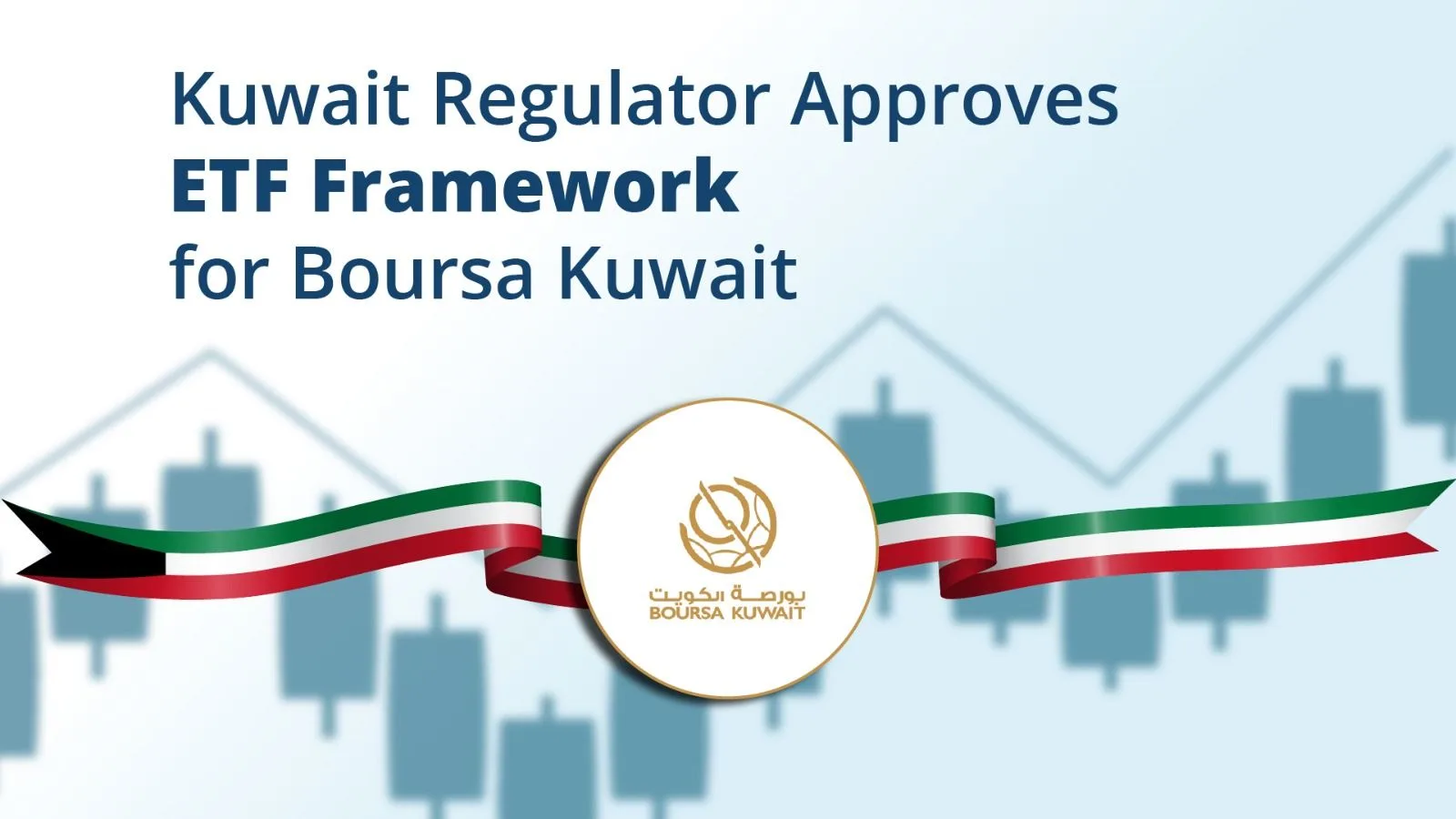
Boursa Kuwait is preparing to introduce exchange-traded funds after the Capital Markets Authority approved the country’s comprehensive regulatory framework for ETFs, marking a major step in the development of Kuwait’s capital market.
The approval, issued under CMA Resolution 80 of 2026, covers amendments to the Executive Bylaws of Law 7 of 2010 and related changes to the Boursa Kuwait Rulebook. The exchange will now introduce dedicated ETF provisions into its own rulebook, creating the legal and operational foundation for listing and trading ETFs in Kuwait.
The move represents the second major product milestone under Phase Three of Kuwait’s Market Development Program, known as MD 3.2. Earlier this year, Boursa Kuwait launched bonds and sukuk trading on April 5, 2026. The introduction of ETFs now broadens the market further, adding a globally recognized investment product that can improve diversification, liquidity, and investor access.
ETFs are important because they allow investors to gain exposure to a basket of securities through a single tradable instrument. Instead of buying individual stocks one by one, investors can access an index, sector, asset class, or strategy in a more efficient and transparent way. Because ETFs trade during regular market hours, they also offer flexibility for entry and exit compared with traditional funds.
Boursa Kuwait said it has completed the operational and technical preparations required for the launch, including testing with the broader capital market ecosystem. The framework covers the full ETF lifecycle, from listing to daily trading, and includes requirements for both local and international funds. Fund managers will also have ongoing disclosure obligations, while a dedicated ETF trading board will be created.
The new framework also requires ETF issuers to identify a clear benchmark index, appoint a market maker to support liquidity, and provide regular disclosures on the fund’s components and net asset value. These requirements are designed to protect investors while supporting efficient trading.
For Kuwait, the launch of ETFs is about more than adding another product. It is part of a wider effort to modernize market infrastructure, attract foreign capital, empower investment companies, and reduce reliance on single-stock equity investing. If successful, ETFs could become an important tool in making Kuwait’s market deeper, more diversified, and more competitive within the GCC.