Dubai Investments plans to sell a 20% stake in DIP Holding through an initial public offering (IPO) on the Dubai Financial Market (DFM), marking the UAE’s first IPO of 2026. The offer comprises 1,735,243,300 existing shares, with subscriptions scheduled from 27 October to 3 November and listing expected around 11 November, subject to regulatory approvals and market conditions.
DIP Holding owns and operates Dubai Investments Park, a mixed-use development spanning 23 million square metres, with around 1,000 tenants and more than 150,000 residents. Dubai Investments will receive the proceeds from the sale, while DIP Holding will not receive any funds from the offering. The offer price and implied valuation have not yet been announced.
DIP Holding IPO: Key Dates and Offer Structure
The offer is divided into four tranches, with professional investors accounting for the largest allocation. The final offer price will be determined through book-building based solely on orders from the professional-investor tranche.
Professional investors take 92% of the shares on offer.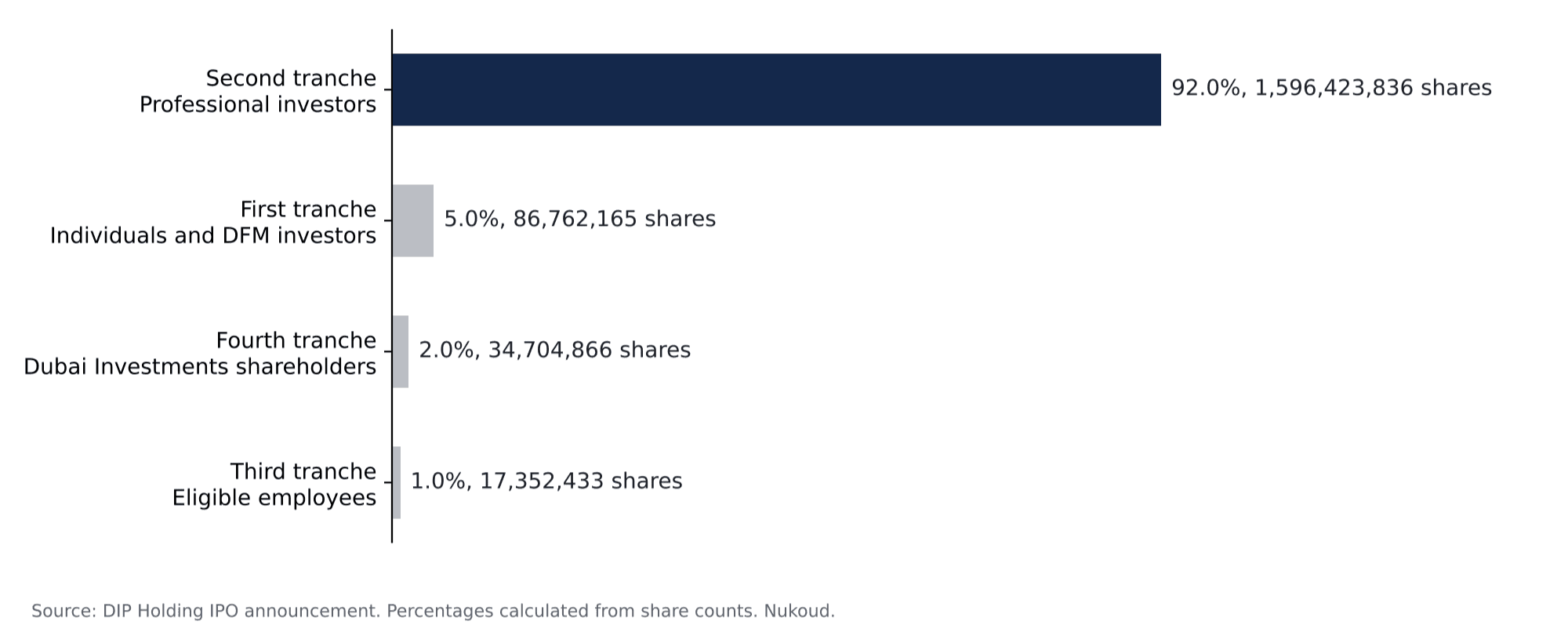 DIP Holding IPO announcement, share counts by tranche; percentages calculated from the share counts
DIP Holding Financial Performance and Dividend Outlook
DIP Holding’s revenue rose to AED 960 million in 2025, from AED 892 million in 2024 and AED 838 million in 2023. Adjusted EBITDA reached AED 678 million, while net profit was AED 1.09 billion. Investors should consult the prospectus and audited financial statements for details of the items contributing to net profit.
In the first half of 2026, like-for-like revenue increased 6.9% to AED 492 million from AED 460 million a year earlier. The comparison excludes revenue from assets subsequently sold and no longer part of the portfolio; reported first-half 2025 revenue was AED 483 million.
Subleasing revenue grew 31% to AED 92 million on a like-for-like basis, while ground rent rose 4% to AED 302 million. Ancillary income declined 2% to AED 98 million.
Chairman Khalid Jassim Bin Kalban described the listing as “a natural next step”, while CEO Omar AlMesmar highlighted disciplined execution, operational excellence and sustainable performance as priorities for the company as a listed business.
DIP Holding targets annualised dividends of AED 700 million in 2026, AED 725 million in 2027 and AED 750 million in 2028. The 2026 target excludes an AED 100 million pre-IPO dividend paid to Dubai Investments in September. The first post-IPO distribution, expected to be AED 350 million in April 2027, will cover H2 2026. Distributions remain subject to approvals and available reserves.
Dubai Islamic Bank’s Role in the DIP Holding IPO
Dubai Islamic Bank (DIB) is a joint bookrunner for the offering. Its Internal Shariah Supervision Committee has issued a pronouncement confirming that, in its view, the IPO complies with Shariah principles.
Dubai Islamic Bank 9M 2026 Results: Revenue Up 7%
Dubai Islamic Bank reported gross revenue of AED 18.6 billion for the first nine months of 2026, up 7% year on year. Operating profit before impairment charges rose 4% to AED 7.1 billion, while profit before tax remained broadly flat at AED 6.6 billion. Net income attributable to shareholders declined approximately 1.6% to AED 5.37 billion, while earnings per share remained unchanged at AED 0.72.
The non-performing financing ratio improved to 2.4%, down 30 basis points since December 2025. Total assets reached AED 427 billion, while net financing assets rose 10% to AED 287.1 billion. The capital adequacy ratio stood at 16.5%, and the CET1 ratio at 13.4%.
Outlook: What to Watch After the IPO
Investor interest in DIP Holding will depend on the final offer price, valuation, and demand during the subscription period. The company’s targeted dividends of AED 700 million in 2026, AED 725 million in 2027 and AED 750 million in 2028 may also attract attention from income-focused investors, although the implied dividend yield cannot be calculated until the offer price is announced.
After listing, investors will be watching rental-income growth, tenant demand, cash generation, and the company’s ability to meet its dividend targets. All dividend distributions remain subject to the relevant approvals and available distributable reserves.