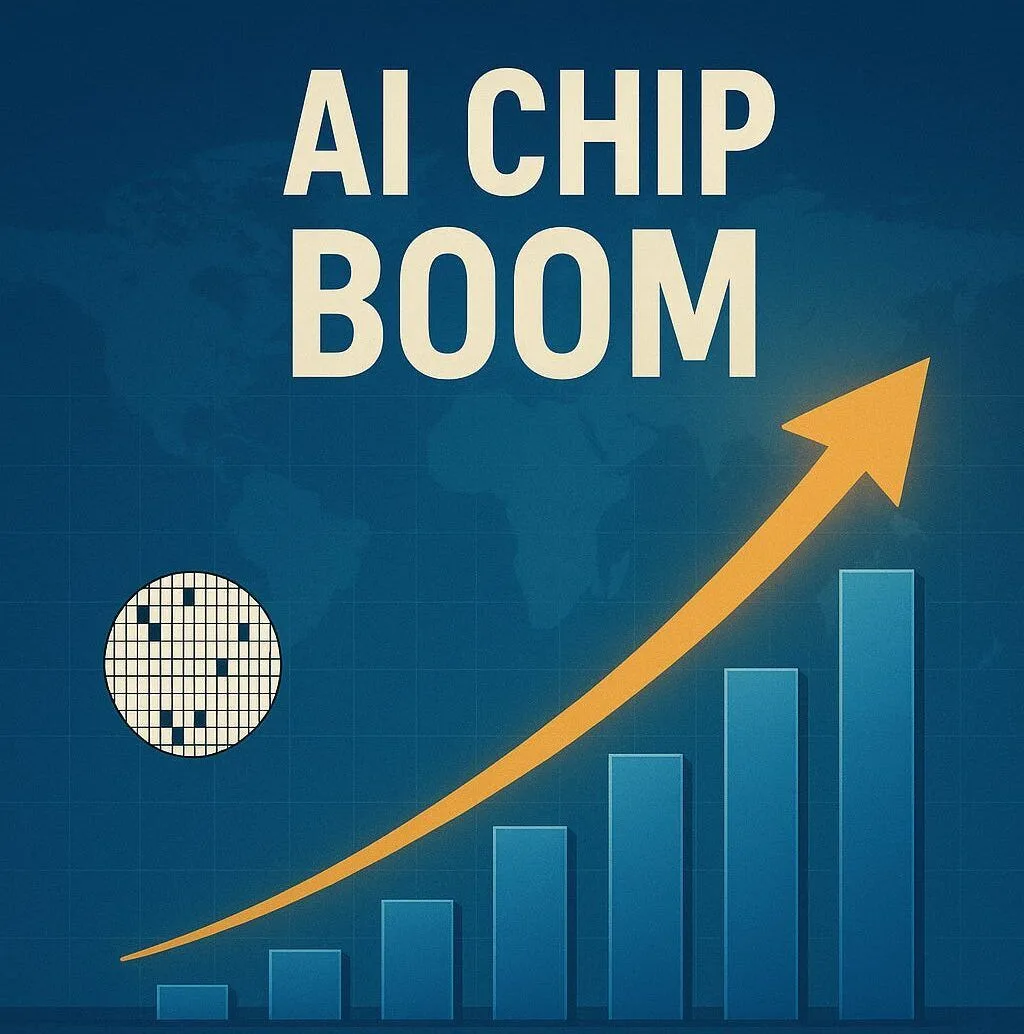
The U.S. earnings season is underway. The stellar performances of semiconductor powerhouses Taiwan Semiconductor Manufacturing Company (TSMC) and ASML Holding, fuelled by the relentless demand for artificial intelligence (AI) chips, are reverberating through global markets.
While these companies are headquartered in Taiwan and the Netherlands, respectively, their success has a significant, albeit indirect, connection to the Gulf Cooperation Council (GCC) region, particularly for investors looking for diversified exposure through ETFs.
TSMC’s “Insane” AI Demand
TSMC, the world’s leading contract chipmaker, reported staggering third quarter results. Net profit soared by 39% year-over-year, and revenue growth jumped 30% year-over-year led by high demand for its advanced processor technologies related to AI applications.
CEO Wei described AI demand as “stronger than we thought,” calling the figures “insane.”
The company’s CoWoS advanced packaging technology, essential for AI chips, remains in “very tight” supply despite rapid expansion. This directly signals massive ongoing investment in AI infrastructure by tech giants globally.
Senior VP and CFO Wendell Huang added that the company anticipates “continued strong demand for our leading-edge process technologies” to sustain business momentum moving into the fourth quarter of 2025.
Also, this week, Nvidia and TSMC completed production of Nvidia’s first Blackwell wafer in the United States, marking a major step in bolstering America’s AI chip manufacturing capabilities.
ASML Future AI Bets
ASML, the exclusive supplier of the EUV lithography tools essential for crafting state-of-the-art chips, had a solid Q3 2025, with €7.5 billion in net sales. The company’s future outlook appears particularly strong with net bookings coming in at €5.4 billion (including €3.6 billion for EUV systems).
Goldman Sachs analyst raised the price forecast for the company stating that ASML is a “clear beneficiary of improved leading-edge Logic/Memory demand from AI.’’
Chief Executive Christophe Fouquet stated that AI momentum is strengthening across the customer base, driving demand for both leading-edge Logic and advanced DRAM chips. Despite forecasting a significant drop in China sales in 2026 (following very strong 2024 and 2025 performance), the company still projects that total net sales for 2026 won’t fall below the 2025 level.
AI Earnings Momentum Fuels Gains Across Tech and Thematic ETFs
The surge in AI-related earnings from chipmakers has rippled through global equity markets, fuelling gains in technology-focused ETFs. VanEck Semiconductor ETF, which has top holdings in giant tech stocks like TSMC & Nvidia, grew around 44% year-to-date.
In GCC, funds such as the Albilad MSCI US Tech ETF in Saudi Arabia have benefited from strong performance among U.S. tech giants leading AI innovation and risen around 22% year to date.
Also, the Chimera S&P UAE Shariah ETF has gained traction, rising around 17% year to date, as Gulf investors seek exposure to diversified, Shariah-compliant equities amid rising interest in digital transformation.
Meanwhile, Lunate Capital recently launched the Boreas Solactive Quantum Computing UCITS ETF (Ticker: QUANTM) on the Abu Dhabi Securities Exchange (ADX), marking the first thematic quantum computing ETF listed in Abu Dhabi. Read more about it here.
Outlook
The semiconductor industry is undeniably at the forefront of the AI revolution. The ongoing AI surge has fuelled a string of high-profile deals between Big Tech companies and Silicon Valley startups, pushing global stock markets to record levels as investors grow more confident that the Federal Reserve’s early rate cuts have helped the U.S. avoid recession.
UBS Global Wealth Management recently upgraded its view on global equities to “attractive”, citing anticipated productivity improvements driven by AI investment and a favourable policy environment.
The future growth prospects for AI in the GCC are exceptionally strong, driven by ambitious national visions for economic diversification and digital transformation. Reports project that AI could contribute up to $320 billion to the Middle East economy by 2030, with the GCC states, particularly the UAE and Saudi Arabia, positioned to capture the largest share of this value. The annual growth in AI’s contribution to the region is anticipated to be in the range of 20%-34%, highlighting a rapid acceleration in adoption.
*Data sourced from Yahoo Finance, Company press release, Reuters, UBS