
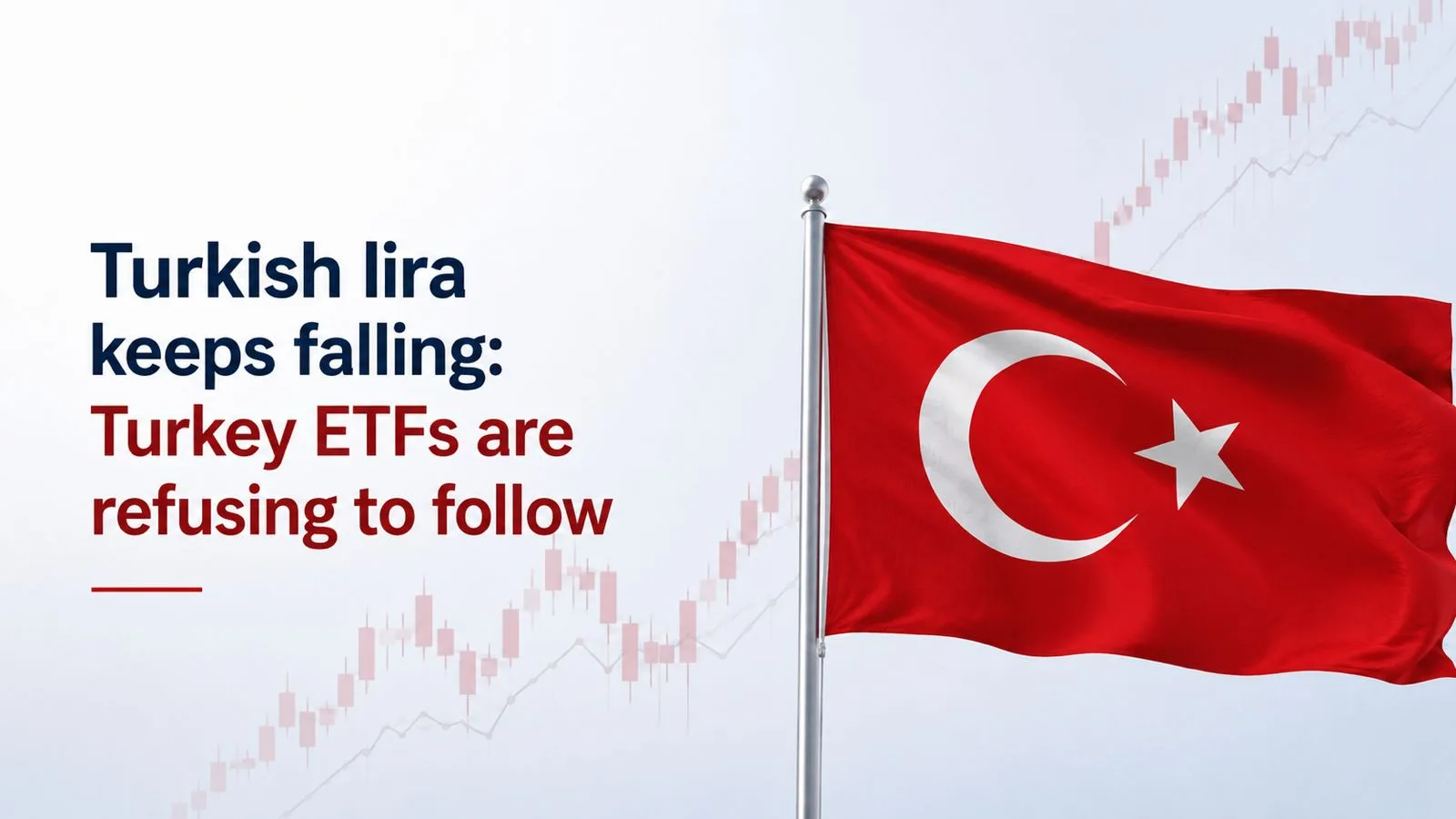
The Turkish lira is again sending investors a familiar warning signal. Another slide. Another record low. Another reminder that Turkey’s macro story rarely moves in a straight line.
Reuters reported in late May that the lira had weakened nearly 6% year to date and touched a fresh record low of 45.74 per U.S. dollar during renewed political stress. By mid-June, after Turkey’s central bank kept rates unchanged, the currency was around 46.1550 per dollar.
On the surface, that should be bad news for Turkish equities. In practice, the ETF market is telling a more complicated story.
The U.S.-listed iShares MSCI Turkey ETF, ticker TUR, had a 15.75% year-to-date NAV total return as of 2026-07-01, according to BlackRock. The fund had $200.6 million in net assets, 73 holdings and a 0.59% expense ratio as of today.
For GCC investors, the more relevant product is the UAE-listed Lunate S&P Turkey Shariah ETF, ticker TURKI on ADX. The fund is Shariah-compliant, physically replicated, UAE-domiciled and trades in AED. Its June 2026 factsheet shows a 29.54% year-to-date NAV return, a 60.28% one-year return and a 425.03% return since inception in August 2022. The fund had AED 37.12 million in assets under management, known as AUM, and a 1.00% total expense ratio, known as TER.
The Currency Is Not the Whole Market
The easy conclusion is that Turkish equities are ignoring the lira. The better conclusion is that an equity ETF is not just a currency chart with a stock ticker attached.
Turkey’s currency weakness is real. Inflation was still 32.61% year on year in May 2026, while the central bank kept its key policy rate at 37% in June for a third consecutive meeting. Reuters also reported that the central bank had sold around $26 billion in foreign currency since the Iran war began and sold about $3 billion worth of gold in one week as part of efforts to stabilise markets.
Those numbers point to a difficult macro regime. High inflation, heavy intervention and political risk are part of the Turkey trade.
Yet listed companies can behave differently from the currency. Exporters, defence companies, energy-linked businesses, retailers with pricing power and owners of inflation-sensitive assets may still grow nominal earnings even while the lira weakens. That is where TURKI becomes interesting.
TURKI is not a Broad Turkey Exposure
The U.S.-listed TUR ETF holds 73 stocks and gives broader exposure to the Turkish equity market. TURKI is much more concentrated. It holds only 20 stocks, and its June factsheet shows a heavy 47.3% allocation to industrials, followed by 18.8% in consumer staples, 13.3% in energy, 7.6% in materials and 7.4% in real estate.
The top holdings make the point. Aselsan, the Turkish defense-electronics company, was 26.40% of the fund. BIM, the discount retailer, was 18.79%. Tüpraş, the refiner, was 13.30%.
A Shariah-screened Turkey ETF can end up looking very different from the conventional market because financials and highly leveraged companies are filtered out. That mattered during Turkey’s political selloff earlier this year. In Nukoud’s previous analysis, linking the phrase Turkey’s Political Shock Hits Markets, we noted that TURKI’s Shariah structure helped reduce exposure to banks, one of the areas hit hardest by the market shock.
The Real Story Is Concentration
TURKI is best understood as a concentrated basket of Shariah-compliant Turkish companies tied to defense, consumption, energy and inflation-linked nominal growth.
That structure can work well when Turkey’s economy is running hot and listed companies can pass through inflation. It can also cut both ways. Aselsan alone accounts for more than a quarter of the fund, which means one defence stock can have an outsized impact on returns. BIM adds consumer-defensive exposure. Tüpraş brings energy and refining sensitivity.
So TURKI’s strong year-to-date performance is not simply a story of Turkish equities rebounding. It is a story about which Turkish equities the ETF owns.
Buying TURKI through ADX gives local-market access, AED trading and Shariah screening. It also brings single-country risk, lira-linked earnings risk, political risk and high stock concentration.
Buying TUR in the U.S. gives broader Turkey exposure, but it is not Shariah-screened for halal investors and comes with the usual considerations for U.S.-listed ETFs, including tax, trading hours and currency exposure for non-U.S. investors.
A Rally With a Warning Label
The lira’s fall should still be treated as a warning. A 37% policy rate, inflation above 30%, reserve pressure and repeated political shocks are not signs of a low-risk market.
But the ETF performance shows why currency headlines can be incomplete. Equity returns depend on sector mix, company revenues, inflation pass-through, index rules and fund structure.
For GCC investors, TURKI’s 29.54% year-to-date return makes the Turkey rebound hard to ignore. The catch is that the return comes from a narrow set of drivers. Industrials dominate. Aselsan is a major force. Political risk remains difficult to price.
Turkey may still reward investors who can tolerate volatility. But this is more than just a buy-the-dip story. It is a test of whether the right companies can keep outrunning the currency.