
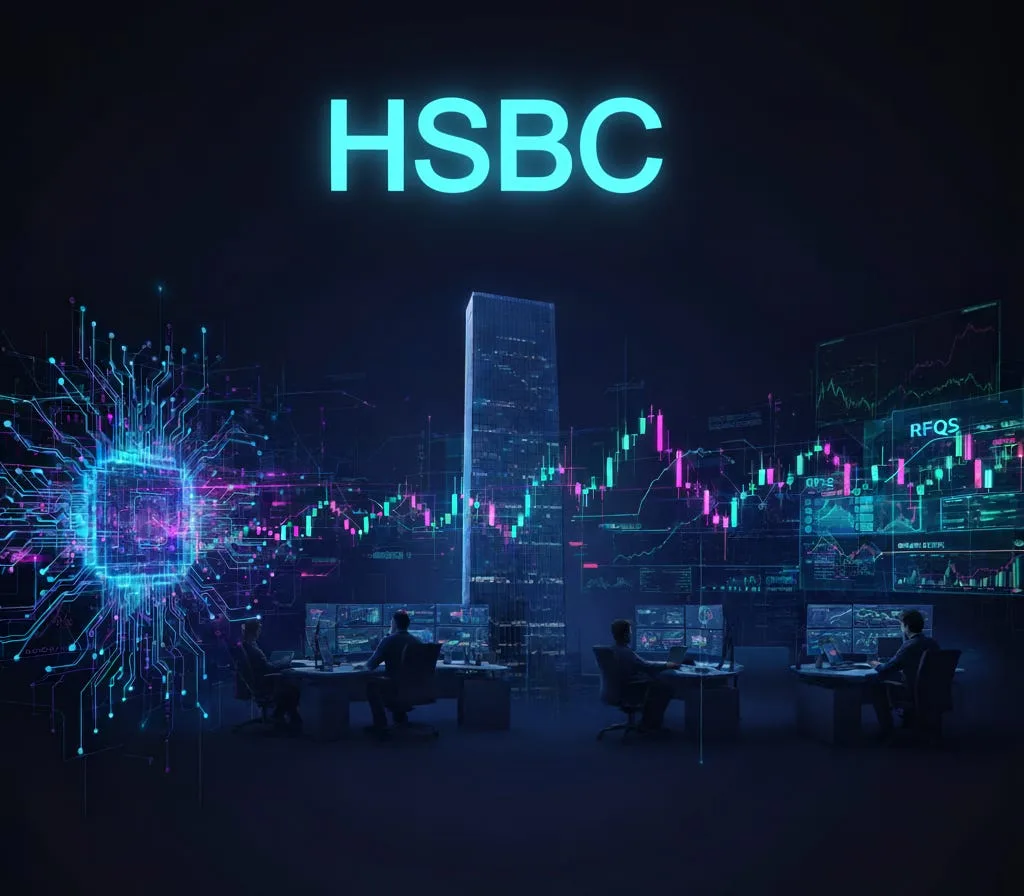
HSBC says a hybrid quantum classical model boosted the accuracy of its algorithmic corporate-bond trading by up to 34% in tests run with IBM’s latest Heron quantum processors. One of the clearest “real market” claims yet for quantum in finance. The work used production-scale RFQ data from Europe’s corporate-bond market and is backed by a technical preprint posted this week.
What HSBC actually did
HSBC and IBM tested a hybrid workflow where classical models for algorithmic trading were enhanced with quantum-transformed features. These features were generated both on IBM’s Heron hardware and in noiseless simulators for comparison. In backtests, the models using hardware-generated transforms predicted the probability of a quote being filled more accurately than HSBC’s classical baselines, and the same quantum transforms when computed on a noiseless simulator.
The counterintuitive takeaway is that hardware noise may have helped extract useful signals from the data. Overall, the team reported up to ~34% improvements in out-of-sample test scores on production-scale intraday trade events, using a framework that keeps the quantum step decoupled and offline so that low-latency trading remains feasible.
The dataset and scope
According to coverage of the study, the experiment drew on >1 million RFQs across more than 5,000 bonds spanning September 2023 to October 2024 a large, realistic sample for OTC credit where RFQ win-probability is a key driver of dealer economics and client experience. HSBC describes it as the first known empirical evidence that current-generation quantum machines can add value in a practical trading use-case.
Why Heron matters (and what it doesn’t solve yet)
IBM’s Heron line (now up to 156 qubits on the System Two platforms) is the company’s best-performing family to date, with markedly improved two-qubit error rates versus prior chips. Heron-class devices rely on error mitigation rather than full error correction and are accessible via Qiskit on IBM’s cloud. That puts HSBC’s test squarely in today’s NISQ regime useful for certain data-transform tasks, but not the fault-tolerant quantum computing that IBM targets by 2029.
HSBC’s reported uplift is a backtested accuracy gain in estimating the probability that a quote would be filled, achieved when classical models were supplied with quantum-hardware-generated features.
Interestingly, the effect disappeared when the same features were produced on a noiseless simulator, suggesting that today’s hardware noise may itself contribute to useful signal extraction in complex financial time-series. What this result does not represent is a live, end-to-end profit-and-loss outcome, a latency-tested production deployment, or a sweeping “quantum advantage” over the most advanced classical machine-learning approaches.
Instead, HSBC has shown a carefully engineered proof of concept, where the quantum step is kept offline and decoupled to avoid latency bottlenecks, a pragmatic design that stops short of true real-time decisioning.
Where the rest of the Street is
Banks have been in proof-of-concept mode for years in portfolio optimization, option pricing, and risk simulation usually on simulators or small chips. What distinguishes HSBC’s announcement is the scale of real trading data and a measurable lift on a metric that matters commercially in OTC credit RFQ. Press reports frame it as a world-first at this scope, and the technical paper is public both useful credibility checks.
Quantum Promise and Peril for Investors and Bond Dealers
HSBC’s reported quantum breakthrough lands at a moment when quantum-computing stocks are already red hot, with investors chasing outsized gains despite the risks of fragile technology roadmaps, capital intensity, and uncertain adoption beyond pilots. For markets, the implications could be more tangible: better fill-probability estimates have the potential to change how bond dealers price RFQs, allocate balance sheets, and manage client interactions particularly in European corporate credit, where voice and RFQ still dominate.
If such quantum-enhanced tools become standard, investors could ultimately benefit from tighter pricing, narrower spreads, improved ETF basket liquidity, and more stable premiums and discounts in fixed-income funds. For GCC investors, the theme is already accessible through the Boreas Quantum ETF listed on ADX, which packages exposure to global quantum-computing companies into a regional vehicle.
The HSBC study remains backtested, not live, but it offers both investors and dealers a glimpse of how quantum might reshape trading efficiency, while underscoring the risks that still shadow the sector.
Bottom line
HSBC’s study is not the long-promised, all-purpose quantum advantage but it is a credible, data-rich result on a meaningful trading task, published with technical detail and run on current hardware. If subsequent replications confirm the ~34% lift and the economics work at scale, this kind of hybrid quantum classical feature engineering could slip into dealer workflows sooner than skeptics expect. First as an offline module, later as hardware improves. For now, it’s a legit marker that moves quantum computing a step closer to practical finance, and it sets a bar for rivals to clear.