

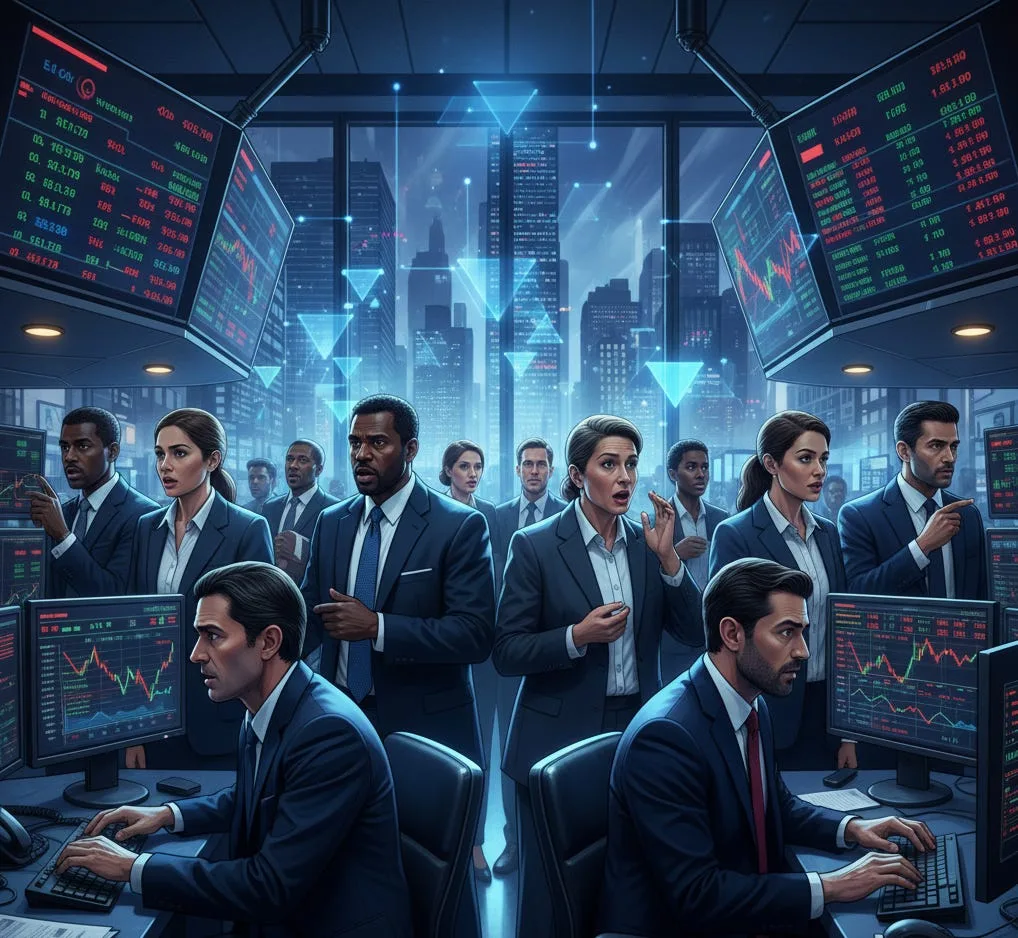
Quantum-computing shares swung sharply lower after Google announced that its Willow chip and new Quantum Echoes algorithm achieved the first verifiable quantum advantage, a breakthrough that briefly shifted capital toward Big Tech incumbents and away from smaller pure-plays.
By midweek, D-Wave (QBTS), IonQ (IONQ) and Rigetti (RGTI) were all trading lower, with intraday charts resembling trap doors. Then came a second jolt: reports that the Trump administration is exploring taking equity stakes in U.S. quantum firms in exchange for federal funding.
The Science That Sparked It
Google’s research team said Willow executed the Quantum Echoes algorithm about 13,000 times faster than the best classical approach, describing it as the first verifiable quantum advantage on real hardware. The company released full technical details and a hardware explainer, signaling that practical use cases are drawing closer.
This progress tends to benefit large, well-capitalized platforms able to fund the long path toward fault-tolerant machines, while smaller developers face tougher scrutiny on execution and differentiation.
The Policy Twist
Separately, the White House is reportedly in discussions with several quantum companies including IonQ, Rigetti, and D-Wave about potential ownership stakes linked to federal funding. The reported goal is to secure supply chains, protect intellectual property, and maintain a national-security edge in a race where the U.S., Europe, and China are all pushing for technological leadership.
If implemented, the framework would echo previous industrial-policy initiatives but mark a rare step for publicly listed tech firms. As of publication, neither the White House nor the companies had issued formal comment.
Why the Sell-Off Makes Sense
The market reaction looks less like panic and more like a re-pricing of innovation risk. After a year of extraordinary gains, valuations had little margin for disappointment. A headline concentrating the advantage in a mega-cap lab naturally pressures smaller peers, yet it also validates the sector’s scientific momentum.
How Broader Tech and Related ETFs Traded
Beyond the pure-play names, chip and AI-linked ETFs softened slightly. The VanEck Semiconductor ETF (SMH) fell 1.94 % on October 22 2025 but remains up nearly 40 % year-to-date, underscoring how quantum headlines are landing in an already crowded semiconductor and AI trade.
The Defiance Quantum ETF (QTUM), a diversified quantum-and-AI basket, also eased from recent highs.
A new entrant, the Boreas Solactive Quantum Computing UCITS ETF (QUANTM UH) launched in September 2025 on the Abu Dhabi Securities Exchange saw modest early-stage outflows of about USD 1.2 million during the pullback. The fund tracks the Solactive Quantum Computing Index, holds roughly 27 names, and carries an expense ratio of 0.49 %. Units trade in AED with an average bid-ask spread near 1.1 %, reflecting limited but steadily improving liquidity.
In Europe, VanEck’s Quantum Computing UCITS ETF (QNTM), launched in May 2025, mirrored sector volatility yet continued attracting inflows, evidence that investor appetite for quantum exposure remains intact.
What to Watch Next
The next phase for the quantum sector depends on validation and policy clarity. If Google’s results are corroborated by academic peers and industry partners, the confidence gap between mega-caps and pure-plays could narrow. A confirmed government equity program would further institutionalize the theme, integrating quantum into national-strategy portfolios.
Liquidity and positioning will stay critical as many quantum-linked stocks remain volatile and options activity drives short-term moves. Thematic ETFs such as SMH, QTUM, QNTM, and QUANTM UH serve as transmission lines across regions, amplifying both rallies and corrections.
Bottom Line
Google’s Willow milestone represents real scientific progress, and the market is simply re-allocating capital toward those best placed to commercialize it. The parallel policy discussions in Washington add a strategic layer that could accelerate investment and partnership flows.
Quantum computing is entering a new chapter, one where volatility accompanies validation, and innovation steadily reshapes the market narrative.
Disclaimer: Nukoud is not a licensed financial advisor. This article is for informational and educational purposes only and does not constitute investment advice.