
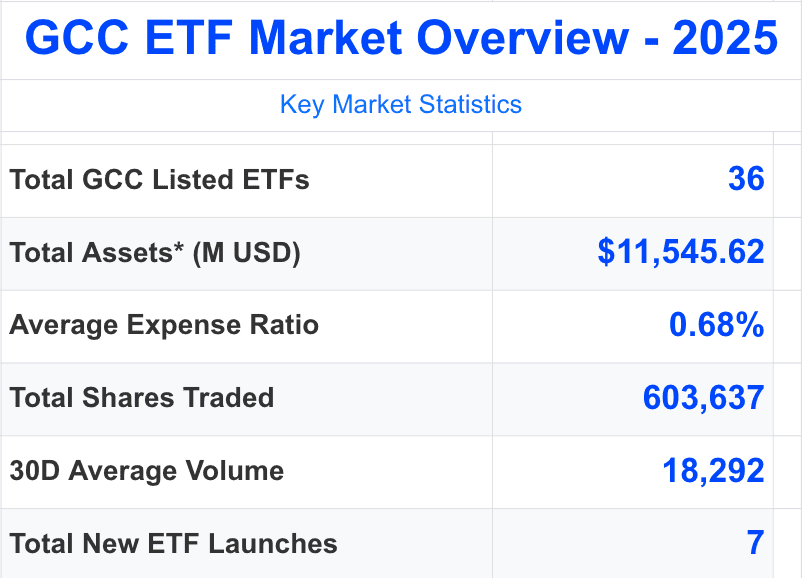
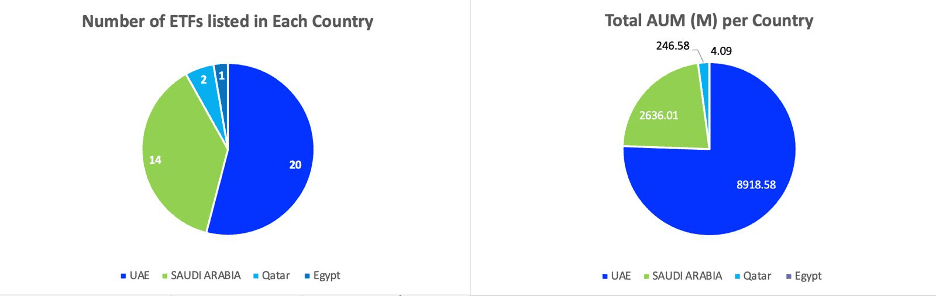
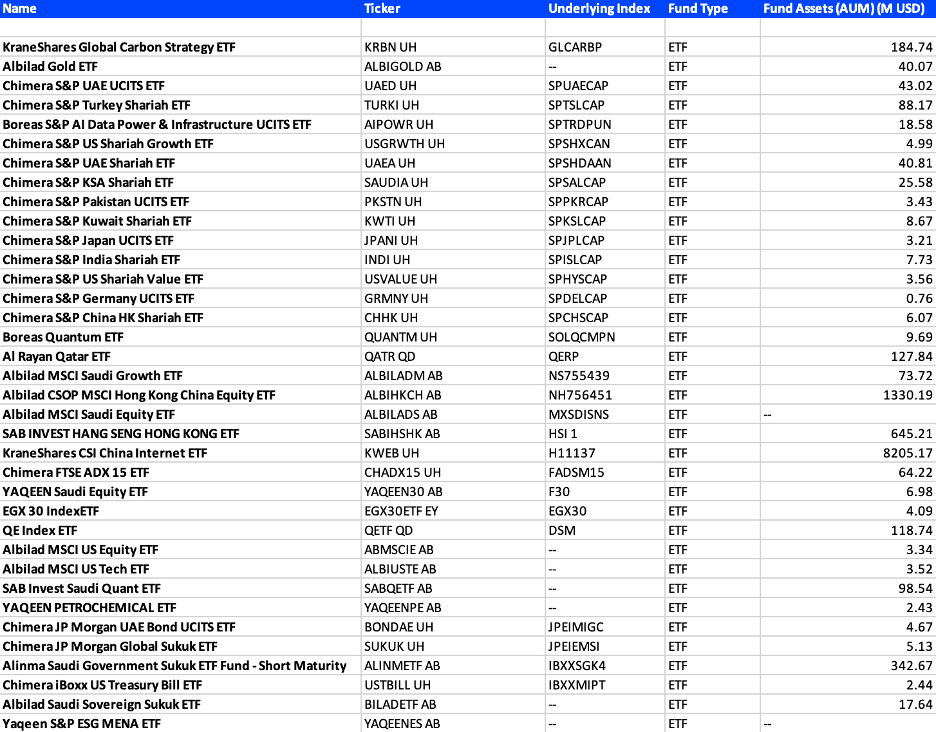
2025 marked a watershed moment for the GCC ETF industry. The year thematic exposures moved from niche to mainstream, and plain-vanilla beta gave way to specialized strategies targeting the forces reshaping the global economy. With 36 ETFs managing $11.54 billion in assets, the market’s headline numbers masked a notable structural transformation: GCC investors are no longer satisfied with simple regional equity exposure. They want quantum computing, AI infrastructure, carbon markets, and direct access to China’s digital economy packaged in exchange-traded, Shariah-compliant, and liquid vehicles.
While gold dominated performance and headlines for much of the year, the GCC also witnessed the launch of four thematic ETFs, introducing new and differentiated investment opportunities to the region and to Abu Dhabi in particular. Notably, two of these launches marked the first-ever cross-listing of U.S.-listed ETFs from the New York Stock Exchange onto ADX a significant milestone that expands local access to globally recognized ETFs.
This development enables investors to gain exposure to themes such as quantum computing, AI infrastructure, carbon credits, and China technology directly on ADX, trading in local currency and within the local time zone. In total, the region saw six ETF launches during the year, with more than 600,000 shares traded across all products.
2025 new thematic ETFs launches
The most significant development in 2025 was not a single product, but a paradigm shift and to thematic ETFs. The four launches KWEB, KRBN, AIPOWR, and QUANTM represent a fundamental shift in the GCC ETF narrative. For years, the industry was dominated by local issuers offering regional equity beta or low-cost index trackers. Now, global players are entering with specialized thematic strategies, bringing operational sophistication, established liquidity frameworks, and the institutional credibility that comes with managing billions globally.
Lunate’s Boreas had two thematic launches targeting frontier technologies:
● Lunate’s Boreas S&P AI Data Power & Infrastructure UCITS ETF (AIPOWR): Launched November 24, 2025, with $18.5M AUM. The fund targets the picks-and-shovels of the AI revolution: data centers, power infrastructure, semiconductor fabs, and cloud hyperscalers. This is not exposure to ChatGPT hype, but to the industrial base powering the AI economy (utilities, real estate, networking equipment, and energy infrastructure).
● Lunate’s Boreas Quantum ETF (QUANTM): Launched September 19, 2025, with $9.4M AUM. The fund offers exposure to quantum computing, a nascent but potentially transformative technology with applications in cryptography, drug discovery, financial modeling, and materials science. This launch reflects conviction that GCC investors, particularly sovereign wealth funds and family offices, are willing to allocate to frontier technologies with decade-long time horizons.
KraneShares (via ADX cross-listing) delivered the year’s most transformative moment with two flagship products:
● KraneShares CSI China Internet ETF (KWEB): Cross-listed December 10, 2025, with $9 billion in global AUM. This is concentrated access to the digital infrastructure powering the world’s second-largest economy. For GCC investors who have long sought China exposure through locally domiciled proxies, KWEB offers direct access to the source, now tradable during Abu Dhabi hours in familiar custody frameworks.
● KraneShares Global Carbon Strategy ETF (KRBN): Cross-listed December 10, 2025, as the global benchmark for compliance carbon markets. The fund provides diversified exposure to cap-and-trade carbon allowance programs valued at over $110 billion: EU ETS, California Cap-and-Invest, RGGI (Northeastern US), Washington State, and UK ETS. As governments mandate emissions reductions and corporations face carbon pricing, KRBN positions investors at the intersection of climate policy and financial returns, a nascent but rapidly growing asset class that was previously inaccessible to most GCC allocators.
First ever US cross listing on ADX
December 10, 2025 was another defining moment during the year, when KraneShares’ KWEB (CSI China Internet ETF) and KRBN (Global Carbon Strategy ETF) became the first US-domiciled ETFs to cross-list on the Abu Dhabi Securities Exchange a watershed that signals global asset managers now view the GCC as a strategic distribution market . KWEB, with ~$9 billion (at listing) in global assets, provides direct exposure to China’s digital giants (Alibaba, Tencent, JD.com, Meituan), while KRBN delivers access to $110 billion in compliance carbon markets both now tradable during Abu Dhabi hours without offshore friction.
The significance of these listings cannot be overstated. This marks the first time US ’40 Act ETFs have been made available on a GCC exchange, bridging NYSE liquidity with ADX accessibility. The operational framework, Oceane Invest as market maker, BNY Mellon as global custodian, DTCC settlement integration demonstrates institutional-grade infrastructure that makes these products as operationally simple as buying a local stock.
Jonathan Krane, CEO of KraneShares, framed it clearly: “This is a transformational step for regional investors seeking global exposure through world-class ETFs… strengthening financial bridges between the US, China, and the Middle East.”
Other launch
Chimera Capital continued its aggressive product expansion with:
● Chimera S&P Germany UCITS ETF (GRMNY): Launched September 25, 2024, now with $760K AUM and a +38.0% return in 2025. The fund rode Europe’s industrial resilience and technology strength, offering GCC investors diversification into a developed market with strong governance and secular growth drivers.
Performance highlights
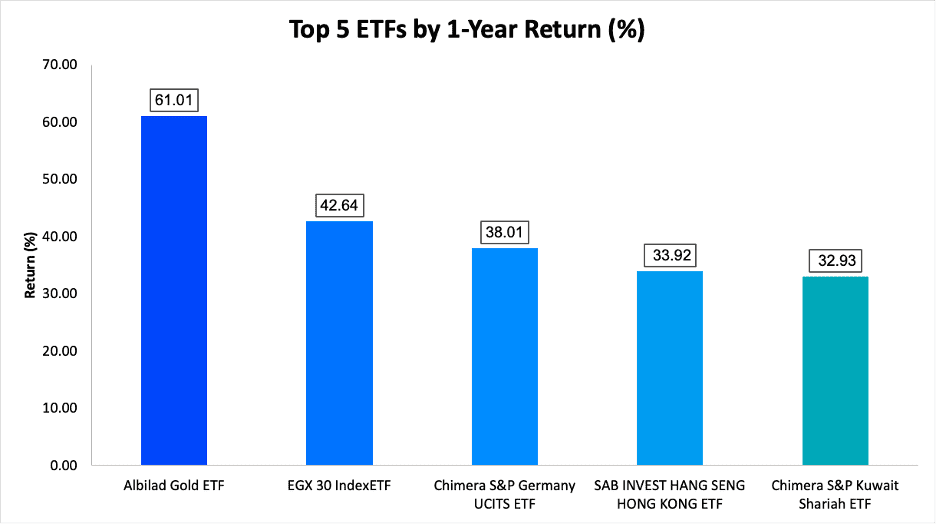
2025 performance was bifurcated between thematic winners and regional consolidation.
Top performers:
- Albilad Gold ETF: +61.0%, $39.8M AUM, $18.8M inflow. Gold was the year’s undisputed conviction trade, driven by safe-haven demand, macro uncertainty, persistent inflation concerns, and central bank buying. The fund has become a core tactical allocation tool, with inflows reflecting sustained investor confidence in gold as a portfolio stabilizer.
- EGX 30 IndexETF (Egypt): +42.6%, $4.1M AUM. Egypt’s equity market benefited from renewed foreign interest, currency stabilization, and structural reforms that improved investor sentiment.
- Chimera S&P Germany UCITS ETF: +38.0%, $760K AUM. European tech and industrial resilience delivered outsized gains, reflecting the diversification value of developed market exposures.
- SAB Invest Hang Seng Hong Kong ETF: +33.9%, $634M AUM. China policy stimulus and attractive valuations drove strong performance in Hong Kong equity markets.
- Chimera S&P Kuwait Shariah ETF: +32.9%, $8.7M AUM. Kuwait’s equity market benefited from oil price stability and corporate action pipelines.
Regional core beta:
● UAE Equity ETFs: Median return of +16.0%, led by Chimera S&P UAE UCITS ETF (+21.7%, $42.7M AUM) and Chimera FTSE ADX 15 ETF (+14.3%, $63.9M AUM). The UAE market demonstrated resilience, supported by improving liquidity, robust IPO pipelines, and structural reforms that continue to narrow valuation discounts to global peers.
● Saudi Equity ETFs: Median return of -14.6%, weighed by sector rotation, regional headwinds, and profit-taking following multi-year outperformance. Albilad MSCI Saudi Growth ETF fell -26.3% despite attracting $75.9M in inflows, suggesting contrarian positioning by investors viewing the drawdown as a buying opportunity.
● Qatar Equity ETFs: Low-single-digit returns, with QE Index ETF (+6.5%, $116.9M AUM) and Al Rayan Qatar ETF (+1.3%, $126.0M AUM) reflecting a period of consolidation after strong multi-year gains.
Top Yielders in 2025
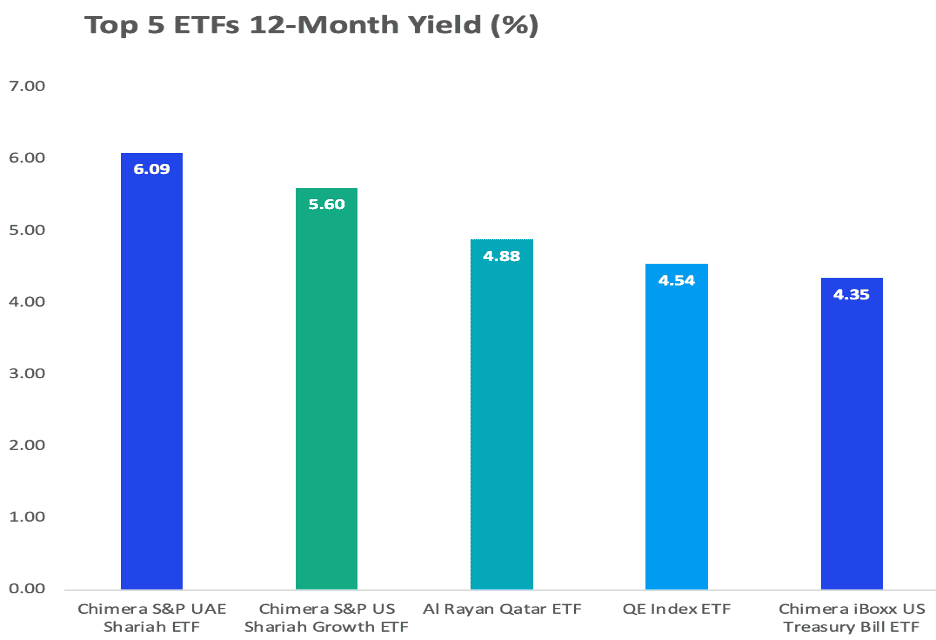
The top-yielding GCC ETFs span three distinct asset pools. Chimera S&P UAE Shariah ETF (6.09%) and Al Rayan Qatar ETF (4.88%) invest in regional blue-chip equities, UAE real estate and banking, Qatar energy and financials basically sectors with strong dividend cultures.
Chimera S&P US Shariah Growth ETF (5.60%) accesses dividend-paying US large-caps screened for Shariah compliance, while QE Index ETF (4.54%) tracks Qatar’s benchmark index.
Chimera iBoxx US Treasury Bill ETF (4.35%) offers the only pure fixed-income option, holding short-term US government securities for cash-equivalent safety. The message: GCC investors seeking yield don’t need to sacrifice equity upside, dividend-paying stocks from UAE, Qatar, and the US deliver 4-6% income with growth potential embedded.
Market composition & AUM $11.54 Billion
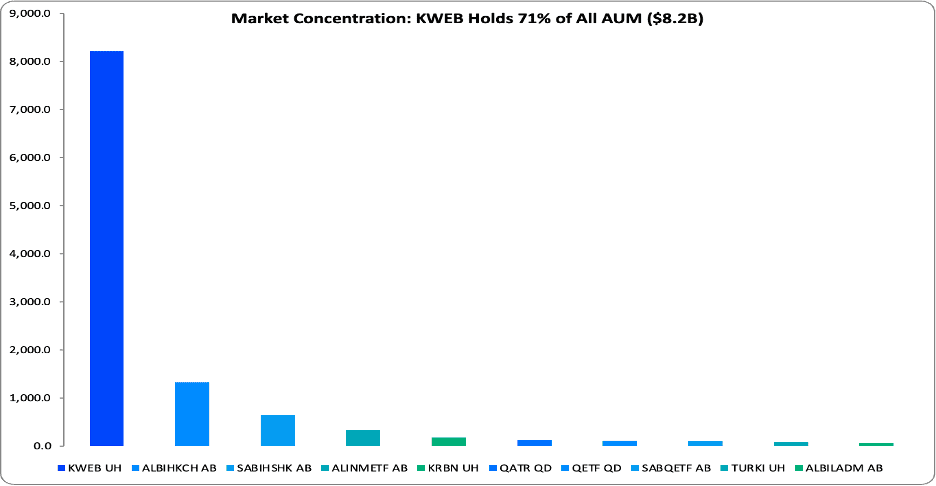
Hong Kong / China: The 88.2% anchor
Hong Kong and China equity ETFs dominate the GCC ETF landscape with unprecedented concentration. When including the December 2025 cross-listings of KWEB ($8.2B) and KRBN ($185M), the category commands $10.2 billion 88.2% of the $11.54 billion regional market. Even excluding these transformative cross-listings, the three locally-listed Hong Kong/China ETFs still account for $1.96 billion (59.2% of the pre-cross-listing base), underscoring structural, not cyclical, investor preference.
This concentration reflects a fundamental reality: GCC investor whether sovereign wealth funds, family offices, or retail participants remain more comfortable allocating capital to international beta than to local markets. The appeal is multifaceted: diversification, Shariah compliance, access to global growth, and familiarity with listed vehicles that trade during GCC hours and settle through regional custody frameworks.

The two largest locally-listed products Albilad CSOP MSCI Hong Kong China Equity ETF ($1.32B AUM, +25.8%) and SAB Invest Hang Seng Hong Kong ETF ($645M AUM, +36.3%) are strategic holdings, embedded in long-term portfolios as core China exposure without the operational complexity of offshore accounts or direct A-share access. The December cross-listing of KWEB, the world’s largest China internet ETF with $8.2B in global assets, further validates this structural preference by offering direct access to Alibaba, Tencent, JD.com, and Meituan, China’s digital infrastructure giants through familiar ADX trading mechanics.
Thematic ETFs: From niche to mainstream
Thematic exposures, once relegated to the edges of the market, are now gaining critical mass. Gold, quantum computing, AI infrastructure, carbon markets, and sector-specific strategies collectively represent a growing share of both AUM and investor attention. The launches of 2025 signal that GCC allocators are ready to move beyond core beta and into specialized exposures tied to secular growth themes.
Local GCC markets: 11.8% of AUM
Saudi, UAE, and Qatar equity exposures combined account for $942M in AUM, representing 30.1% of the total market. While this is a respectable share, it remains dwarfed by international exposures, reflecting a persistent reality: the ETF wrapper has not yet catalyzed material domestic equity allocations at scale. Instead, the industry functions largely as a conduit for international diversification, with local beta playing a supporting role.
Capital flows: Modest primary activity, active secondary trading
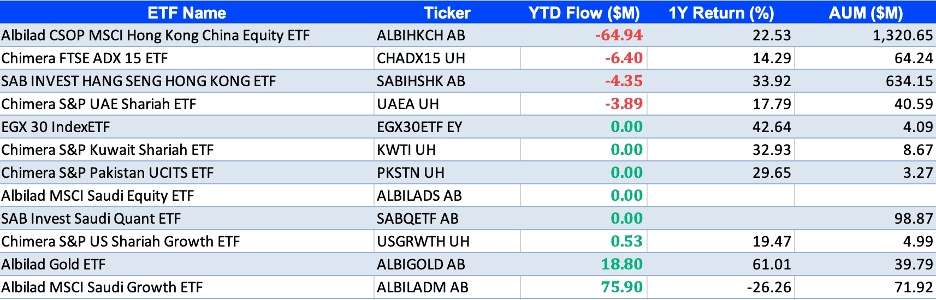
Net flows for 2025 totaled just $3.0 million, masking significant churn beneath the surface. Total inflows of $95.2 million were nearly offset by $92.2 million in outflows, suggesting investors were actively repositioning rather than making net new strategic allocations.
Top inflows:
- Albilad MSCI Saudi Growth ETF $75.9M inflow despite -26.3% return, indicating contrarian positioning or rebalancing into depressed assets.
- Albilad Gold ETF $18.8M inflow, reflecting sustained conviction in the gold thesis.
Top outflows:
- Albilad CSOP MSCI Hong Kong China Equity ETF -64.94M outflow with a 1year return of 22.53%
- Chimera S&P UAE Shariah ETF -$3.9M outflow, reflecting tactical adjustments.
The tepid primary market activity suggests that most trading occurred in the secondary market, where investors adjusted positions without triggering large-scale creation or redemption cycles. This is typical of a maturing ETF ecosystem: as liquidity improves and market-making capacity deepens, investors can express views through secondary trading rather than relying solely on authorized participants.
Costs & liquidity: Improving, but still uneven
Expense Ratios: The median expense ratio remains around 0.75%, reflecting the region’s small scale and higher operational costs. Hong Kong index trackers charge as little as 0.30%, while narrow Shariah-screened single-country products can exceed 1.00%. As assets scale and competition intensifies, fee compression is expected to accelerate.
Liquidity: Daily trading volumes vary wildly, from under 1,000 shares in niche products to over 200,000 shares in Albilad Gold ETF. This dispersion reflects where investor comfort and market-maker capacity currently cluster. As more global issuers cross-list and local market-makers scale operations, liquidity should improve meaningfully, tightening spreads and reducing implementation costs.
Conclusion
2025 was the year thematic ETFs came of age in the GCC. The launches of quantum computing, AI infrastructure, carbon markets, and cross-listed global strategies signal a decisive shift: GCC investors are no longer satisfied with plain-vanilla beta. They want exposure to the forces reshaping the global economy, and they want it packaged in exchange-traded, Shariah-compliant, and liquid vehicles.
The cross-listing of KraneShares’ carbon ETF is particularly symbolic; it marks the first time a major US issuer viewed the GCC as a strategic distribution market worth the regulatory and operational lift. This is not charity. It’s recognition that the region’s capital markets, investor sophistication, and institutional infrastructure have reached a threshold where global issuers can deploy their products profitably.
Gold dominated performance, Hong Kong and China continue to command the lion’s share of AUM, and local markets delivered mixed results. But the real story is structural: the GCC ETF industry is maturing, innovating, and attracting the attention of global players who see opportunity where others once saw complexity.
The next chapter will be written by those who can deliver genuine innovation, robust liquidity, and investor education that transforms ETFs from niche tactical tools into mainstream portfolio components. 2025 proved the market is ready. Now the industry must deliver.
click here for the for the full guide for investing in GCC ETFs in 2026