

In a year when most global investors are re-pricing risk, GCC income seekers have quietly built a more resilient corner of the ETF market.
From Doha to Dubai, listed funds targeting dividend-paying equities and sukuk are providing real cash flow at a time when volatility and currency risk dominate global headlines.
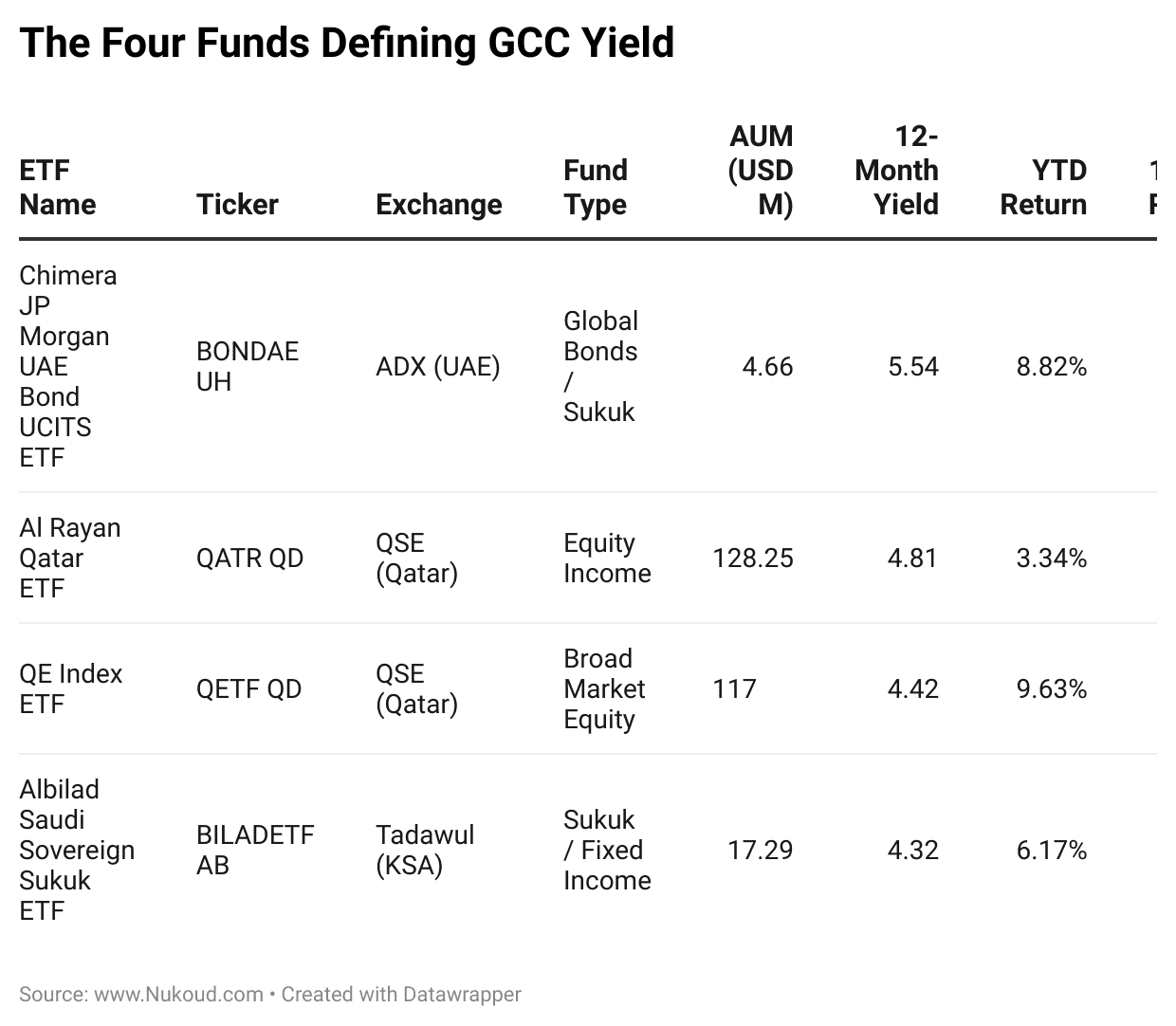
The following analysis looks at the highest-yielding ETFs currently available to Gulf investors, based on verified fund data as of late October 2025.
A Region Re-Discovering Income
Gulf markets have traditionally leaned on bank deposits and sovereign sukuk for income. But with benchmark rates stabilising and inflation proving sticky, investors are again hunting for steady yield that can compete with real-world costs.
Enter ETFs transparent, locally listed and increasingly liquid.
Across the region, a handful of income-oriented funds now offer 4 %–6 % cash yields while maintaining daily tradability on ADX, Tadawul and QSE.
They blend equity dividends with fixed-income or sukuk coupons, giving investors both growth optionality and regular distributions.
Fund Notes
Chimera JP Morgan UAE Bond UCITS ETF (BONDAE UH)
Anchored to the JP Morgan EM Bond Index, this ETF offers the highest cash yield among ADX listings. It blends global emerging-market sovereign and quasi-sovereign bonds with regional accessibility, giving investors UCITS-level transparency and relatively short duration exposure suitable for income portfolios.
Al Rayan Qatar ETF (QATR QD)
Backed by Qatar’s blue-chip equities, this fund benefits from robust dividend culture and stable corporate cash flows in the energy and financial sectors. Its low tracking error and steady quarterly payouts make it a regional benchmark for dividend income seekers.
QE Index ETF (QETF QD)
Designed to mirror the Qatar Exchange Index, this ETF offers balanced exposure to both growth and dividend payers. It combines moderate yield with consistent capital appreciation, making it a useful core holding for investors seeking domestic market participation plus regular distributions.
Albilad Saudi Sovereign Sukuk ETF (BILADETF AB)
A Sharia-compliant sukuk vehicle investing primarily in Saudi government and quasi-sovereign issues. It provides predictable coupon income with minimal credit risk and strong secondary-market liquidity on Tadawul, effectively the Gulf’s fixed-income anchor ETF.
Why These Yields Matter Now
A 4 %–5 % cash yield may sound modest in isolation, but in dirham- or riyal-linked economies, where inflation is trending near 2 % and deposit rates are slipping below 3 %, these ETFs provide a positive real return with transparency and liquidity that bank products lack.
Crucially, they trade during Gulf market hours, avoiding the timezone mismatches that plague U.S.-listed ETFs. For local institutions and family offices, that means fewer settlement frictions and tighter bid-ask spreads.
The Cross-Border and Sharia Lens
Each fund also illustrates how regulation and faith-based finance intersect in the Gulf:
- Albilad Sovereign Sukuk ETF maintains full Sharia compliance by holding sovereign-backed sukuk only, avoiding interest-based instruments.
- Chimera JP Morgan UAE Bond UCITS ETF blends global emerging-market exposure with local accessibility under UCITS standards, though investors should review underlying credit screens if strict Sharia adherence is required.
- Qatar’s ETFs (QATR QD and QETF QD) reflect domestic dividend policy rather than complex derivatives, a positive for Islamic investors prioritizing simplicity.
For international buyers accessing through Gulf brokers, these listings also reduce withholding-tax friction compared with U.S.-domiciled funds.
Interpreting Yield Versus Return
It bears repeating, yield is income; return is total performance.
While all four funds show positive one-year price appreciation, their primary role in a portfolio is to distribute cash, not chase capital gains.
In practice, a 5 % yield compounded annually and reinvested can generate higher real income than many global “high-yield” strategies that rely on leverage or derivatives.
Building a GCC Income Core
For investors constructing a regional income sleeve, these four ETFs together cover the essential bases:
1-Sukuk exposure through Albilad BILADETF AB
2-Regional bond yield via Chimera BONDAE UH
3-Dividend equity income through QATR QD and QETF QD
A blended allocation can produce a portfolio yield of roughly 4.7 %, with lower volatility than global high-yield credit and minimal FX exposure.
The Takeaway
The Gulf’s ETF ecosystem is finally maturing beyond equity-only exposure. Investors no longer need to go offshore to earn real income.
The data show that the region’s own funds from Riyadh to Doha are already delivering competitive, transparent yield.
For GCC portfolios balancing income and stability, these ETFs prove that high yield need not mean high risk.