


Franklin Templeton is preparing to launch its first spot XRP exchange-traded fund, with a planned listing date widely cited as 18 November 2025 under the ticker EZRP on the Cboe. The launch would mark one of the most significant digital-asset ETF debuts since the approval of bitcoin and ether spot ETFs earlier this year.
While regulatory documentation, including a Form 8-A filing, confirms the ETF is moving through the final stages of registration, market sources note that the official live date remains subject to SEC approval. Analysts expect substantial demand, with first-day volume projections ranging from $150 million to $250 million, potentially surpassing the $58 million record set by Canary Capital’s XRP ETF debut on 13 November.
Institutional-scale access to XRP
For years, institutional investors have grappled with how to gain regulated, large-scale exposure to digital assets without relying on offshore products or direct token custody. The emergence of spot digital-asset ETFs has transformed that landscape, enabling allocators to access crypto through the traditional ETF ecosystem with complete with intraday liquidity, NAV-based pricing, and regulated custody.
If approved, Franklin Templeton’s EZRP would deliver institutional XRP exposure at scale, backed by the firm’s $1.5 trillion asset-management platform. The ETF would hold physical XRP directly, with custody expected to be provided by Coinbase Custody Trust Company, according to recent disclosures. For institutions with strict risk controls, a spot ETF provides a route that avoids private-key management, operational frictions, and limited-liquidity venues.
This launch comes at a moment when digital-asset ETFs have gained broad market legitimacy and as XRP sees renewed interest after earlier regulatory uncertainties were resolved.
ETF structure & mechanics
(Based on public filings, issuer communications, and media reports; final details subject to regulatory approval.)
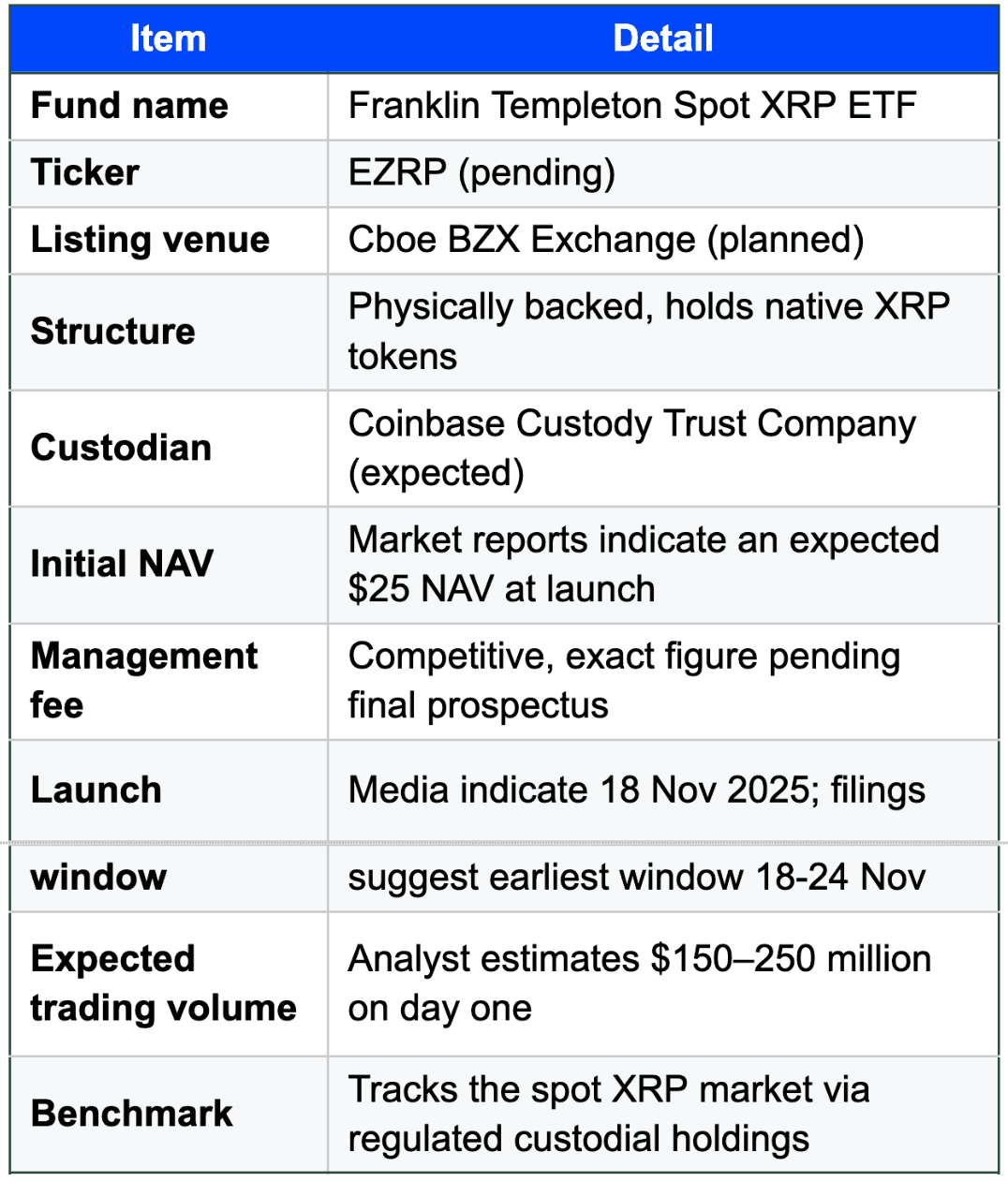
Note: Full fee schedule, daily creation/redemption mechanics, and distribution parameters will be confirmed in the effective prospectus once SEC approval is finalised.
Market Positioning and Competitive Dynamics Behind EZRP
The Franklin Templeton proposal stands out for three key reasons:
1. Scale and credibility.
Franklin Templeton’s $1.5 trillion AUM gives the ETF immediate institutional legitimacy, potentially drawing interest from pension funds, hedge funds, and model-portfolio providers seeking regulated XRP exposure.
2. Infrastructure maturity.
Using Coinbase Custody, the ETF adopts infrastructure already approved for bitcoin spot ETFs, reducing operational friction and aligning with institutional custody standards.
3. Strong demand signals.
The recent debut of Canary Capital’s XRP ETF recording $58 million in day-one volume demonstrates meaningful market appetite. Franklin Templeton’s brand scale and distribution network may amplify that demand significantly.
The launch also fits into Franklin Templeton’s broader digital-asset strategy, which already includes tokenised funds, blockchain-enabled transfer-agency systems, and thematic digital-asset ETFs.
Digital-asset ETFs enter mainstream allocation
The rise of spot digital-asset ETFs in 2025 mirrors earlier adoption cycles in commodities and thematic equities. Across both the U.S. and Asia, institutions now have a broader set of regulated instruments and crypto is increasingly treated as a satellite allocation within alternative or thematic sleeves.
Regulatory clarity, particularly around XRP, has also encouraged issuers to pursue physically backed structures. With bitcoin and ether ETFs already established, XRP is positioned as the third major crypto asset to gain scalable ETF infrastructure.
Key details to watch
Several elements remain pending until SEC approval and final prospectus release:
- Exact management fee and expense ratio
- Authorised participant roster
- Final listing date confirmation
- In-kind vs. cash creation redemptions
- Custody and security protocols
- Share creation unit sizeLiquidity will be closely monitored in the first week, especially the interplay between spot XRP markets and ETF arbitrage flows.
Key Risks to Watch
Regulatory timing.
Launch dates reported in the media should be treated as indicative until the SEC declares the registration effective.
Digital-asset volatility.
Spot XRP prices remain sensitive to regulatory developments, macro liquidity cycles, and crypto-specific market structure dynamics.
Custodial concentration.
Coinbase Custody’s dominant market share introduces single-provider dependency risk, a common consideration across U.S. digital-asset ETFs.
Market-impact dynamics.
Large creations/redemptions could influence spot market liquidity, though XRP’s daily turnover is typically large enough to absorb ETF flows.
A milestone moment for institutional XRP exposure
If approved, EZRP would be a major step forward for digital-asset ETFs, opening the door for institutions seeking regulated, scalable XRP exposure within traditional asset-management frameworks. Franklin Templeton’s involvement elevates the category, signaling that spot XRP ETFs may be on the verge of mainstream adoption.
Analysts expect strong volume, a tight bid-ask spread driven by arbitrage activity, and rapid growth if XRP becomes a standard allocation across thematic, macro and alternative sleeves.
While final approvals remain pending, the industry consensus is clear:
A Franklin Templeton spot XRP ETF would mark one of the most consequential digital-asset ETF launches to date and a serious moment for XRP’s institutional narrative.