



Bitcoin's rally through $86,000 and briefly above $87,000 this week has traders and analysts debating whether the so-called crypto winter has finally ended.
Bitcoin price today: Where does BTC stand now?
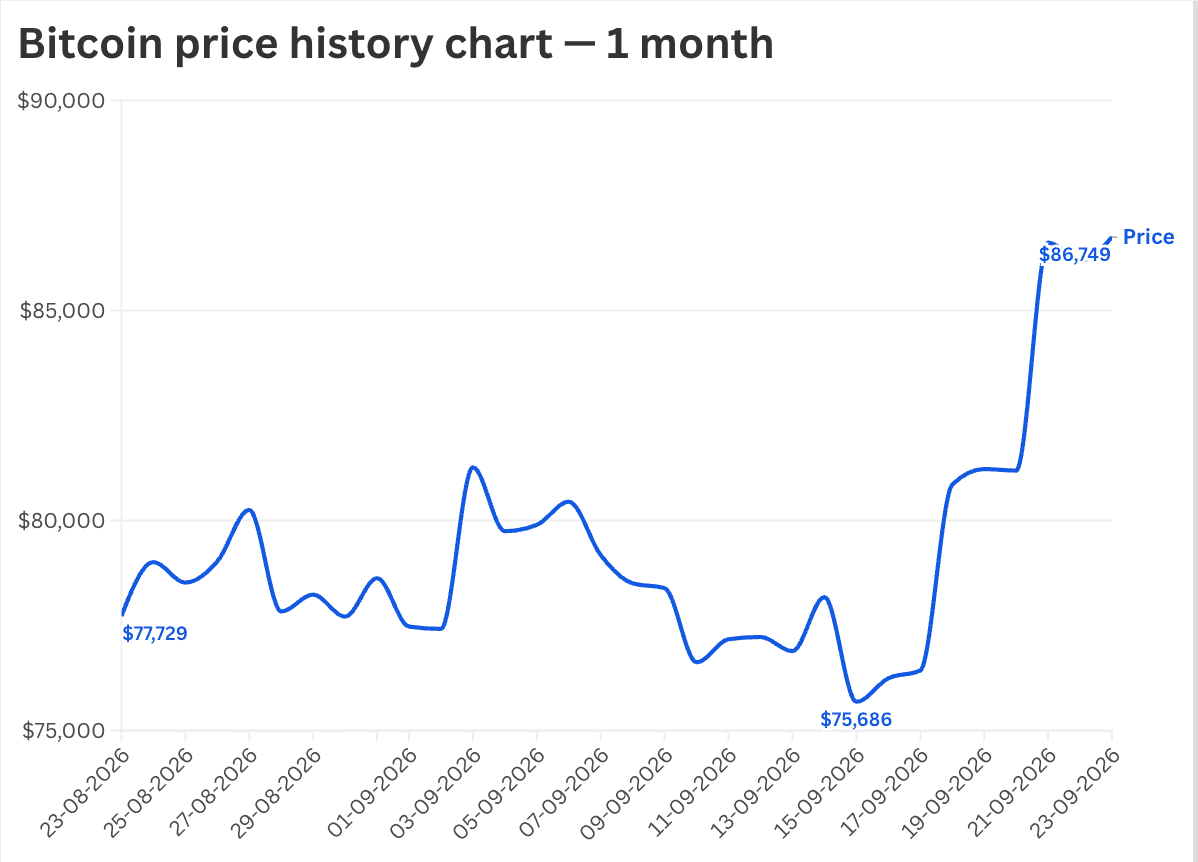
Bitcoin is trading around $86,749 after touching an intraday high of $87,371 on September 21, its highest level since late January. It remains well below its October 2025 record of $126,198.
The broader crypto market capitalization stood near $2.94 trillion as of September 21; that figure is a dated snapshot and may have changed as the rally continued.
Why is Bitcoin rising? ETF inflows and institutional demand
The clearest evidence behind the rally is the ETF data. U.S. spot Bitcoin ETFs recorded $998.95 million in net inflows on September 21, their largest single-day inflow since October 2025. BlackRock's IBIT led with $381.4 million, followed by ARK 21Shares' ARKB at $289.1 million and Fidelity's FBTC at $238.8 million. The inflows were spread across several funds, but IBIT, ARKB, and FBTC accounted for most of the day's total. The scale of the inflow gives the rally a stronger demand signal than price momentum alone, although a single day's flow does not establish a lasting trend.
Institutional accumulation has also continued. Strategy's bitcoin holdings now stand near 846,000 BTC after another recent purchase.
Bitcoin has also broken solidly above its 50-day moving average, a signal some strategists view as evidence the move is more than a short-lived relief rally. Nansen senior research analyst Nicolai Sondergaard pointed to renewed ETF demand combined with short covering, as traders who had bet against bitcoin were forced to buy back into the market.
The September 21 inflow was part of a three-session run that brought total U.S. spot Bitcoin ETF inflows to nearly $1.6 billion, providing a broader indication of renewed demand than the single-day figure alone.
Is the crypto winter ending? What analysts are saying
Bitwise chief investment officer Matt Hougan has taken a strongly bullish view, arguing that crypto fundamentals kept improving even as prices fell earlier this year. He expects prices to catch up by year-end and has said he doubts bitcoin will still be below its all-time high a year from now. Hougan has also argued that some momentum-driven capital is rotating out of AI stocks and back into crypto. However, that is his interpretation rather than an established market-wide flow.
Bitcoin, crypto regulation and the Fed: What matters now
The rally followed the SEC's September 17 order granting temporary, conditional five-year exemptions to certain Tokenized Securities Venues and liquidity providers involved in trading tokenized U.S. stocks. The relief requires eligible tokenized stocks to provide holders the same rights and privileges as the underlying securities, including dividend and voting rights.
The Senate failed to advance the CLARITY Act, legislation that would establish a broader US regulatory framework for digital assets and address the division of oversight between the SEC and CFTC. Without the legislation, the existing regulatory framework remains in place while the SEC and CFTC continue their respective oversight of digital assets. That sits alongside the GENIUS Act, enacted in 2025 to establish a federal framework for stablecoins.
The Federal Reserve raised its target rate range by 25 basis points on September 16 to 3.75%–4.00%, in a 12–0 vote and its first rate hike since July 2023.
What could challenge Bitcoin's rally?
Bitcoin remains meaningfully below its October 2025 high of $126,198, while the $2.94 trillion total crypto market-capitalization figure is a September 21 snapshot rather than a current real-time measure. Part of the rally has also been attributed to short covering, in which traders closing bearish positions can add buying pressure; that flow may not represent sustained spot demand once positioning normalizes. The Fed's September 16 hike also came even as the rally was underway, a reminder that tighter monetary policy has not stopped the move but remains a headwind if it continues. And BTIG's $82,000 to $90,000 levels are the firm's technical framework, not a guaranteed trajectory.
What to watch next
Bitcoin is currently around $86,700, leaving it above BTIG's $75,000 support level and within the firm's $82,000-to-$90,000 technical range. Whether the September 21 ETF inflow of nearly $1 billion marks the start of a sustained trend or a single strong day will likely become clearer over the next week or two of flow data.